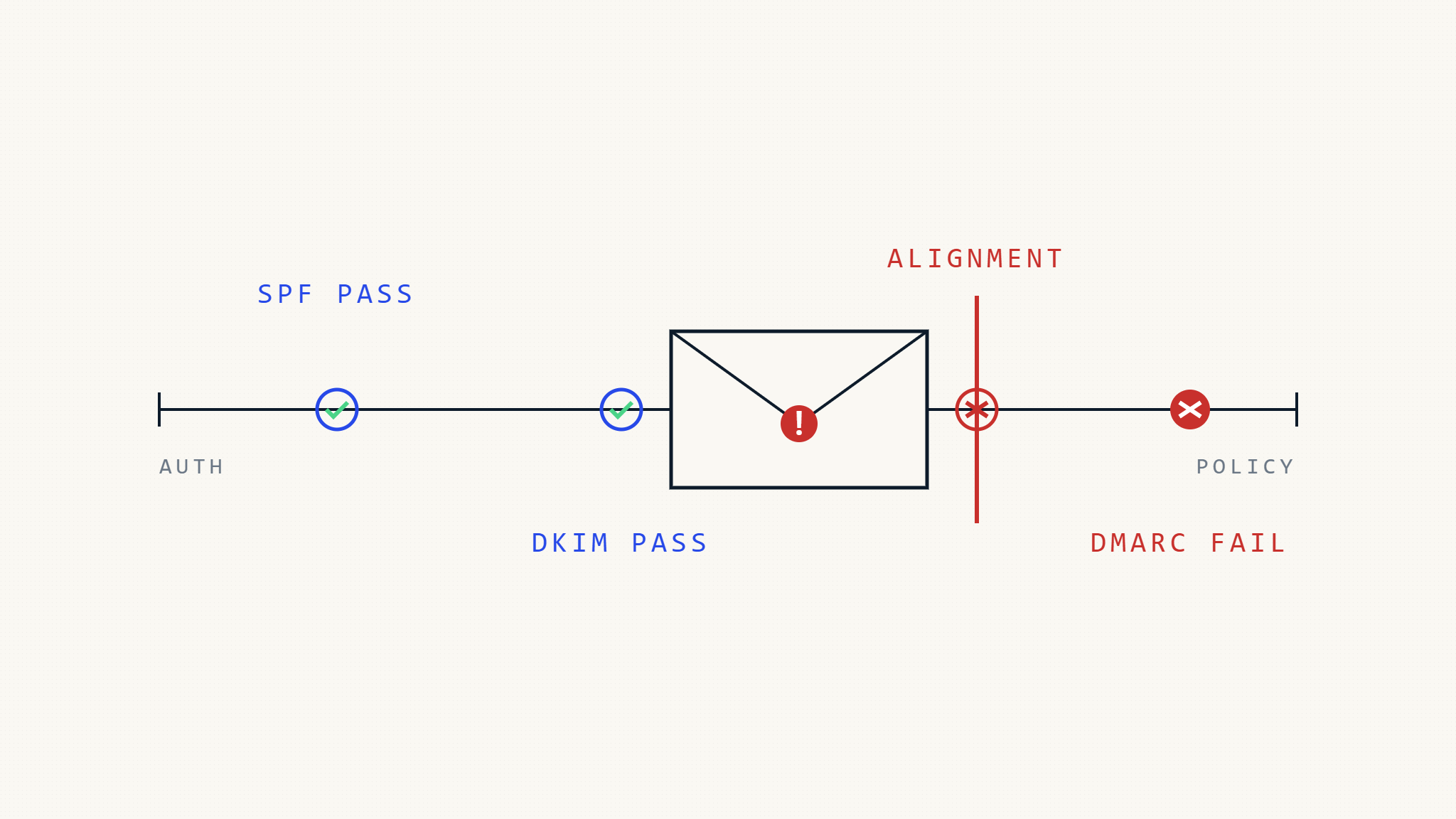
Your DMARC report shows SPF pass and DKIM pass. Every authentication check returns green. Yet the email still lands in spam or never arrives at all.
The gap between authentication success and delivery failure often traces to a misunderstood technical boundary: DMARC alignment. Passing authentication checks does not automatically mean passing DMARC. And passing DMARC does not guarantee inbox placement.
This article explains why authenticated emails fail, how DMARC alignment differs from authentication, where the system breaks, and what organizations should verify beyond green checkmarks.
I. Why Authentication Passing Does Not Mean DMARC Passing
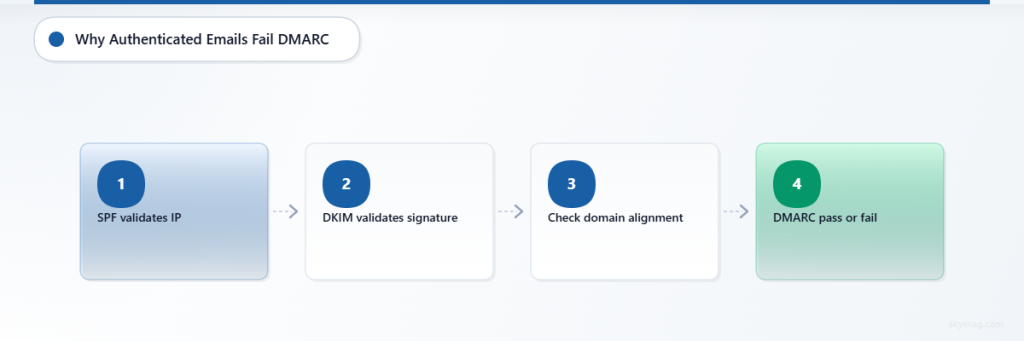
SPF and DKIM validate sender identity. DMARC enforces alignment between authenticated identifiers and the visible From address.
An email can pass SPF and DKIM but still fail DMARC if the authenticated domain does not align with the header From domain.
What SPF Actually Validates
SPF checks whether the sending IP address is authorized to send on behalf of the envelope sender domain (the domain in the MAIL FROM command during SMTP).
Where SPF can fail silently:
- DNS lookup timeout returns
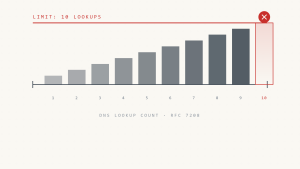
temperrorinstead of pass or fail - More than 10 DNS lookups triggers
permerrorbefore validation completes - Envelope sender domain differs from header From domain—SPF passes, but DMARC alignment fails
Example: A transactional email service sends from bounce.sender.com (envelope) but displays your-company.com in the visible From header. SPF passes for bounce.sender.com. DMARC fails because the domains do not align.
What DKIM Actually Validates
DKIM cryptographically signs the message and validates that the signature matches a public key published in DNS for the DKIM signing domain (d= in the DKIM-Signature header).
Where DKIM can fail silently:
- Signature key rotates but DNS record is not updated or cached
- Mailing list or forwarder modifies subject line, footer, or attachments—signature breaks
- DKIM signing domain differs from header From domain—DKIM passes, but DMARC alignment fails
Example: A marketing platform signs messages with d=platform.com. The visible From address shows your-company.com. DKIM passes. DMARC fails because platform.com does not align with your-company.com.
II. DMARC Alignment: The Enforcement Layer Authentication Alone Does Not Provide
DMARC alignment requires that at least one authenticated identifier matches the organizational domain in the header From address.
DMARC passes when:
- Aligned SPF pass: envelope sender domain matches header From domain (or shares the same organizational domain)
- OR aligned DKIM pass: DKIM signing domain matches header From domain (or shares the same organizational domain)
DMARC fails when:
- SPF passes but envelope sender domain does not align with header From
- DKIM passes but signing domain does not align with header From
- Both SPF and DKIM fail
- Both SPF and DKIM pass but neither aligns
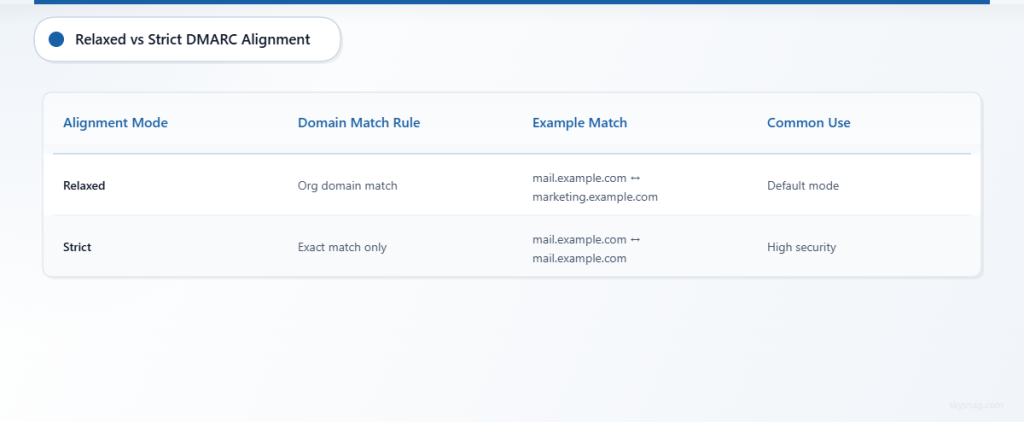
Relaxed vs Strict Alignment
DMARC supports two alignment modes:
Relaxed alignment (default): Organizational domains must match. Subdomains are allowed.
- Header From:
[email protected] - SPF envelope sender:
[email protected] - Result: Aligned (both share
example.com)
Strict alignment: Domains must match exactly.
- Header From:
[email protected] - SPF envelope sender:
[email protected] - Result: Not aligned (subdomains differ)
Most organizations use relaxed alignment to accommodate legitimate subdomain senders. Strict alignment can break transactional workflows that rely on service-specific subdomains.
When Authentication Passes But DMARC Fails
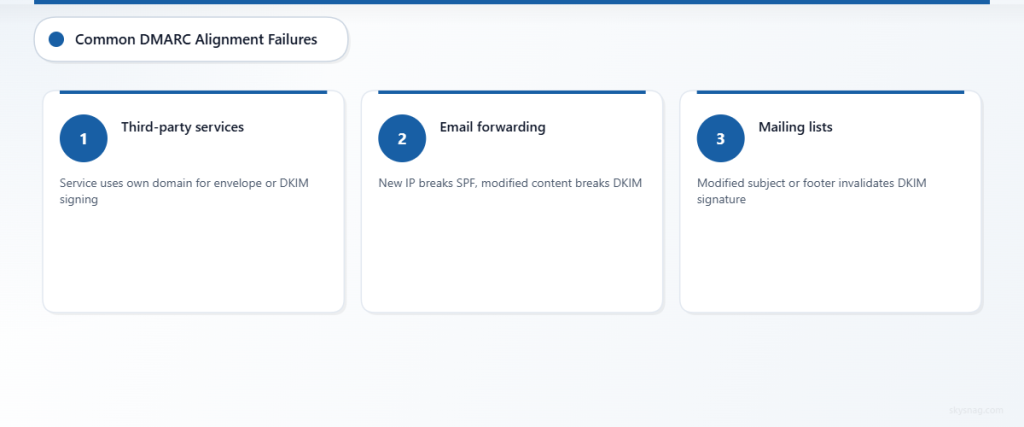
Common scenarios where SPF or DKIM passes but DMARC alignment fails:
Third-party transactional services:
- Service sends using its own envelope sender or DKIM signing domain
- Header From displays the customer’s domain
- Authentication passes for the service’s domain
- DMARC fails because domains do not align
Forwarded messages:
- Original sender passes SPF and DKIM
- Forwarder relays message from a new IP address
- SPF breaks (new IP not authorized for original domain)
- DKIM may survive if message is not modified
- DMARC depends on whether DKIM alignment survives
Mailing lists:
- List modifies subject line, footer, or attachments
- DKIM signature breaks
- SPF may pass for the list server domain, but not the original sender
- DMARC fails unless list rewrites the From address
III. Why DMARC Passing Still Does Not Guarantee Inbox Placement
DMARC passing removes one failure condition. It does not override reputation, content analysis, complaint rates, or internal abuse signals.
Mailbox providers evaluate:
- DMARC authentication and alignment
- Sending IP and domain reputation
- Complaint rates and engagement signals
- Content characteristics (links, images, language patterns)
- Forwarding context and mailing list behavior
Silent Filtering Despite DMARC Compliance
An email can pass DMARC at p=reject and still be filtered to spam or blocked if:
- The sending IP has poor reputation from prior abuse
- Complaint rates exceed mailbox provider thresholds
- Content triggers spam classification signals
- Recipient engagement history shows low open or high delete rates
- The sending domain is newly registered or lacks sending history
When enforcement depends on receiver behavior:
- Some mailing lists and forwarders do not honor DMARC policies
- Some mailbox providers apply reputation overrides that deprioritize DMARC signals
- Internal abuse teams may override authentication if behavioral signals indicate coordinated abuse
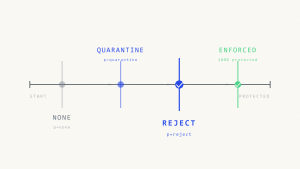
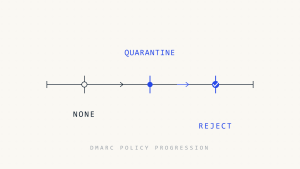
DMARC enforcement (p=quarantine or p=reject) instructs receivers to reject or quarantine unauthenticated messages. Whether receivers honor that instruction depends on their filtering architecture, forwarding handling, and local policy.
IV. What Can Fail and How to Detect It
Failure Mode 1: Authentication Passes But Alignment Fails
What happens:
- SPF or DKIM returns pass
- DMARC report shows
dmarc=failwithreason=alignment_failure - Receiving server may still deliver the message, depending on DMARC policy and reputation
Detection:
- Review DMARC aggregate reports for rows where
auth_results.spf.result=passorauth_results.dkim.result=passbutpolicy_evaluated.dmarc=fail - Check whether envelope sender domain or DKIM signing domain aligns with header From
Fix:
- Configure third-party senders to use aligned envelope sender or DKIM signing domains
- Use subdomain alignment if exact match is not feasible
- Verify that transactional services support DKIM signing with your domain
Failure Mode 2: DMARC Passes But Message Is Filtered
What happens:
- DMARC report shows
policy_evaluated.dmarc=pass - Message does not reach inbox
- No SMTP rejection or bounce occurs
Detection:
- Complaint rate monitoring through postmaster tools (Google Postmaster Tools, Microsoft SNDS)
- Engagement metrics showing low open rates or high spam folder placement
- Reputation monitoring for sending IPs and domains
Fix:
- Audit sending reputation and complaint sources
- Review content for spam trigger patterns
- Verify subscriber consent and list hygiene
- Test deliverability to multiple mailbox providers
Failure Mode 3: Forwarding Breaks Authentication
What happens:
- Original sender passes DMARC
- Forwarder relays message from new IP
- SPF fails (new IP not authorized)
- DKIM may survive if message is not modified
- DMARC depends on DKIM alignment survival
Detection:
- DMARC reports showing
forwardeddisposition or SPFfailwith DKIMpass - Delivery issues reported by users who forward to personal accounts
Fix:
- Use
p=quarantineinstead ofp=rejectto reduce forwarding impact - Monitor DMARC reports for forwarding patterns
- Communicate with users about forwarding behavior
Failure Mode 4: Subdomain Spoofing Despite Parent Domain Enforcement
What happens:
- Parent domain enforces DMARC at
p=reject - Subdomain lacks explicit DMARC record
- Attacker sends spoofed messages from subdomain
- DMARC policy applies, but alignment evaluation may differ depending on subdomain use
Detection:
- DMARC reports showing authentication failures for subdomains
- Phishing reports targeting subdomain addresses
Fix:
- Publish explicit DMARC records for active subdomains
- Use
sp=rejectin parent domain record to enforce subdomain policy - Monitor DMARC reports for unauthorized subdomain use
V. What to Document and Verify
Organizations that assume authentication passing means DMARC compliance introduce operational blind spots. Document the following:
Authenticated identifiers for every sender:
- Envelope sender domain (SPF check domain)
- DKIM signing domain (
d=value) - Header From domain (visible sender)
- Whether alignment is relaxed or strict
Sender configuration by mail stream:
- Transactional email: CRM, support ticketing, password resets
- Marketing email: Newsletter platforms, promotional campaigns
- Operational email: Internal notifications, system alerts
- Third-party services: SaaS tools, plugins, integrations
Failure conditions observed in DMARC reports:
- Volume of
dmarc=failwithspf=passordkim=pass - Frequency of forwarding-related failures
- Unauthorized sender attempts
- Subdomain spoofing patterns
Reputation and filtering context:
- Complaint rates by sending domain and IP
- Spam folder placement trends
- Engagement metrics (open rates, delete rates)
- Postmaster tool feedback from major receivers
VI. How Skysnag Supports Alignment Verification and Monitoring

Skysnag Protect identifies alignment failures, unauthorized senders, and authentication gaps across mail streams and third-party services.
Alignment visibility:
- Aggregate DMARC report parsing showing SPF, DKIM, and alignment status by sender
- Detection of passing authentication with failing alignment
- Identification of third-party services using misaligned identifiers
Sender authorization:
- Inventory of authorized and unauthorized mail sources
- Detection of shadow IT and unmanaged third-party senders
- Validation of SPF includes and DKIM signing configurations
Enforcement staging:
- Gradual policy enforcement by domain, subdomain, and sender group
- Monitoring of impact before moving from
p=nonetop=quarantineorp=reject - Evidence collection for compliance and audit programs
Start DMARC monitoring with Skysnag and verify whether your authenticated senders align with your domain:
VII. Key Takeaways
- Passing SPF or DKIM does not mean passing DMARC. Alignment requires that the authenticated domain matches the header From domain.
- Passing DMARC does not guarantee inbox placement. Mailbox providers evaluate reputation, content, complaint rates, and engagement alongside authentication.
- DMARC alignment can fail even when authentication passes. Envelope sender domain mismatches (SPF) and DKIM signing domain mismatches cause alignment failures.
- Forwarding and mailing lists commonly break authentication. SPF fails when the relay IP changes. DKIM fails when the message is modified.
- Subdomain spoofing can bypass parent domain enforcement. Use explicit subdomain DMARC records or
sp=rejectto enforce subdomain policy. - Authentication is necessary but not sufficient. Deliverability depends on authentication, reputation, content, and recipient behavior.
- DMARC reports show where alignment fails. Monitor aggregate reports for rows where
spf=passordkim=passbutdmarc=fail. - Third-party senders commonly introduce alignment gaps. Verify that transactional services, marketing platforms, and SaaS tools use aligned identifiers.
- Organizations should document authenticated identifiers by mail stream. Envelope sender domain, DKIM signing domain, and header From domain must be tracked and validated.
- Skysnag Protect identifies alignment failures and unauthorized senders. Use Skysnag to verify alignment, detect shadow IT, and stage enforcement safely.