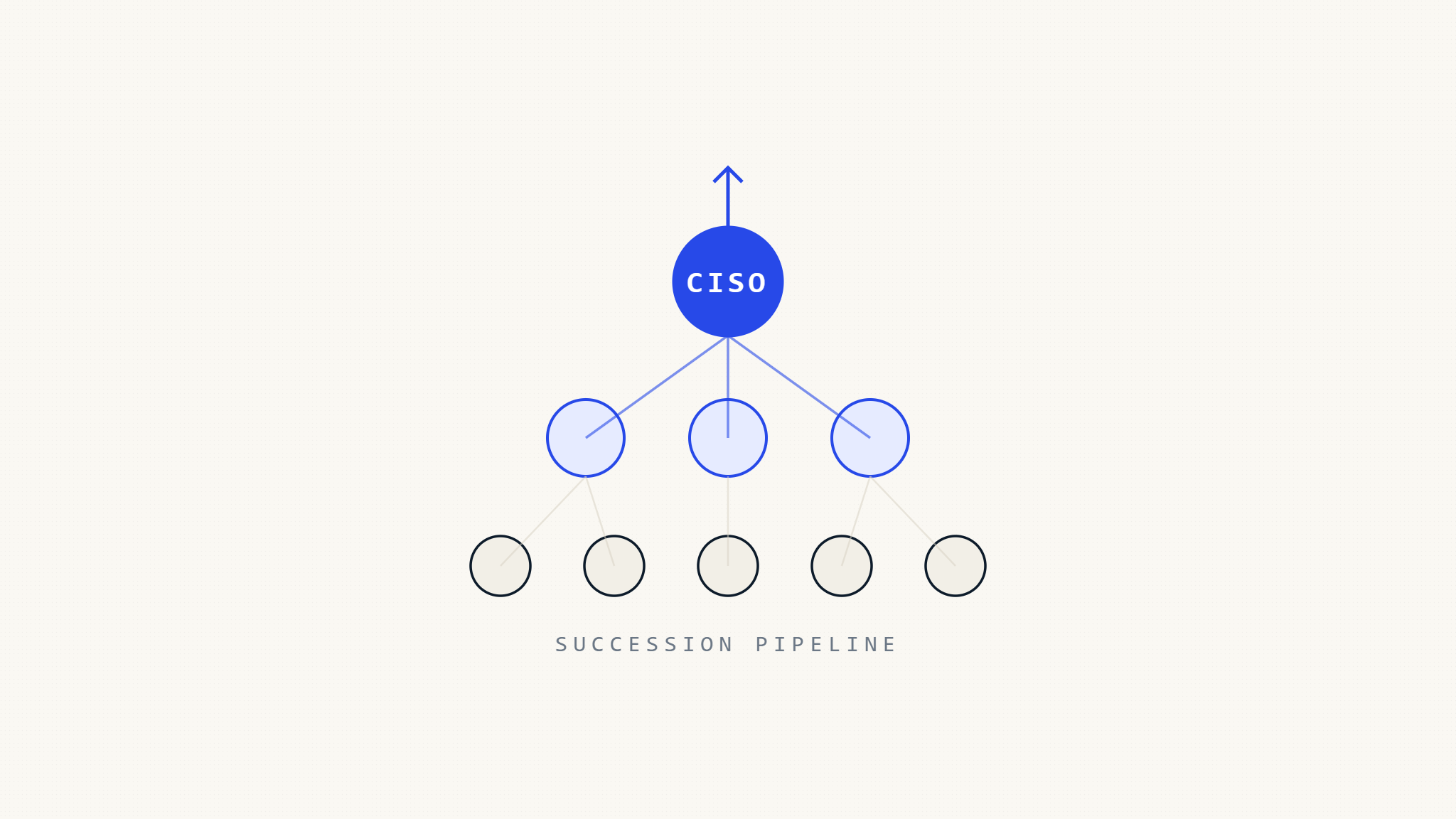
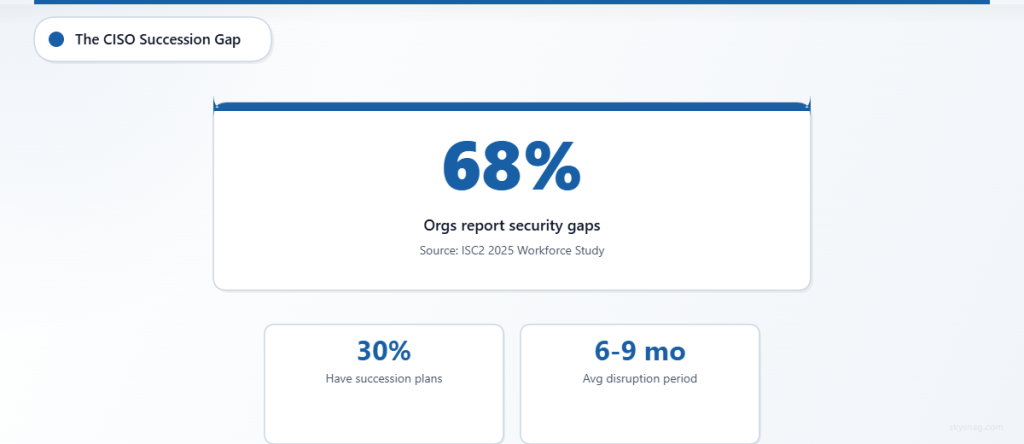
When a Chief Information Security Officer departs without a prepared successor, the average company experiences 6-9 months of operational disruption, delayed security initiatives, and increased vulnerability to incidents. According to ISC2’s 2025 Cybersecurity Workforce Study, 68% of organizations report critical security leadership gaps, yet fewer than 30% maintain formal succession plans for their security executives.
CISO succession planning is not about replacing a person—it’s about ensuring continuous security governance, maintaining board confidence, preserving institutional knowledge, and protecting the organization’s security posture through leadership transitions.
This guide provides a strategic framework for identifying internal security leadership candidates, developing their capabilities, managing knowledge transfer, and executing smooth transitions that maintain security program continuity.
I. Why CISO Succession Planning Fails
Most security leadership transitions fail not because of technical skill gaps, but because organizations treat succession planning as a crisis response rather than a strategic program.
Common failure modes include:
Silent knowledge loss. Departing CISOs hold undocumented vendor relationships, board communication patterns, executive trust networks, incident response decision frameworks, and compliance interpretation context. When they leave, this knowledge vanishes unless explicitly transferred.
Mismatched leadership expectations. Organizations promote strong technical security professionals into executive roles without developing their strategic communication, business alignment, board presentation, budget justification, or cross-functional leadership skills. The promoted candidate struggles, and the organization questions their decision.
External hiring without context transfer. External CISO hires bring fresh perspectives but lack organizational context: which executives support security investments, where political resistance exists, how decisions get made, which vendors were already evaluated and rejected, and which initiatives already failed and why. Without structured onboarding, they repeat past mistakes.
Board confidence erosion. When a respected CISO departs suddenly, the board questions whether the security program was built around one person or whether it can sustain itself. If no clear successor exists, confidence drops.
Delayed security decisions. During leadership transitions, major security initiatives stall. No one has authority to approve new vendor contracts, architectural changes, policy updates, or incident response protocol modifications. The organization operates in a holding pattern.
CISO succession planning addresses these failures by treating security leadership as a strategic capability that must be developed, documented, and transferred—not an individual dependency.
II. Strategic Framework for CISO Succession Planning
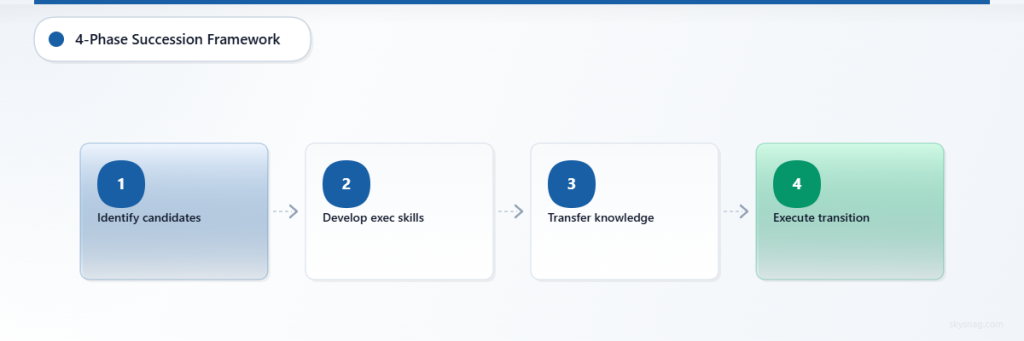
Effective succession planning operates across four connected phases: identification, development, knowledge transfer, and transition execution.
Phase 1: Identify Internal Leadership Candidates
Start by mapping current security team members against the capabilities required for executive security leadership.
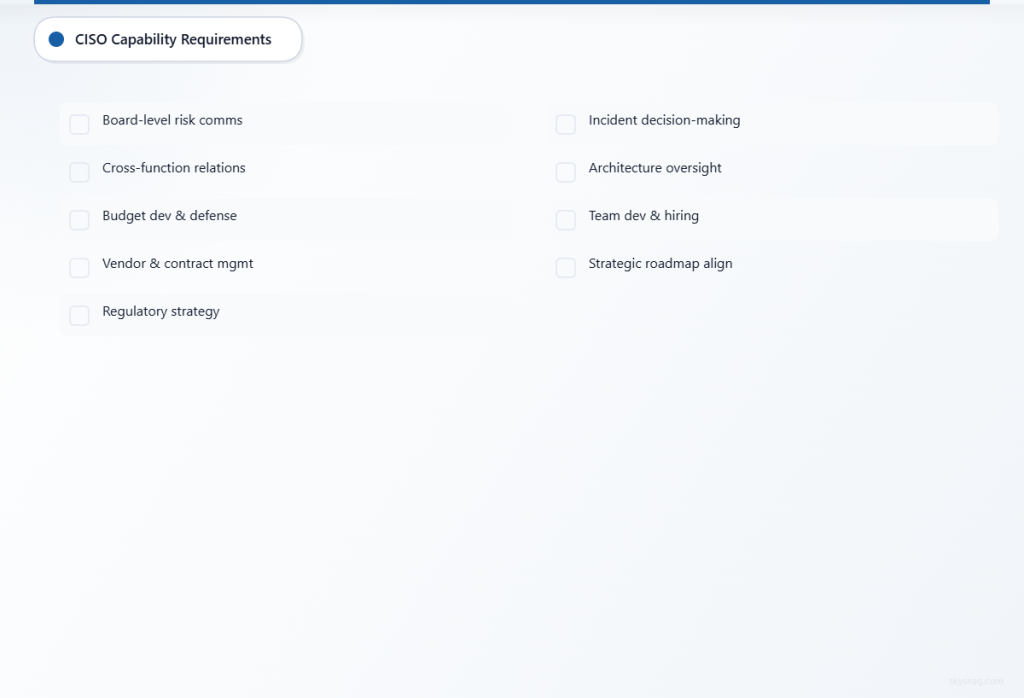
CISO-level responsibilities extend beyond technical security competence. The role requires:
- Board-level communication and risk translation
- Cross-functional relationship building with legal, finance, operations, and business units
- Budget development, justification, and allocation
- Vendor relationship management and contract negotiation
- Regulatory and compliance strategy
- Incident response decision-making under pressure
- Security architecture oversight without hands-on implementation
- Team development, hiring, and performance management
- Strategic roadmap development aligned to business objectives
Evaluate internal candidates against these dimensions, not just technical depth.
Look for emerging leadership signals:
- Candidates who naturally build relationships across departments
- Team members who translate technical security concepts into business impact
- Professionals who ask strategic questions about why, not just how
- Individuals who take ownership of outcomes, not just tasks
- Security professionals who engage with compliance, legal, and audit teams proactively
Identify 2-3 internal candidates who demonstrate leadership potential even if they lack current executive experience. Multiple candidates create healthy competition, provide backup options, and ensure continuity even if one candidate departs.
Document candidate profiles:
For each identified candidate, document:
- Current role and technical expertise
- Demonstrated leadership capabilities
- Development gaps (board communication, financial management, strategic thinking)
- Career interests and long-term goals
- Estimated readiness timeline (1 year, 2 years, 3+ years)
Update these profiles quarterly as candidates progress.
Phase 2: Develop Security Leadership Capabilities
Once candidates are identified, create structured development paths that build executive security leadership skills.
Expose candidates to executive-level security work:
- Board meeting participation. Invite candidates to observe CISO board presentations. Afterward, debrief what questions the board asked, why certain metrics were included, how technical risks were translated into business language, and what concerns drove the discussion.
- Executive briefing preparation. Assign candidates to prepare quarterly security briefings for the CEO, CFO, or General Counsel. Review drafts, refine messaging, and accompany them to the actual briefing. This builds executive communication skills under supervision.
- Vendor negotiation involvement. Include candidates in vendor selection processes, contract negotiations, and renewal discussions. This exposes them to commercial decision-making, total cost of ownership analysis, and relationship management.
- Incident response leadership. During non-critical incidents, assign candidates as incident commanders. They make containment decisions, coordinate cross-functional response, manage executive communication, and lead post-incident reviews. This develops decision-making under pressure.
- Regulatory and compliance strategy. Involve candidates in audit preparation, regulatory response planning, compliance roadmap development, and external assessor interactions. This builds familiarity with governance frameworks and evidencing controls.
Provide formal executive development:
- Enroll candidates in executive security leadership programs (CISO development courses, strategic security management programs, executive MBA programs with security focus)
- Support attendance at CISO-focused conferences where they network with peer security executives
- Assign executive coaching focused on strategic communication, influence without authority, and board-level presence
- Facilitate mentorship relationships with current or former CISOs outside the organization
Create stretch assignments:
- Assign candidates to lead cross-functional security initiatives (M&A security diligence, new product security review, third-party risk program overhaul)
- Give candidates temporary budget ownership for specific security domains
- Assign candidates to represent security at executive leadership team meetings
- Have candidates present security program updates directly to the board (with CISO support initially, then independently)
Track development progress:
Maintain a structured development plan for each candidate with specific milestones, skill-building activities, and readiness checkpoints. Review progress quarterly with the candidate, their direct manager, and the current CISO.
Phase 3: Transfer Institutional Knowledge
Knowledge transfer is the most commonly neglected phase of succession planning. It must happen continuously, not just during the final weeks before a CISO departs.
Document critical decision context:
The departing or current CISO should document:
- Executive relationship map. Which executives are security champions? Which resist security investments? Who influences the CEO? Who controls budget approvals? What communication patterns work with each executive?
- Board communication patterns. What questions does the board ask repeatedly? Which metrics do they care about? Which security topics create concern vs. confidence? How does the board prefer to receive bad news?
- Vendor relationship history. Why was each major vendor selected? What alternatives were evaluated and rejected? Which vendors have strong relationships vs. transactional relationships? Which contracts are up for renewal soon and what concerns exist?
- Failed initiative post-mortems. What security initiatives were proposed but failed? Why did they fail? What political, financial, or operational objections surfaced? What lessons were learned?
- Incident response decision frameworks. How does the organization decide when to notify customers, regulators, law enforcement, or the board during security incidents? What past incidents shaped these decisions?
- Compliance interpretation context. How does the organization interpret ambiguous regulatory requirements? What positions have been taken with auditors or regulators? Where does the organization accept risk vs. over-control?
This documentation should be maintained in a secure, access-controlled knowledge repository that successors can reference.
Shadow the CISO:
As succession candidates progress, assign them to shadow the current CISO for:
- Board meetings and preparation
- Executive leadership team meetings
- CEO one-on-one briefings
- Major vendor negotiations
- Regulatory or audit interactions
- Crisis incident response coordination
- Budget reviews with finance
- Strategic planning sessions
After each shadowing session, conduct a debrief: What did the candidate observe? What decisions were made and why? What questions remain?
Reverse shadow:
In later development stages, flip the model: the candidate leads the activity (board presentation, executive briefing, vendor meeting) while the CISO observes. Debrief afterward on what went well, what could improve, and what adjustments are needed.
Transfer communication ownership progressively:
Gradually shift communication ownership from the CISO to the successor candidate:
- First, the candidate prepares materials, the CISO presents
- Next, the candidate presents with the CISO present
- Finally, the candidate presents alone with the CISO available for escalation only
This builds confidence in both the candidate and the organization’s leadership.
Phase 4: Execute the Transition
When the CISO transition occurs—whether planned retirement, departure, or internal promotion—execute a structured handover process.
Pre-transition communication:
Before announcing the transition:
- Brief the CEO, CFO, General Counsel, and key executives individually on the succession plan
- Brief the board on the successor’s background, development path, and readiness
- Prepare internal communication for the security team explaining the transition timeline and continuity plan
- Prepare external communication for key vendors, partners, and customers (if CISO visibility is public)
Transition timeline:
Structure the transition across phases:
Weeks 1-2: Announcement and relationship transfer
- Announce the transition internally and externally
- Current CISO introduces successor to key executives, board members, vendors, and external partners
- Successor begins attending all CISO meetings as acting CISO (with outgoing CISO support)
Weeks 3-4: Operational handover
- Transfer budget ownership and approval authority
- Transfer vendor contract ownership and relationship management
- Transfer compliance and audit coordination responsibility
- Transfer incident response authority and escalation ownership
- Update access controls, signature authority, and system permissions
Weeks 5-8: Advisory period
- Outgoing CISO remains available for consultation but does not make decisions
- Successor operates as CISO with outgoing CISO available for questions
- Successor chairs board meetings, executive briefings, and leadership meetings independently
- Successor owns all vendor, audit, and regulatory relationships
Week 9+: Full transition
- Outgoing CISO exits the organization (if departing)
- Successor operates independently with no support
- Establish regular check-ins with CEO, board, and key executives to ensure confidence
Transition checklist:
Use the checklist below as a structured guide for managing CISO succession transitions. The exact timeline and requirements will depend on your organization’s size, regulatory environment, and leadership structure.
- [ ] Successor candidate identified and development plan established at least 12-18 months before anticipated transition.
- [ ] Successor candidate has participated in board meetings, executive briefings, and incident response leadership.
- [ ] Successor candidate has shadowed CISO for board presentations, vendor negotiations, and regulatory interactions.
- [ ] Successor candidate has presented independently to board and executive leadership with positive feedback.
- [ ] Knowledge transfer documentation completed: executive relationship map, board communication patterns, vendor history, failed initiatives, compliance context, incident decision frameworks.
- [ ] CEO, CFO, General Counsel, and board briefed on successor candidate’s background, readiness, and development path.
- [ ] Internal communication plan prepared for security team and broader organization.
- [ ] External communication plan prepared for vendors, partners, customers, regulators, and auditors (if CISO role is externally visible).
- [ ] Transition timeline established with clear phases: announcement, relationship transfer, operational handover, advisory period, full transition.
- [ ] Budget ownership, vendor contracts, compliance coordination, incident response authority, and signature authority transferred to successor.
- [ ] Access controls, system permissions, and authorization levels updated to reflect successor as acting CISO.
- [ ] First 90-day plan developed by successor covering immediate priorities, stakeholder meetings, and strategic initiatives.
- [ ] Regular check-ins scheduled between successor and CEO, board, and key executives during first 6 months.
- [ ] Post-transition review scheduled at 90 days and 180 days to assess transition success, identify gaps, and adjust support.
III. What Can Go Wrong During CISO Succession
Even well-planned transitions can encounter failure modes:
Premature promotion. The organization promotes a strong technical security professional before they’ve developed executive communication, strategic thinking, or cross-functional relationship skills. The new CISO struggles, the board loses confidence, and the security team questions the decision.
To mitigate: Follow the development framework rigorously. Do not shortcut board exposure, executive shadowing, or communication development. If the candidate is not ready, hire an external interim CISO while continuing internal development.
Knowledge transfer failure. The outgoing CISO leaves without documenting critical relationships, decision context, or institutional knowledge. The successor inherits a role they do not understand, repeats past mistakes, and loses credibility.
To mitigate: Build knowledge documentation into the current CISO’s ongoing responsibilities, not just their departure process. Update documentation quarterly.
Board confidence erosion. The board questions whether the successor has the experience, presence, or strategic capability to operate at the executive level. They request an external search, undermining the internal candidate.
To mitigate: Expose successor candidates to the board early and often. Do not wait until the transition is announced. Board members should already know, trust, and respect the successor before the formal transition.
Team morale disruption. Security team members question the succession decision, particularly if multiple candidates were considered. Morale drops, and key technical staff depart.
To mitigate: Communicate transparently about the succession process. Explain how candidates were evaluated. Provide clear career development paths for candidates not selected. Ensure the new CISO engages directly with the security team during the transition.
External pressure for outside hiring. Executives or board members push for an external CISO hire, arguing that “fresh perspective” or “industry experience” is needed, even when a qualified internal candidate exists.
To mitigate: Build confidence in the internal candidate before the transition is announced. Demonstrate their capability through board presentations, executive briefings, and strategic initiative leadership. If external hiring pressure persists, consider an external advisory CISO role to supplement the internal successor.
IV. CISO Succession Planning for Mergers and Acquisitions
M&A creates unique succession challenges: which CISO leads the combined security program?
In most acquisitions, the acquiring company’s CISO becomes the security leader for the combined entity. However, if the acquired company has a stronger security program, more mature governance, or a more experienced CISO, the acquiring company may select the acquired CISO as the post-merger security leader.
M&A CISO succession considerations:
- Evaluate both CISOs objectively based on strategic capability, board presence, cross-functional relationships, and security program maturity—not just organizational seniority
- Conduct structured interviews with both CISOs covering executive communication, incident response philosophy, risk management approach, and leadership style
- Assess cultural fit and integration capability
- If the acquired CISO is selected, provide structured knowledge transfer from the acquiring CISO on organizational context, executive relationships, and historical decisions
- If the acquiring CISO is retained, ensure the acquired CISO’s security program strengths are not lost (capture documentation, retain key technical staff, adopt superior processes)
Do not make the CISO succession decision based solely on hierarchy. Choose the leader who will best execute security for the combined entity.
V. Measuring CISO Succession Program Success
Evaluate your succession planning program’s effectiveness across these dimensions:
Succession readiness.
- Number of identified internal CISO succession candidates: Target 2-3
- Average readiness timeline for identified candidates: Target 12-24 months
- Board familiarity with succession candidates: Target all board members have interacted with candidates
- Knowledge transfer documentation completeness: Target 90%+ of critical knowledge documented
Development effectiveness.
- Number of candidates who completed board presentation exposure: Target 100%
- Number of candidates who led incident response: Target 100%
- Number of candidates who completed executive development programs: Target 100%
- Candidate confidence in CISO role readiness (self-assessment): Target 7/10+
Transition quality.
- Time to full operational handover: Target <8 weeks
- Board confidence in successor (assessed via board feedback): Target 8/10+
- Security team retention during transition: Target 90%+ retention
- Security program continuity (no major initiative delays): Target 100%
- Vendor relationship continuity (no vendor escalations): Target 100%
Long-term retention.
- Successor CISO tenure: Target 3+ years
- Successor CISO performance assessment: Target meets or exceeds expectations
- Security program maturity trajectory post-transition: Target continued improvement
- Board satisfaction with security leadership: Target 8/10+
Track these metrics quarterly and adjust your succession planning program based on results.
How Skysnag Protect and Skysnag Comply Support Security Program Continuity
Security program continuity depends on two things: operational control and governance evidence.
During a CISO transition, both can weaken if critical knowledge lives only with the outgoing security leader.
Email authentication is a common example. The outgoing CISO may know which domains are protected, which third-party senders are authorized, which vendors still need remediation, which domains are ready for enforcement, and which policies were delayed due to business risk.
If that knowledge is not documented and visible, the incoming CISO inherits risk.
Skysnag Protect helps maintain operational continuity by giving security teams visibility and control over email authentication across domains, subdomains, and authorized senders.
Skysnag Protect supports:
- DMARC monitoring and enforcement readiness
- SPF and DKIM alignment visibility
- Authorized sender identification
- Unauthorized sender detection
- Subdomain visibility
- MTA-STS and TLS-RPT management
- BIMI readiness where applicable
- Ongoing authentication failure monitoring
This helps the incoming CISO quickly understand the organization’s email authentication posture without relying on fragmented notes, tribal knowledge, or manual DNS reviews.
Skysnag Comply supports the governance and evidence layer.
It helps organizations maintain compliance-facing documentation, reporting, and evidence around email authentication controls so security leadership changes do not interrupt audit readiness or control visibility.
Skysnag Comply supports:
- Compliance-facing reporting
- Historical evidence of authentication posture
- Sender and domain governance visibility
- Control documentation for audit teams
- Evidence of monitoring and remediation
- Continuity across leadership transitions
Together, Skysnag Protect and Skysnag Comply help reduce security drift during CISO succession.
Protect keeps the technical control layer operating.
Comply keeps the governance and evidence layer visible.
For growing companies, this matters because security continuity should not depend on one person’s memory.
Learn more about Skysnag Protect:
Learn more about Skysnag Comply: