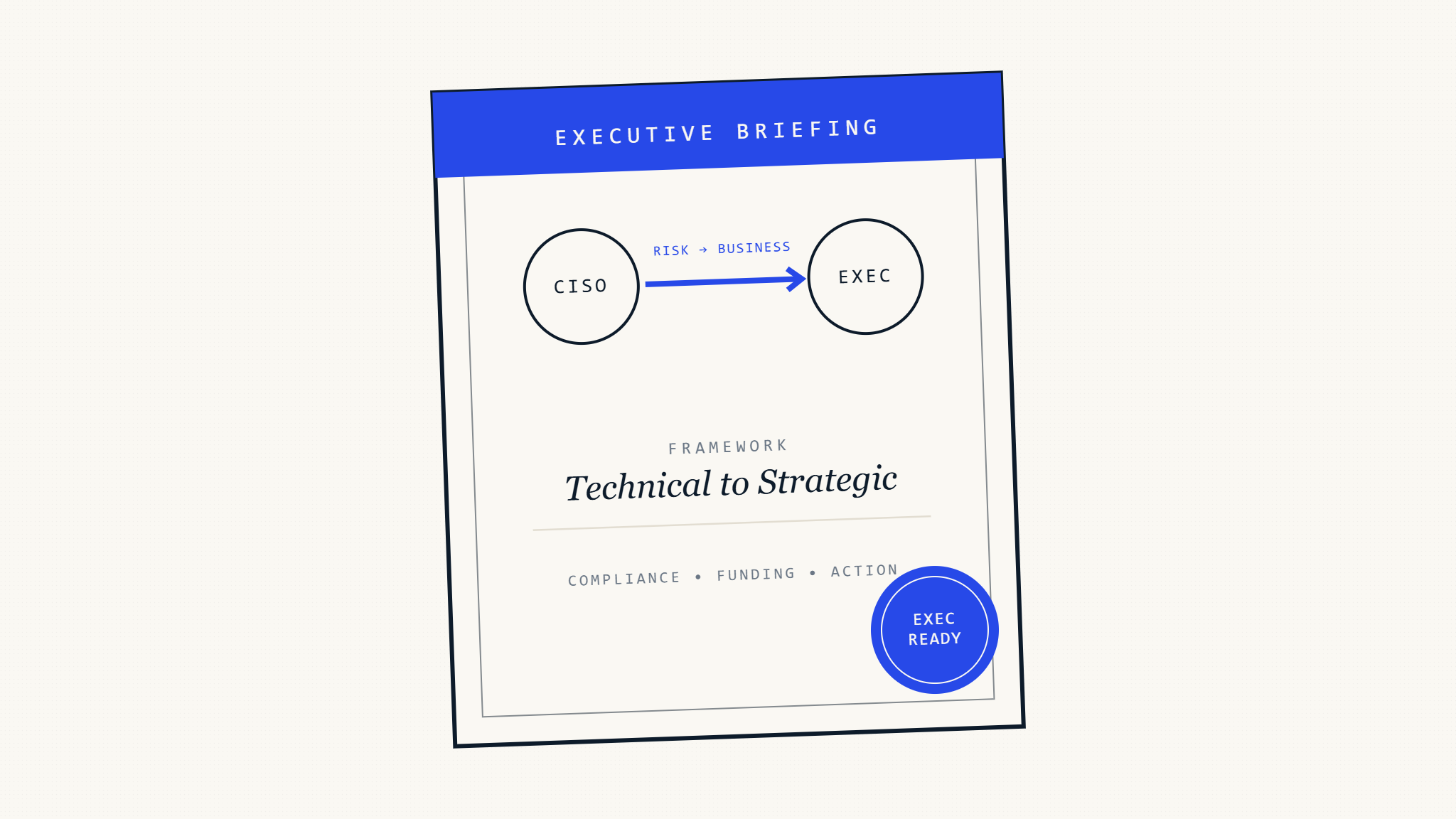
The disconnect between technical security teams and executive leadership remains one of the most significant barriers to effective cybersecurity programs. While CISOs understand the technical intricacies of threats and controls, translating these complexities into actionable business intelligence that resonates with executives requires a fundamentally different communication approach. This guide provides practical frameworks for transforming security conversations from technical discussions into strategic business dialogue.
I. The Executive Communication Challenge
Security leaders face a unique communication paradox: the more technical expertise they possess, the harder it becomes to communicate effectively with non-technical executives. Board members and C-suite leaders make decisions based on business impact, risk tolerance, and resource allocation rather than vulnerability scores or compliance checklists.
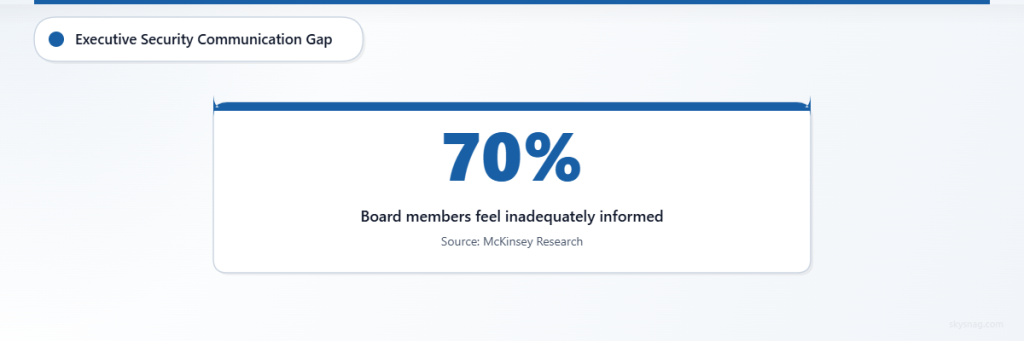
According to recent research by McKinsey, 70% of board members report feeling inadequately informed about their organization’s cybersecurity posture, despite regular security briefings. This disconnect often stems from communication that focuses on technical metrics rather than business outcomes.
The most successful CISOs develop a dual-language capability, maintaining technical depth while mastering business-focused communication patterns that enable executive decision-making.
II. Framework 1: The Business Risk Translation Matrix
Converting Technical Risks to Business Impact
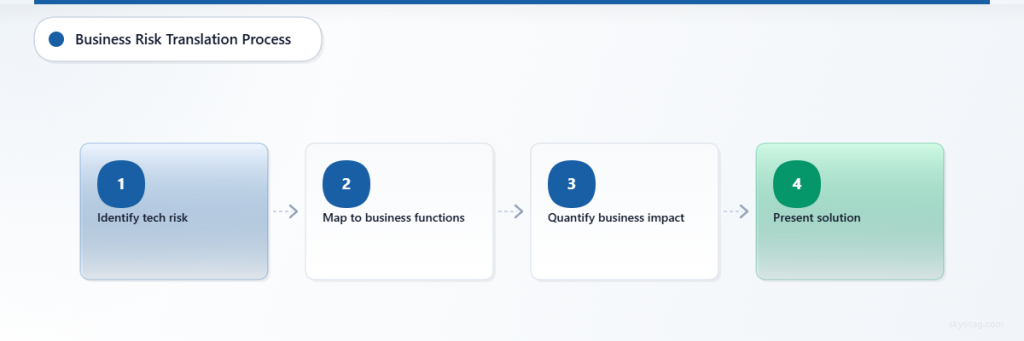
Transform technical findings into business consequences using this systematic approach:
Step 1: Identify the Technical Risk
Start with your technical assessment but immediately pivot to business implications.
Step 2: Map to Business Functions
Connect each technical vulnerability to specific business processes or outcomes it could disrupt.
Step 3: Quantify Business Impact
Translate technical risk into financial, operational, or reputational terms executives understand.
Example Translation:
- Technical: “Our email authentication shows 23% DMARC failure rate”
- Business: “Inadequate email security controls expose us to $2.3M average business email compromise losses and potential regulatory scrutiny that could impact customer trust and market position”
Building Your Translation Skills
Practice this framework with common security scenarios:
Unpatched Systems → Operational Continuity Risk
Instead of: “We have 47 critical vulnerabilities across production systems”
Say: “Our current patch management gaps create a 35% probability of service disruption that would cost approximately $50,000 per hour in lost revenue and productivity”
Access Control Issues → Compliance and Legal Risk
Instead of: “We lack proper segregation of duties in financial systems”
Say: “Current access controls create audit findings that could result in regulatory penalties and increased compliance costs estimated at $200,000 annually”
III. Framework 2: The Executive Decision Structure
Organizing Information for Action
Executives process information differently than technical teams. Structure your communications using this hierarchy:
1. Executive Summary (30 seconds)
- Current state in one sentence
- Primary recommendation
- Resource requirement
- Timeline for decision
2. Business Case (2 minutes)
- Risk exposure in business terms
- Cost of inaction vs. cost of action
- Alignment with business objectives
- Competitive implications
3. Implementation Overview (3 minutes)
- High-level approach
- Key milestones
- Success metrics
- Dependencies and assumptions
4. Supporting Details (as needed)
- Technical specifics available for follow-up
- Detailed project plans
- Vendor comparisons
- Compliance requirements
Sample Executive Brief Template
Subject: Email Security Investment Decision
Executive Summary:
Our current email security posture exposes the organization to business email compromise attacks averaging $1.2M in losses. Implementing comprehensive email authentication would reduce this risk by 85% with a $75,000 investment and 90-day implementation timeline.
Business Case:
Email remains the primary attack vector for financial fraud and data breaches affecting organizations in our sector. Recent incidents at similar companies resulted in average losses of $1.2M per successful attack, plus reputational damage and regulatory scrutiny. The proposed email authentication controls align with our digital transformation initiatives and would position us favorably with cyber insurance underwriters.
Implementation Overview:
Deploy email authentication protocols across all domains with phased rollout over 90 days. Success metrics include 95% email authentication compliance and zero successful business email compromise attempts. Primary dependency is coordination with our email service provider during implementation.
IV. Framework 3: Metrics That Matter to Executives
Choosing the Right Security Metrics
Avoid overwhelming executives with technical metrics that don’t translate to business decisions. Focus on these categories:
Risk Metrics
- Potential financial exposure from identified risks
- Probability of successful attacks based on current controls
- Time to detect and contain incidents
- Percentage of critical assets with adequate protection
Performance Metrics
- Reduction in successful attacks year-over-year
- Mean time to resolution for security incidents
- Percentage of compliance requirements met
- Security awareness training completion rates
Investment Metrics
- Return on investment for security initiatives
- Cost per protected asset or user
- Comparison to industry benchmarks
- Security spending as percentage of IT budget
Creating Executive Dashboards
Design security dashboards that enable quick decision-making:
Red/Yellow/Green Status Indicators
Use color coding for immediate status recognition across key risk areas.
Trend Analysis
Show progress over time rather than point-in-time snapshots.
Benchmark Comparisons
Include industry peer comparisons to provide context for performance metrics.
Forward-Looking Indicators
Highlight emerging risks and proactive measures rather than only reactive metrics.
V. Framework 4: Building Security Business Cases
Justifying Security Investments
Transform security spending from cost centers into business enablers using this approach:
Step 1: Establish Current State Costs
- Calculate the total cost of current security posture
- Include incident response costs, compliance penalties, and business disruption
- Factor in opportunity costs of inadequate security
Step 2: Project Future State Benefits
- Quantify risk reduction from proposed investments
- Calculate efficiency gains from improved security processes
- Estimate competitive advantages from enhanced security posture
Step 3: Present Options and Recommendations
- Provide multiple investment scenarios with different risk profiles
- Include “do nothing” option with associated risks
- Clearly recommend preferred approach with justification
Sample Business Case Structure
Current State Analysis:
- Annual security incidents: 12 (average cost: $45,000 each)
- Compliance audit findings: 8 (remediation cost: $25,000 each)
- Staff time on manual security tasks: 40 hours/week ($75,000 annually)
Proposed Investment:
- Email security automation platform: $75,000 initial, $25,000 annual
- Expected reduction in email-based incidents: 85%
- Automation of routine tasks: 30 hours/week recovered
- ROI timeline: 14 months
Business Impact:
- Risk reduction: $459,000 (potential incident costs)
- Efficiency gains: $56,250 (staff time recovery)
- Competitive advantage: Enhanced customer trust and partner confidence
VI. Framework 5: Crisis Communication Protocols
Managing Security Incidents with Executives
During security incidents, communication becomes critical for maintaining confidence and enabling rapid decision-making.
Initial Notification (within 1 hour)
- Brief description of the incident
- Immediate actions taken
- Estimated business impact
- Next update timeline
Status Updates (every 4-6 hours)
- Progress on containment efforts
- Revised impact assessment
- Resource needs or decisions required
- Stakeholder communication plan
Resolution Summary (within 24 hours of resolution)
- Final impact assessment
- Lessons learned
- Process improvements planned
- Prevention measures implemented
Incident Communication Template
Subject: Security Incident Update – [Severity Level]
Situation:
[Brief, factual description of what happened]
Impact:
[Business systems, data, or operations affected]
Actions Taken:
[Steps completed to address the incident]
Current Status:
[Where we are in the response process]
Next Steps:
[Immediate priorities and timeline]
Business Continuity:
[How operations continue during response]
VII. Implementing Effective CISO Communication
Practical Implementation Steps
Week 1-2: Assessment and Planning
- [ ] Audit current communication methods and executive feedback
- [ ] Identify key stakeholders and their information preferences
- [ ] Develop communication templates for routine and crisis scenarios
- [ ] Create executive dashboard prototypes with relevant metrics
Week 3-4: Framework Development
- [ ] Build risk translation matrices for your organization’s key risks
- [ ] Develop business case templates for common security investments
- [ ] Create presentation formats optimized for executive attention spans
- [ ] Establish regular communication cadence with leadership team
Week 5-6: Implementation and Refinement
- [ ] Deploy new communication approaches in low-stakes scenarios
- [ ] Gather feedback from executives on information clarity and usefulness
- [ ] Refine templates and frameworks based on real-world usage
- [ ] Train security team members on business-focused communication
Tools and Technology Support

Modern security communication benefits from purpose-built tools that automate routine reporting while enabling customization for different audiences. Skysnag Comply provides executive-ready reporting capabilities that translate technical email security metrics into business-focused dashboards and alerts.
The platform’s automated compliance reporting transforms complex authentication data into clear business metrics, enabling CISOs to demonstrate risk reduction and investment value to executive stakeholders. This approach eliminates the manual effort of translating technical data while ensuring consistent, professional communication with leadership teams.
Measuring Communication Effectiveness
Track the success of your executive communication improvements:
Engagement Metrics
- Meeting attendance and participation rates
- Follow-up questions and requests for additional information
- Speed of decision-making on security proposals
Business Outcomes
- Approval rates for security investments
- Executive support during security incidents
- Integration of security considerations in business planning
Relationship Indicators
- Frequency of informal security consultations
- Executive advocacy for security initiatives
- Board-level security discussion quality and depth
VIII. Advanced Communication Strategies
Tailoring Messages to Different Executive Roles
CEO Communication
Focus on strategic risks, competitive implications, and organizational reputation. Emphasize how security enables business objectives rather than constraining them.
CFO Communication
Emphasize financial metrics, ROI calculations, and cost optimization. Present security as investment protection rather than expense.
COO Communication
Highlight operational continuity, process efficiency, and business enablement. Show how security supports operational excellence.
Board Communication
Focus on governance, oversight responsibilities, and strategic risk management. Provide assurance on due diligence and fiduciary obligations.
Building Long-term Executive Relationships
Regular Education Programs
Implement ongoing security awareness programs tailored for executive audiences, focusing on business implications rather than technical details.
Strategic Planning Integration
Participate in business planning processes to ensure security considerations inform strategic decisions from the outset.
Industry Networking
Facilitate executive participation in security industry events and peer discussions to build awareness and support.
Success Celebration
Regularly communicate security program achievements and their business impact to maintain visibility and support.
IX. Key Takeaways
Effective CISO communication transforms security from a technical function into a strategic business capability. The frameworks presented in this guide provide systematic approaches for translating technical risks into business language that drives executive action.
Success requires consistent practice of business-focused communication patterns, regular refinement based on stakeholder feedback, and integration of security metrics into broader business performance discussions. The most effective security leaders develop communication strategies that position security as a business enabler rather than a constraint.
Modern tools like Skysnag Comply support this transformation by automating the translation of technical security data into executive-ready business metrics and dashboards. This technological foundation enables CISOs to focus on strategic communication rather than manual data preparation.
The investment in communication excellence pays dividends through improved executive support, faster security decision-making, and better integration of security considerations into business strategy. Organizations with strong CISO-executive communication consistently demonstrate better security outcomes and business resilience.
Ready to enhance your security communication effectiveness? Explore Skysnag Comply to discover how automated compliance reporting can support your executive communication strategy while ensuring comprehensive email security protection.