Presenting cybersecurity investments to board members who lack technical backgrounds requires a fundamental shift in communication strategy. Rather than focusing on technical specifications and threat vectors, successful security leaders frame cybersecurity as a business enabler that protects revenue, ensures operational continuity, and supports strategic objectives.
The challenge lies in translating complex security concepts into business language that resonates with directors focused on growth, profitability, and competitive advantage. This guide provides proven frameworks and communication strategies to build compelling business cases that secure board approval and ongoing support for cybersecurity initiatives.
I. Understanding Board Perspectives on Cybersecurity
Board members typically view cybersecurity through the lens of business impact rather than technical implementation. They want to understand how security investments protect shareholder value, support business growth, and manage enterprise risk within acceptable parameters.
Common Board Concerns About Security Spending
Directors frequently question cybersecurity investments because they struggle to quantify the return on prevention. Unlike other business investments that generate measurable revenue or cost savings, security spending often appears to be pure cost without obvious benefit until something goes wrong.
Board members also worry about ongoing operational expenses and whether security teams can effectively manage and maintain new technologies. They need confidence that investments will deliver sustainable protection rather than creating additional complexity or vendor dependencies.
The perception that cybersecurity is an IT problem rather than a business issue further complicates investment discussions. Boards that view security as a technical cost center rather than a business function tend to minimize funding and strategic support.
II. Building Your Cybersecurity Business Case Framework
Risk-Based Financial Modeling
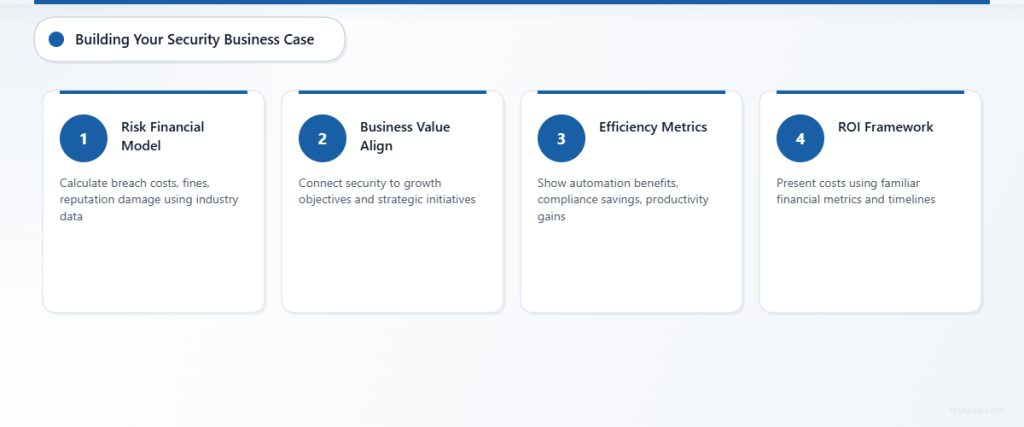
Start with quantifiable business risks that cybersecurity investments help mitigate. Calculate potential financial losses from data breaches, operational disruptions, regulatory fines, and reputation damage using industry benchmarks and your organization’s specific vulnerabilities.
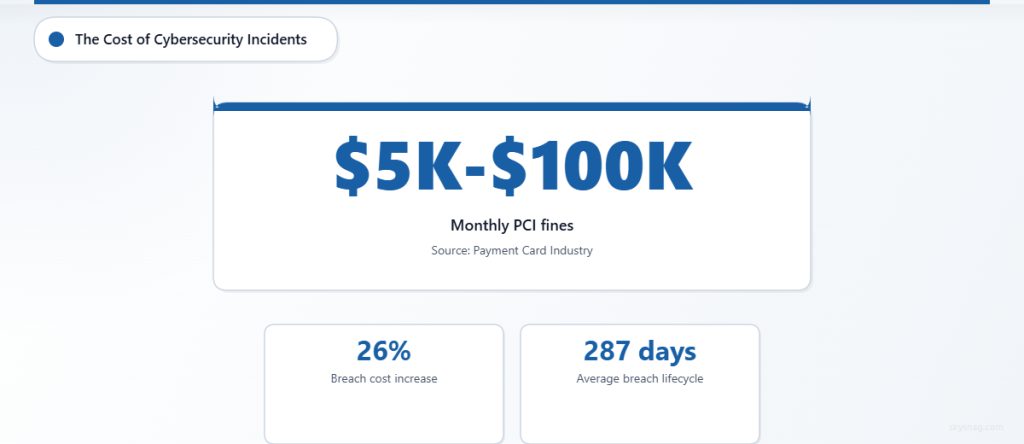
For example, if your organization processes payment data, email-based attacks targeting payment systems could result in PCI DSS compliance violations with fines ranging from $5,000 to $100,000 per month. Email authentication controls like those provided by Skysnag Protect can demonstrate proactive security measures that support compliance objectives.
Use conservative estimates and cite credible sources such as the Ponemon Institute Cost of a Data Breach Report or industry-specific research from organizations like HIMSS for healthcare or FS-ISAC for financial services.
Business Value Alignment
Connect security investments directly to business objectives and strategic initiatives. If the organization is expanding internationally, frame cybersecurity as essential infrastructure for secure global operations. For companies pursuing digital transformation, position security as an enabler that allows safe adoption of new technologies and processes.
Consider how security investments support revenue generation, customer trust, and competitive differentiation. Organizations with strong security postures often win contracts and partnerships that require demonstrated cybersecurity capabilities.
Operational Efficiency Metrics
Highlight how security investments reduce operational costs and improve efficiency. Automated security controls reduce manual effort, streamline compliance reporting, and minimize the business disruption caused by security incidents.

Email authentication platforms demonstrate clear operational benefits through reduced phishing incidents, improved email deliverability, and simplified compliance documentation. These improvements translate directly to productivity gains and cost reductions that boards can easily understand.
III. Presenting Security ROI to Non-Technical Audiences
Avoiding Technical Jargon
Transform technical concepts into business language that board members use in other contexts. Instead of discussing “DMARC policy enforcement,” explain “email brand protection that prevents customer-targeted impersonation attacks.” Rather than detailing “threat detection capabilities,” describe “early warning systems that minimize business disruption.”
Use analogies familiar to board members from other business functions. Compare cybersecurity investments to insurance, quality control processes, or facility security measures that boards already understand and support.
Financial Impact Calculations
Present costs and benefits using familiar financial metrics such as return on investment, total cost of ownership, and payback period. Break down security spending into categories that align with standard business accounting practices.
- Capital investments: Hardware, software licenses, initial implementation
- Operational expenses: Ongoing subscriptions, maintenance, personnel
- Risk mitigation value: Quantified losses prevented or reduced
- Efficiency gains: Process improvements, automation benefits, compliance cost reductions
Timeline and Milestone Communication
Establish clear implementation timelines with measurable milestones that demonstrate progress and value delivery. Board members need confidence that security investments will deliver results within reasonable timeframes.
Create reporting mechanisms that show ongoing value rather than just initial implementation success. Regular security posture updates using business metrics help maintain board support for continued investment.
IV. Essential Elements of Board-Ready Security Presentations
Executive Summary Format
Begin every security presentation with a concise executive summary that states the business problem, proposed solution, required investment, and expected outcomes. Board members should understand your recommendation within the first two minutes of your presentation.
Structure the executive summary around three key points:
- Business Risk: What specific business problems does this solve?
- Investment Requirements: What resources are needed and over what timeframe?
- Expected Outcomes: What measurable benefits will the organization realize?
Peer Comparison and Industry Standards
Board members often find peer comparison and industry benchmarking compelling when evaluating security investments. Present data showing how your organization’s current security spending compares to similar companies and industry averages.
Reference security frameworks and standards that other organizations in your industry commonly implement. This approach helps position security investments as business necessities rather than optional technical enhancements.
Risk Scenario Development
Create realistic scenarios that illustrate potential business impacts of security incidents. Focus on scenarios that would directly affect business operations, customer relationships, or regulatory standing rather than technical system failures.
Develop three scenario levels:
- Minor incident: Limited impact with manageable recovery costs
- Moderate incident: Significant operational disruption requiring substantial resources
- Major incident: Severe business impact threatening organizational viability
V. Addressing Common Board Questions and Objections
“How do we know this investment will work?”
Address efficacy concerns by referencing industry success rates, peer organization outcomes, and vendor track records. Provide evidence from similar organizations that have implemented comparable solutions.
Offer pilot program options or phased implementations that allow the board to evaluate results before committing to full-scale deployments. This approach reduces perceived risk while demonstrating commitment to measured progress.
“Can’t we just buy insurance instead?”
Explain the relationship between cybersecurity investments and insurance coverage. Insurance policies require organizations to implement specific security controls and may not cover all types of losses or business disruption.
Security investments often reduce insurance premiums and deductibles while providing protection that insurance cannot offer, such as preserved customer trust and competitive advantage.
“Why is this more important than other business investments?”
Position cybersecurity as foundational infrastructure that enables other business investments rather than competing with them. Security investments protect and maximize the value of technology modernization, digital transformation, and growth initiatives.
Use opportunity cost analysis to show how security incidents could derail strategic initiatives or require emergency resources that could otherwise support business growth.
VI. Implementing Successful Communication Strategies
Regular Board Reporting Rhythms
Establish consistent cybersecurity reporting schedules that keep security visible and relevant in board discussions. Monthly or quarterly security updates help maintain awareness and support for ongoing investments.
Structure regular reports around business metrics rather than technical indicators. Report on prevented incidents, compliance status, and operational efficiency improvements rather than system configurations or threat detection statistics.
Building Security Literacy Gradually
Invest time in educating board members about cybersecurity concepts using business contexts they understand. Provide brief educational segments during regular meetings rather than overwhelming directors with technical training sessions.
Focus on helping board members understand their governance responsibilities for cybersecurity oversight and the questions they should ask management teams about security posture and incident preparedness.
VII. Leveraging External Validation and Industry Standards
Third-Party Assessments
Independent security assessments provide credible validation for security investment recommendations. Board members often find third-party perspectives more persuasive than internal recommendations, particularly for significant investments.
Consider engaging cybersecurity consultants, audit firms, or specialized assessment organizations to provide objective evaluations of your security posture and investment priorities.
Regulatory and Compliance Drivers
Frame security investments within regulatory and compliance contexts that board members must address as part of their fiduciary responsibilities. Many industries have specific cybersecurity requirements that boards must ensure organizations meet.
Email authentication requirements are increasingly common across industries, with standards that support various compliance frameworks. Implementing comprehensive email security solutions like Skysnag Protect helps organizations address multiple regulatory expectations while improving overall security posture.
Industry Participation and Benchmarking
Demonstrate organizational commitment to industry best practices through participation in security forums, information sharing initiatives, and industry associations. Board members appreciate evidence that organizations are learning from industry peers and contributing to collective security improvement.
VIII. Measuring and Communicating Success
Key Performance Indicators
Develop cybersecurity KPIs that align with business objectives and board reporting expectations. Focus on metrics that demonstrate business value rather than purely technical measurements.
Effective board-level security metrics include:
- Risk reduction indicators: Decreased incident frequency, reduced severity of security events
- Operational efficiency: Improved system availability, reduced recovery times
- Compliance status: Audit results, regulatory assessment scores
- Business enablement: Security-supported business initiatives, customer trust metrics
Continuous Value Demonstration
Create reporting mechanisms that consistently show ongoing value from cybersecurity investments. Regular success stories, prevented incident reports, and efficiency improvements help maintain board support for security programs.
Document and communicate instances where security investments enabled business opportunities, prevented losses, or supported strategic initiatives. These success stories provide compelling evidence for continued investment.
IX. Key Takeaways
Building effective cybersecurity business cases requires translating technical requirements into business language that resonates with non-technical board members. Success depends on focusing on business impact, financial metrics, and strategic alignment rather than technical specifications.
Effective board communication emphasizes risk mitigation, operational efficiency, and business enablement rather than threat landscapes or technical capabilities. Regular reporting using business metrics maintains visibility and support for ongoing security investments.
Organizations that successfully secure board support for cybersecurity investments demonstrate clear connections between security spending and business objectives. They provide quantified risk assessments, peer comparisons, and measurable outcomes that board members can evaluate using familiar business frameworks.
Ready to strengthen your organization’s email security posture with solutions that support clear business cases? Skysnag Protect provides comprehensive email authentication and monitoring capabilities that translate directly to business value through improved security posture, compliance support, and operational efficiency.