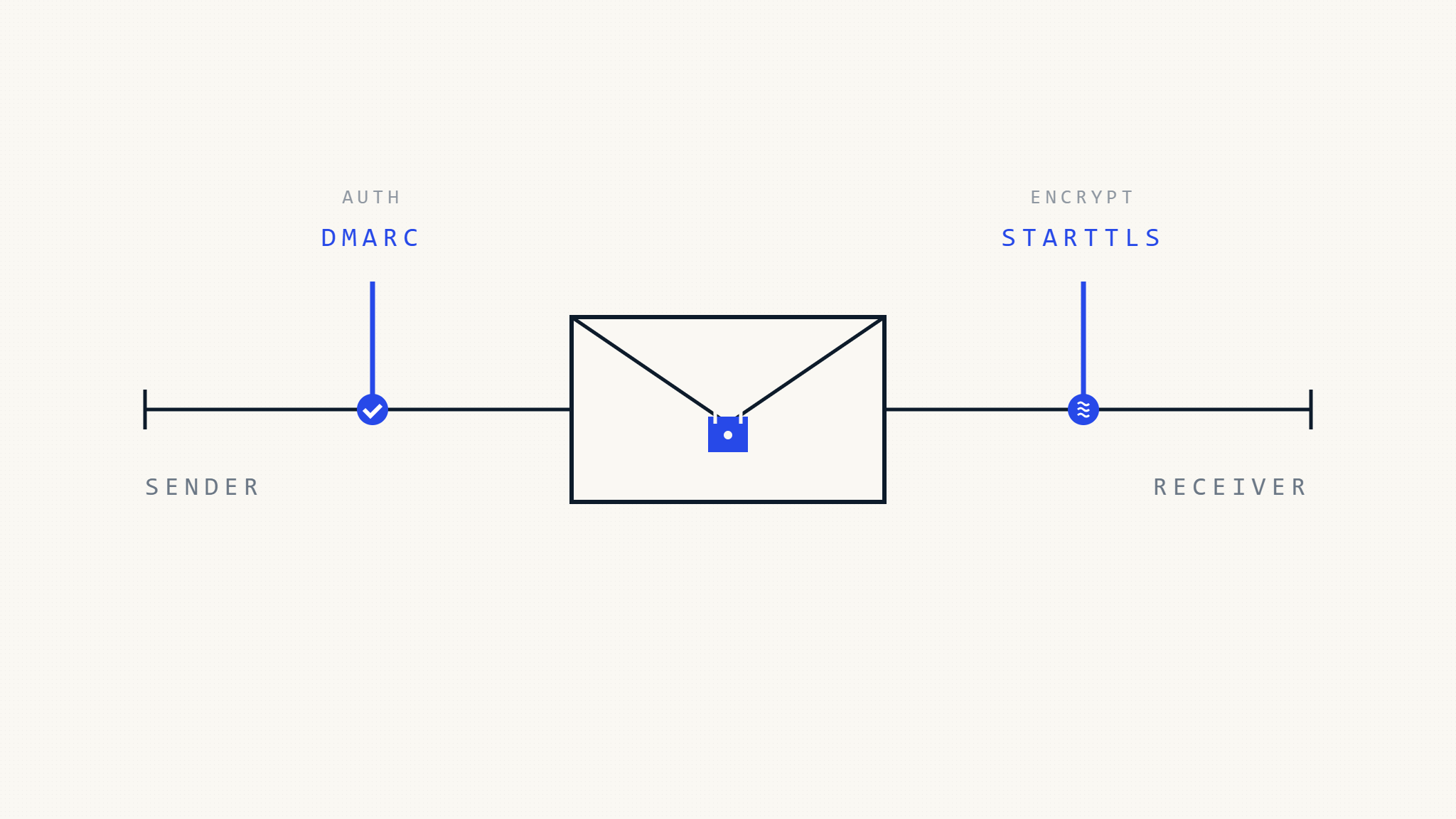
Email security depends on multiple layers of protection that address fundamentally different threats. STARTTLS encrypts messages during transmission between mail servers, while DMARC authenticates sender identity and prevents domain spoofing. Organizations often assume one replaces the other, but each protocol solves a distinct problem—and failing to implement both creates exploitable gaps in your email infrastructure.
Understanding the technical and operational differences between STARTTLS and DMARC determines whether your email security program actually protects against the threats you face. Transport encryption without authentication allows attackers to send convincing phishing messages through encrypted channels. Authentication without encryption exposes message content to interception during transit. This comparison explains how each protocol works, where each protocol can fail, and how to deploy both together for comprehensive email protection.
I. What STARTTLS Actually Does (and Where It Fails)
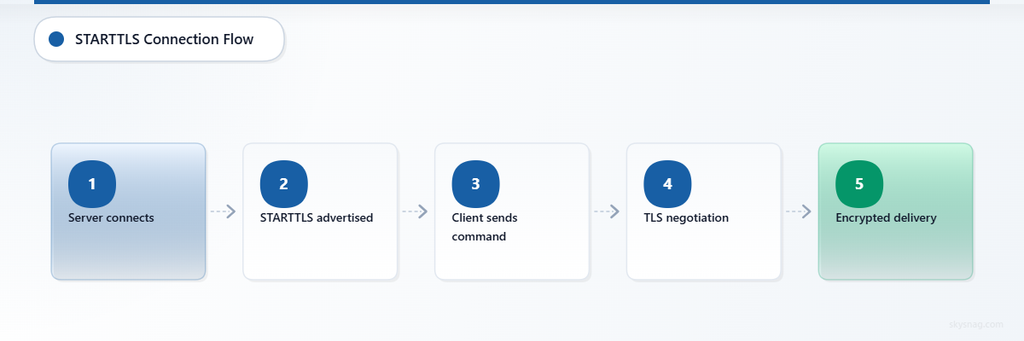
STARTTLS is an SMTP extension that upgrades a plaintext email connection to an encrypted TLS connection during the SMTP handshake. When a sending mail server connects to a receiving mail server, STARTTLS negotiates encryption before message content is transmitted, protecting email data in transit from network-level interception.
How STARTTLS Works:
- Sending server connects to receiving server over port 587 (submission) or port 25 (relay)
- Receiving server advertises STARTTLS capability
- Sending server issues STARTTLS command
- Both servers negotiate TLS version and cipher suite
- Encrypted connection established for message transmission
Where STARTTLS Can Fail:
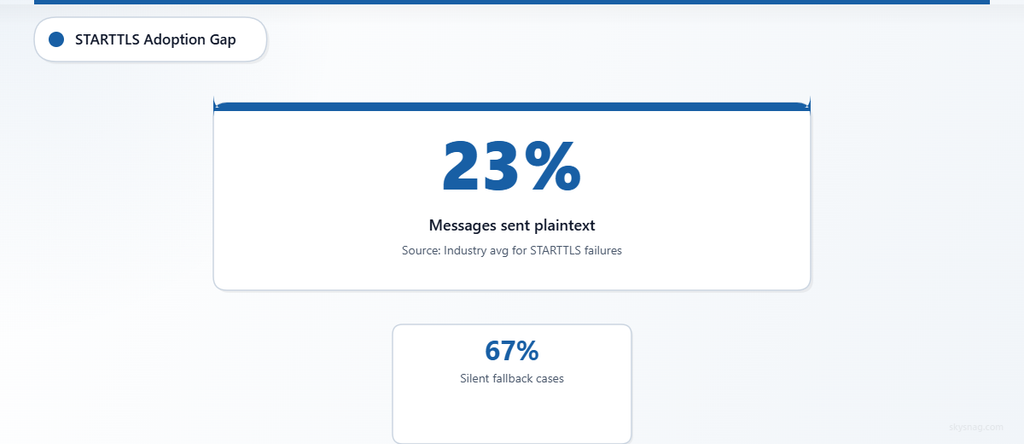
STARTTLS is opportunistic by default, meaning the sending server attempts encryption but falls back to plaintext if the receiving server does not support STARTTLS, if the TLS handshake fails, or if an attacker performs a downgrade attack during negotiation. Common failure conditions include:
- STARTTLS stripping attacks: An attacker intercepts the SMTP session and removes the STARTTLS capability announcement, forcing plaintext transmission. The sending server completes delivery without realizing encryption was blocked.
- Certificate validation failures: If the receiving server presents an invalid, expired, or self-signed certificate, many sending servers still complete delivery in plaintext rather than reject the message.
- TLS version and cipher negotiation failures: Misconfigured servers may fail to agree on supported TLS versions (e.g., one requires TLS 1.3, the other only supports TLS 1.0) or cipher suites, causing the connection to fall back to unencrypted transmission.
- Silent fallback behavior: Unless explicitly configured otherwise, most mail servers do not alert administrators when STARTTLS fails and messages are sent in plaintext.
What STARTTLS Does Not Protect:
- STARTTLS does not authenticate sender identity. An attacker can send spoofed messages over an encrypted connection.
- STARTTLS does not prevent phishing or business email compromise. Encryption protects content during transmission, not sender legitimacy.
- STARTTLS does not enforce encryption at rest. Messages remain encrypted only during the network hop between servers, not in mailboxes or logs.
II. What DMARC Actually Does (and Where It Fails)
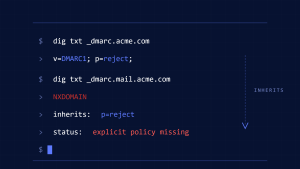
DMARC authenticates that an email message originates from an authorized source by validating SPF and DKIM authentication results and checking for domain alignment. When DMARC passes, the receiving mail server has cryptographic and DNS-based evidence that the message was sent from a legitimate sender authorized by the domain owner. When DMARC fails, the domain owner instructs the receiving server to quarantine or reject the message.
How DMARC Works:
- Sending server delivers message with SPF authentication (validates sending IP) and DKIM signature (validates message integrity)
- Receiving server performs SPF and DKIM checks
- Receiving server retrieves DMARC policy from the domain’s DNS (
_dmarc.example.com) - Receiving server checks for alignment: SPF-authenticated domain or DKIM d= domain must match the visible From: domain
- If alignment passes, DMARC passes. If not, the DMARC policy (p=none, p=quarantine, p=reject) determines handling
Where DMARC Can Fail:
DMARC passing does not guarantee inbox placement. DMARC failing does not always mean immediate rejection. Enforcement depends on the receiving server honoring the policy, and many legitimate scenarios cause DMARC failures that require operational adjustments:
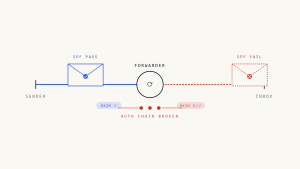
- Forwarding scenarios: When a message is forwarded through a mailing list or auto-forwarder, SPF typically breaks (the forwarding server’s IP is not authorized for the original domain) and DKIM may break if the forwarder modifies the message body or subject line. If DKIM also fails, DMARC fails even for legitimate messages.
- SPF lookup failures: SPF can fail silently when DNS lookup times out (temperror), when the record exceeds 10 DNS lookups (permerror), or when the envelope sender differs from the header From address (passes SPF but provides no DMARC alignment).
- DKIM signature failures: DKIM signatures fail when keys are rotated without updating DNS, when message content is modified in transit (by disclaimer appenders, antivirus scanners, or transport agents), or when the signature header is malformed.
- Alignment failures despite authentication passing: A message can pass SPF and pass DKIM but still fail DMARC if neither the SPF-authenticated domain nor the DKIM d= domain aligns with the visible From: domain. This commonly occurs with third-party senders that sign with their own domain instead of the customer’s domain.
- Policy enforcement variability: DMARC p=reject instructs the receiving server to refuse the message during SMTP delivery. When honored by the receiving server, the message is refused during SMTP delivery and should not reach the inbox or spam folder. However, enforcement depends on the receiving server honoring the policy—some forwarders, mailing lists, and misconfigured receivers do not enforce DMARC as specified.
What DMARC Does Not Protect:
- DMARC does not encrypt message content. Authenticated messages can still be intercepted during transmission if STARTTLS is not used.
- DMARC does not validate message content accuracy, only sender identity.
- DMARC does not prevent account compromise. If an attacker gains access to a legitimate email account, messages sent from that account pass DMARC.
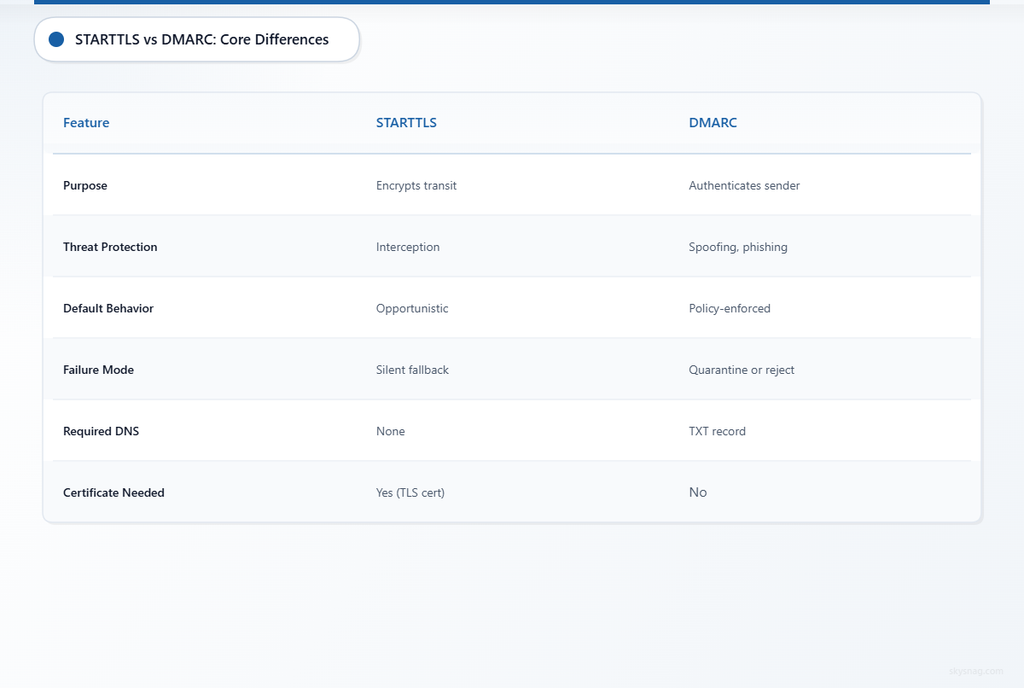
III. Technical Comparison: STARTTLS vs DMARC
| Dimension | STARTTLS | DMARC |
|---|---|---|
| Purpose | Encrypts email content during transmission between mail servers | Authenticates sender identity and prevents domain spoofing |
| Threat Model | Protects against network-level eavesdropping, man-in-the-middle interception during transit | Protects against phishing, business email compromise, domain spoofing, brand impersonation |
| Implementation Layer | Transport layer (SMTP protocol extension) | Authentication layer (DNS policy + SPF + DKIM validation) |
| Default Behavior | Opportunistic (attempts encryption, falls back to plaintext) | Policy-driven (p=none monitors, p=quarantine filters, p=reject blocks) |
| Failure Visibility | Often silent unless enforced via MTA-STS or DANE | Visible through aggregate reports (rua=) when monitoring is configured |
| Enforcement Mechanism | MTA-STS (requires HTTPS-published policy) or DANE (requires DNSSEC) | DMARC policy published in DNS, enforced by receiving mail server |
| Interoperability | Requires both sending and receiving servers to support STARTTLS and compatible TLS versions | Requires SPF, DKIM, and DMARC DNS records; receiving server must honor policy |
| Failure Impact | Message delivered in plaintext, content exposed to interception | Message quarantined or rejected (if policy enforced), or delivered with authentication failure signal |
| Operational Complexity | Low—most modern mail servers support STARTTLS by default | Moderate to high—requires SPF record maintenance, DKIM signing infrastructure, DMARC policy tuning, and third-party sender coordination |
IV. Why You Need Both (Not One or the Other)
STARTTLS and DMARC are not alternative security options. They are complementary protocols that address different attack vectors:
- Transport encryption without authentication allows spoofed phishing messages to be delivered over encrypted channels. An attacker can send a spoofed message claiming to be from your company, and if the attacker’s mail server supports STARTTLS, the message is delivered securely to the victim’s inbox—but the victim has no way to verify sender authenticity.
- Authentication without transport encryption exposes message content to interception during transit. Even if a message passes DMARC and proves the sender is legitimate, the message content can be intercepted by network-level attackers if STARTTLS is not enforced.
- Business email compromise attacks exploit both gaps simultaneously. Attackers send spoofed messages from domains without DMARC enforcement, over unencrypted or downgraded SMTP connections, to maximize delivery success and minimize forensic evidence.
Organizations subject to compliance frameworks such as PCI DSS, HIPAA, GDPR, and NIS2 commonly implement both STARTTLS and DMARC as part of their email security programs. STARTTLS supports data protection during transmission, while DMARC supports anti-phishing, anti-spoofing, and sender accountability objectives.
V. When STARTTLS Alone Is Not Enough
Deploying STARTTLS across your mail infrastructure encrypts email content during transmission, but does not address sender authentication or domain spoofing. Scenarios where STARTTLS alone provides incomplete protection:
- Phishing attacks using your domain: An attacker spoofs your domain and sends phishing messages to your customers. If the attacker’s mail server supports STARTTLS, the messages are delivered over encrypted connections, and recipients have no technical signal that the messages are fraudulent.
- Third-party senders with weak authentication: Your company uses a marketing platform, support ticketing system, or HR platform that sends email on your behalf. If those senders are not included in your SPF record, do not sign with DKIM using your domain, and your domain does not publish a DMARC policy, recipients cannot verify that those messages are legitimate.
- Post-delivery attacks: STARTTLS protects messages during transmission, but once messages are delivered to the recipient’s mailbox, they are no longer protected by transport encryption. If an attacker compromises the recipient’s mailbox or webmail session, STARTTLS provides no protection.
VI. When DMARC Alone Is Not Enough
Deploying DMARC at p=reject prevents attackers from spoofing your domain, but does not protect message content from interception during transmission. Scenarios where DMARC alone provides incomplete protection:
- Sensitive data exposure during transit: Your company sends financial statements, medical records, legal documents, or payroll information via email. If STARTTLS is not enforced, those messages may be transmitted in plaintext and intercepted by network-level attackers.
- Credential harvesting via unencrypted channels: Your company sends password reset links, account verification tokens, or authentication codes. If STARTTLS is not enforced, attackers can intercept those messages and gain account access even though the messages pass DMARC.
- Compliance gaps: Many compliance frameworks emphasize protecting data in transit. DMARC authenticates sender identity but does not encrypt content. Organizations that rely solely on DMARC may fail to demonstrate adequate data protection during transmission.
VII. How to Deploy STARTTLS and DMARC Together
A comprehensive email security architecture uses both STARTTLS and DMARC, with enforcement policies that reduce the risk of transport downgrade attacks and domain spoofing.
STARTTLS Deployment Checklist
Use the checklist below as a practical starting point for deploying and enforcing STARTTLS across your email infrastructure. The exact requirements will depend on your mail server platform, outbound relay configuration, and compliance objectives.
- Verify that outbound mail servers support STARTTLS on port 587 (submission) and port 25 (relay) and are configured to attempt encryption for all outbound SMTP sessions.
- Verify that inbound mail servers advertise STARTTLS capability and support modern TLS versions (TLS 1.2 or higher) with strong cipher suites (avoid RC4, 3DES, and export ciphers).
- Deploy valid TLS certificates for mail server hostnames, ensuring certificates are issued by trusted certificate authorities, not expired, and include correct Subject Alternative Names (SAN) for all mail server hostnames.
- Configure sending mail servers to require certificate validation for STARTTLS connections where possible, rejecting connections if certificate validation fails.
- Publish an MTA-STS policy (via HTTPS at MTA-STS) to enforce STARTTLS for inbound mail, instructing sending servers to require encryption and reject delivery if STARTTLS fails.
- Publish a TLS-RPT record in DNS (e.g.,
_smtp._tls.example.com) to receive reports when sending servers fail to deliver over STARTTLS, providing visibility into connection failures, certificate errors, and downgrade attempts. - Monitor TLS-RPT aggregate reports to identify sending domains that fail to connect over STARTTLS, investigate whether failures indicate infrastructure issues or downgrade attacks.
- Test STARTTLS configuration using tools like checkltls or by manually testing SMTP sessions (openssl s_client -starttls smtp -connect mail.example.com:25).
DMARC Deployment Checklist
Use the checklist below as a practical starting point for deploying and enforcing DMARC authentication across your domains. The exact requirements will depend on your authorized sender ecosystem, third-party integrations, and enforcement readiness.
- Audit all authorized senders: marketing platforms, support tools, payroll systems, HR platforms, CRM systems, and transactional email services that send email using your domain.
- Publish SPF records for each sending domain, including all authorized sending IPs and SPF include mechanisms for third-party senders (e.g.,
include:_spf.google.comfor Google Workspace). Ensure SPF records remain under the 10-DNS-lookup limit. - Configure DKIM signing for all authorized senders, using your domain in the DKIM d= tag (not the third-party sender’s domain) to ensure alignment with the visible From: domain.
- Start DMARC monitoring through Skysnag and get a managed DMARC record generated for your domain. Skysnag generates a DMARC record with the correct reporting destination for your account and monitors aggregate reports automatically.
- Review DMARC aggregate reports to identify authentication failures, unauthenticated senders, spoofing attempts, and legitimate senders that require SPF or DKIM configuration updates.
- Resolve authentication failures by updating SPF records, fixing DKIM signing configuration, adjusting third-party sender settings, or coordinating with vendors to sign with your domain.
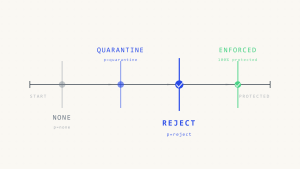
- Move DMARC policy to p=quarantine when SPF and DKIM pass rates are consistently high (95%+ pass rate across authorized senders), instructing receiving servers to filter unauthenticated messages.
- Move DMARC policy to p=reject when operational confidence is high, blocking unauthenticated messages entirely and preventing domain spoofing attacks.
Avoid relying on percentage-based rollout as the primary strategy. Current DMARC-aware programs should stage enforcement by domain, subdomain, sender group, and business function.
VIII. STARTTLS + DMARC + MTA-STS: The Complete Stack
MTA-STS (Mail Transfer Agent Strict Transport Security) enforces STARTTLS for inbound mail, preventing downgrade attacks and ensuring that sending mail servers require encryption when delivering to your domain. When STARTTLS is opportunistic, attackers can strip the STARTTLS capability announcement and force plaintext delivery. MTA-STS eliminates this risk by publishing an HTTPS policy that instructs sending servers to require encryption and reject delivery if STARTTLS fails.
MTA-STS Deployment:
- Publish an MTA-STS policy at
https://mta-sts.example.com/.well-known/mta-sts.txtwith the following structure:version: STSv1 mode: enforce mx: mail.example.com max_age: 86400 - Publish an MTA-STS DNS record:
_mta-sts.example.com. IN TXT "v=STSv1; id=20260115T120000" - Update the
id=value whenever the policy changes to force sending servers to re-fetch the policy.
What MTA-STS Does Not Protect:
- MTA-STS only enforces STARTTLS for inbound mail (messages sent to your domain). It does not enforce STARTTLS for outbound mail (messages you send to other domains).
- MTA-STS does not prevent spoofing—it only ensures encryption. You still need DMARC for authentication.
Deploying the Full Stack Together:
- STARTTLS encrypts email content during transmission
- DMARC authenticates sender identity and prevents spoofing
- MTA-STS enforces STARTTLS and prevents downgrade attacks
- TLS-RPT provides visibility into STARTTLS connection failures
This combination ensures that messages are both authenticated and encrypted, and that enforcement policies prevent both spoofing and interception.
IX. Operational Considerations: Which Protocol to Prioritize First
Organizations with limited resources should prioritize DMARC deployment before STARTTLS enforcement, for two reasons:
- DMARC provides broader threat coverage: Phishing, business email compromise, and domain spoofing attacks are more common than network-level interception during email transit. DMARC directly prevents attackers from impersonating your domain.
- DMARC provides visibility into your email ecosystem: DMARC aggregate reports reveal all senders using your domain, including shadow IT, unauthorized third-party services, and legacy systems that you may not know exist. This visibility is required before you can enforce authentication or encryption policies.
However, organizations handling sensitive data (financial services, healthcare, legal, government, defense contractors) should deploy both protocols in parallel. Regulatory frameworks such as HIPAA, PCI DSS, and GDPR emphasize protecting data in transit, and STARTTLS enforcement through MTA-STS demonstrates that email content is encrypted during transmission.
X. How Skysnag Supports STARTTLS and DMARC Deployment
Skysnag Protect automates DMARC monitoring, policy enforcement, and sender discovery, helping organizations move from p=none to p=reject while maintaining operational visibility. Use Skysnag Protect to identify legitimate senders, detect unauthorized sources, and move toward enforcement without disrupting business-critical email flows.
Skysnag Protect Capabilities:
- Automated DMARC aggregate report parsing and analysis
- Real-time alerts for authentication failures, spoofing attempts, and configuration errors
- Sender discovery and classification (authorized, unauthorized, third-party)
- Policy simulation to test enforcement impact before moving to p=quarantine or p=reject
- SPF and DKIM troubleshooting to resolve authentication failures
For TLS-RPT Monitoring:
Skysnag also supports TLS-RPT aggregate reporting, providing visibility into STARTTLS connection failures, certificate errors, and downgrade attempts when MTA-STS is deployed.
Start DMARC monitoring with Skysnag and get your free DMARC record. If you need TLS-RPT monitoring for MTA-STS enforcement, contact our team to enable TLS-RPT parsing and alerting.
XI. Key Takeaways
- STARTTLS encrypts email content during transmission between mail servers, protecting against network-level interception. DMARC authenticates sender identity and prevents domain spoofing. Both protocols are required for comprehensive email protection.
- STARTTLS is opportunistic by default, meaning sending servers fall back to plaintext if encryption fails. MTA-STS enforces STARTTLS for inbound mail, preventing downgrade attacks and ensuring that messages are delivered over encrypted connections.
- DMARC passing does not guarantee encryption. STARTTLS enforcement does not guarantee sender authenticity. Organizations that deploy only one protocol leave exploitable gaps in their email security architecture.
- DMARC should be prioritized first for most organizations, as phishing and domain spoofing attacks are more common than network-level interception. However, organizations handling sensitive data should deploy both DMARC and MTA-STS in parallel.
- STARTTLS can fail silently when certificate validation is disabled, when TLS negotiation fails, or when downgrade attacks occur. DMARC can fail when SPF or DKIM authentication breaks due to forwarding, message modification, or third-party sender misconfiguration.
- Use Skysnag Protect to automate DMARC monitoring, policy enforcement, and sender discovery. Start DMARC monitoring with Skysnag and get your free DMARC record.