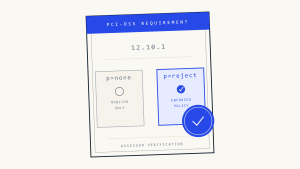
The Network and Information Systems Directive 2 (NIS2) has transformed cybersecurity obligations across the European Union, with Article 21 establishing comprehensive risk management measures that encompass email security controls. While NIS2 Article 21 doesn’t explicitly mandate DMARC implementation, organizations subject to the directive commonly implement email authentication protocols as part of their cybersecurity risk management framework to address the directive’s broad security requirements.
Understanding how DMARC implementation supports NIS2 Article 21 compliance objectives is crucial for EU organizations navigating the directive’s risk-based cybersecurity requirements. This guide examines the relationship between NIS2 obligations and email authentication controls, providing actionable implementation guidance for compliance-focused organizations.
I. Understanding NIS2 Article 21 Security Requirements
Article 21 of the NIS2 Directive establishes mandatory cybersecurity risk management measures for essential and important entities across the EU. The directive takes a risk-based approach to cybersecurity, requiring organizations to implement appropriate and proportionate technical and organizational measures.
Core Article 21 Obligations
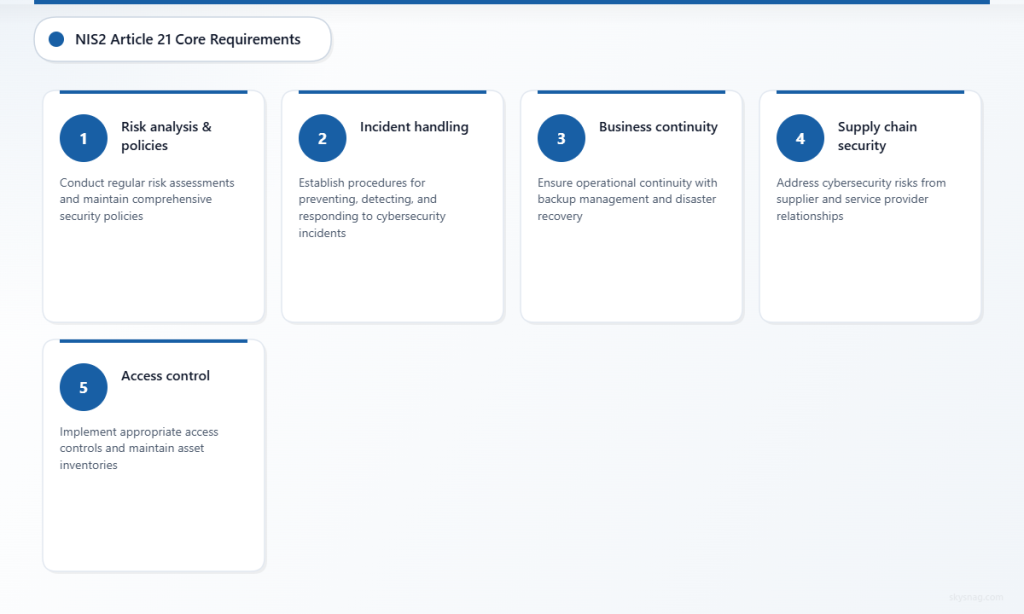
NIS2 Article 21 requires covered entities to implement cybersecurity risk management measures including:
- Risk analysis and information system security policies: Organizations must conduct regular risk assessments and maintain comprehensive security policies covering their network and information systems.
- Incident handling: Entities must establish procedures for preventing, detecting, and responding to cybersecurity incidents, including clear escalation and communication protocols.
- Business continuity: The directive requires measures ensuring operational continuity, including backup management and disaster recovery planning.
- Supply chain security: Organizations must address cybersecurity risks arising from relationships with suppliers and service providers.
- Security in network and information systems acquisition: The directive covers security measures for system development, deployment, and maintenance.
- Access control and asset management: Entities must implement appropriate access controls and maintain inventories of their network and information system assets.
Email Security Within the NIS2 Framework
Email systems represent critical infrastructure components for most organizations subject to NIS2. The directive’s emphasis on protecting against unauthorized access, ensuring system integrity, and maintaining operational continuity naturally extends to email infrastructure security.
Email-based attacks, including phishing, business email compromise, and domain spoofing, pose significant risks to the availability, authenticity, and integrity of network and information systems. These attack vectors can compromise the very objectives that NIS2 Article 21 seeks to protect.
II. How DMARC Supports NIS2 Article 21 Compliance Objectives
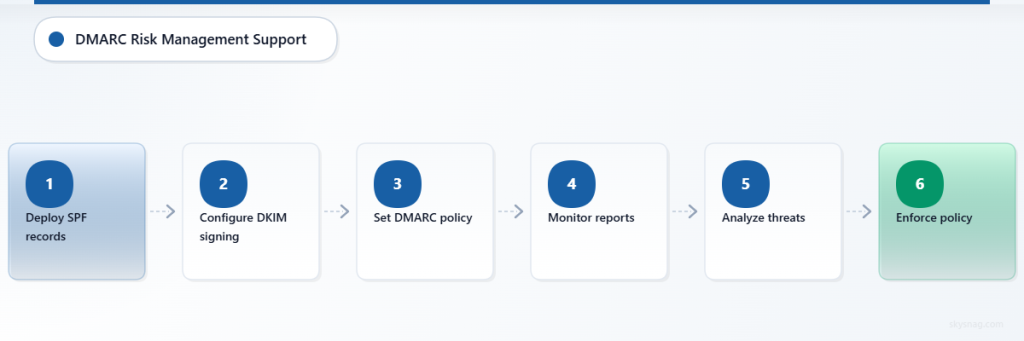
DMARC (Domain-based Message Authentication, Reporting and Conformance) implementation supports several key objectives outlined in NIS2 Article 21, though organizations must evaluate their specific risk profile and compliance requirements.
Risk Management and System Integrity
DMARC enforcement helps organizations address NIS2’s risk management requirements by:
Reducing unauthorized email use: DMARC at enforcement policy (quarantine or reject) prevents unauthorized parties from successfully sending emails that appear to originate from the organization’s domain, supporting the directive’s emphasis on protecting against unauthorized access.
Providing visibility into email threats: DMARC aggregate and forensic reports offer detailed insights into email authentication attempts, failed authentications, and potential spoofing activities, supporting the risk analysis requirements under Article 21.
Establishing baseline security controls: Email authentication represents a fundamental security control that supports the directive’s requirement for appropriate technical measures proportionate to identified risks.
Incident Detection and Response
DMARC reporting capabilities support NIS2’s incident handling requirements by:
Early threat detection: Regular analysis of DMARC reports can identify spoofing attempts, unauthorized sending sources, and authentication failures that may indicate broader security incidents.
Forensic evidence collection: DMARC forensic reports provide detailed evidence of authentication failures and potential abuse, supporting incident investigation and response procedures required under the directive.
Trend analysis: Long-term DMARC reporting data enables organizations to identify patterns and trends in email-based threats, supporting proactive risk management approaches.
Supply Chain and Third-Party Risk Management
NIS2 Article 21 emphasizes supply chain security, and DMARC implementation supports these objectives by:
Third-party sender validation: DMARC policies help organizations control which third-party services can send emails on their behalf, supporting supply chain security requirements.
Vendor security monitoring: DMARC reports reveal authentication issues with legitimate third-party senders, enabling organizations to work with vendors to address configuration problems that could create security vulnerabilities.
Service provider oversight: Organizations can monitor how managed email services and other providers handle their domain’s email authentication, supporting the directive’s supply chain risk management requirements.
III. NIS2 DMARC Implementation Framework
Organizations subject to NIS2 should approach DMARC implementation as part of their broader cybersecurity risk management program, aligning email authentication controls with Article 21’s risk-based requirements.
Phase 1: Risk Assessment and Planning
Before implementing DMARC, conduct a comprehensive assessment of your organization’s email infrastructure and threat landscape:
Email infrastructure mapping: Document all legitimate email sending sources, including internal mail servers, third-party services, and partner integrations that send emails using your domain.
Threat landscape analysis: Evaluate your organization’s exposure to email-based attacks, considering factors such as industry targeting patterns, previous incidents, and regulatory requirements beyond NIS2.
Impact assessment: Analyze the potential business impact of DMARC enforcement failures, including blocked legitimate emails and operational disruptions during the implementation process.
Resource requirements: Determine the technical expertise, tools, and ongoing resources needed for DMARC implementation and maintenance.
Phase 2: Foundation Setup
Establish the technical foundation for DMARC implementation:
SPF record optimization: Ensure Sender Policy Framework (SPF) records accurately reflect all legitimate sending sources and follow best practices, including the use of include mechanisms for third-party services and appropriate fail mechanisms.
DKIM implementation: Deploy DomainKeys Identified Mail (DKIM) signatures for all legitimate sending sources, using appropriate key lengths and rotation procedures that align with your organization’s cryptographic standards.
Subdomain strategy: Develop a comprehensive approach to subdomain email authentication, considering both operational requirements and security objectives.
Monitoring infrastructure: Implement systems for collecting, parsing, and analyzing DMARC reports, ensuring alignment with NIS2’s incident detection and response requirements.
Phase 3: DMARC Policy Deployment
Deploy DMARC policies using a risk-based approach that aligns with NIS2 principles:
Initial monitoring phase: Begin with a DMARC policy set to “none” (p=none) to collect baseline data on email authentication without impacting mail flow.
Gradual enforcement: Progress through quarantine (p=quarantine) and reject (p=reject) policies based on risk assessment results and operational confidence levels.
Percentage-based rollout: Use DMARC percentage tags to gradually increase enforcement coverage, allowing for careful monitoring and adjustment.
Subdomain considerations: Implement appropriate policies for subdomains, considering operational requirements and security objectives specific to different business functions.
IV. Operational Integration with NIS2 Requirements
Successful DMARC implementation requires integration with broader NIS2 compliance processes and procedures.
Incident Response Integration
DMARC monitoring should integrate with your organization’s incident response procedures required under NIS2 Article 21:
Alert thresholds: Establish specific thresholds for DMARC authentication failures that trigger incident response procedures, considering both volume and pattern-based indicators.
Escalation procedures: Define clear escalation paths for DMARC-related security events, ensuring appropriate notification to internal teams and, where required, relevant authorities under NIS2 reporting obligations.
Documentation requirements: Maintain detailed records of DMARC-related incidents and responses, supporting NIS2’s emphasis on comprehensive incident handling procedures.
Coordination with other controls: Ensure DMARC incident response procedures coordinate effectively with other security controls and monitoring systems deployed to meet NIS2 requirements.
Continuous Monitoring and Improvement
NIS2’s risk-based approach requires ongoing assessment and improvement of cybersecurity measures:
Regular policy reviews: Conduct periodic reviews of DMARC policies and configurations, ensuring they remain aligned with business requirements and threat landscape changes.
Performance metrics: Establish key performance indicators for email authentication effectiveness, including authentication rates, policy compliance levels, and incident detection capabilities.
Threat intelligence integration: Incorporate relevant threat intelligence into DMARC monitoring and analysis, supporting the proactive risk management approach emphasized in Article 21.
Control effectiveness assessment: Regularly evaluate DMARC’s contribution to overall cybersecurity risk management, considering both technical effectiveness and business impact.
Documentation and Reporting
NIS2 compliance requires comprehensive documentation of cybersecurity risk management measures:
Policy documentation: Maintain detailed documentation of DMARC policies, implementation decisions, and risk assessments supporting those decisions.
Operational procedures: Document standard operating procedures for DMARC monitoring, incident response, and policy management activities.
Regular reporting: Include DMARC implementation status and effectiveness metrics in regular cybersecurity risk management reports to senior management and relevant oversight bodies.
Audit preparation: Ensure DMARC documentation and evidence collection supports potential NIS2 compliance assessments and audits.
V. Implementation Checklist for NIS2 Organizations
Use the checklist below as a practical starting point for implementing DMARC as part of your NIS2 Article 21 compliance program. The exact requirements will depend on your organization’s specific risk profile, technical infrastructure, and operational requirements.
- [ ] Complete comprehensive email infrastructure inventory identifying all legitimate sending sources.
- [ ] Conduct risk assessment evaluating email-based threats and potential business impact of authentication failures.
- [ ] Implement and optimize SPF records for all domains used for email communication.
- [ ] Deploy DKIM signatures across all legitimate email sending sources with appropriate key management procedures.
- [ ] Establish DMARC monitoring infrastructure capable of processing and analyzing aggregate and forensic reports.
- [ ] Deploy initial DMARC policy at monitoring level (p=none) to collect baseline authentication data.
- [ ] Integrate DMARC monitoring with existing incident response procedures and escalation protocols.
- [ ] Develop documented procedures for DMARC policy management, incident response, and ongoing maintenance.
- [ ] Progress through quarantine and reject enforcement policies based on risk assessment and operational readiness.
- [ ] Establish regular review cycles for DMARC policy effectiveness and alignment with evolving business requirements.
- [ ] Document DMARC implementation decisions and maintain evidence supporting NIS2 compliance objectives.
- [ ] Train relevant personnel on DMARC monitoring, incident response, and policy management procedures.
VI. Leveraging Skysnag Protect for NIS2 Compliance
Skysnag Protect provides comprehensive email authentication management capabilities designed to support organizations subject to regulatory requirements like NIS2. The platform’s automated monitoring, policy management, and detailed reporting capabilities help organizations implement and maintain DMARC controls as part of their broader cybersecurity risk management framework.
Skysnag’s approach to email authentication aligns with NIS2’s risk-based methodology, providing organizations with the visibility and control needed to address email security risks while maintaining operational efficiency. The platform’s integration capabilities support the comprehensive monitoring and incident response procedures required under Article 21.
VII. Key Takeaways
NIS2 Article 21 establishes comprehensive cybersecurity risk management requirements that encompass email security controls, making DMARC implementation a valuable component of compliance-focused organizations’ security frameworks. While the directive doesn’t explicitly mandate specific email authentication protocols, DMARC enforcement supports key Article 21 objectives including risk management, incident detection, and supply chain security.
Successful implementation requires a risk-based approach that aligns email authentication controls with broader NIS2 compliance procedures. Organizations should focus on comprehensive planning, gradual deployment, and integration with existing cybersecurity risk management processes.
The evolving threat landscape and regulatory environment make email authentication controls increasingly important for organizations subject to NIS2. By implementing DMARC as part of a comprehensive cybersecurity program, organizations can address multiple compliance objectives while strengthening their overall security posture.
Ready to strengthen your email security posture in support of NIS2 compliance objectives? Explore Skysnag Protect to discover how automated DMARC management can support your organization’s cybersecurity risk management requirements.