When European organizations implement DMARC to protect their email domains, the choice of DMARC provider is not only a technical decision.
It can also become a data governance, vendor risk, and international transfer decision.

DMARC reports can reveal more than authentication status. They may show which systems send email on behalf of a domain, which vendors are involved, where authentication fails, which IP addresses are active, how mail flows across regions, and where unauthorized sending attempts may be occurring.
For EU organizations, that information may be relevant under GDPR, contractual data protection obligations, sector-specific rules, and internal data residency policies.
The U.S. CLOUD Act adds another layer to this assessment.
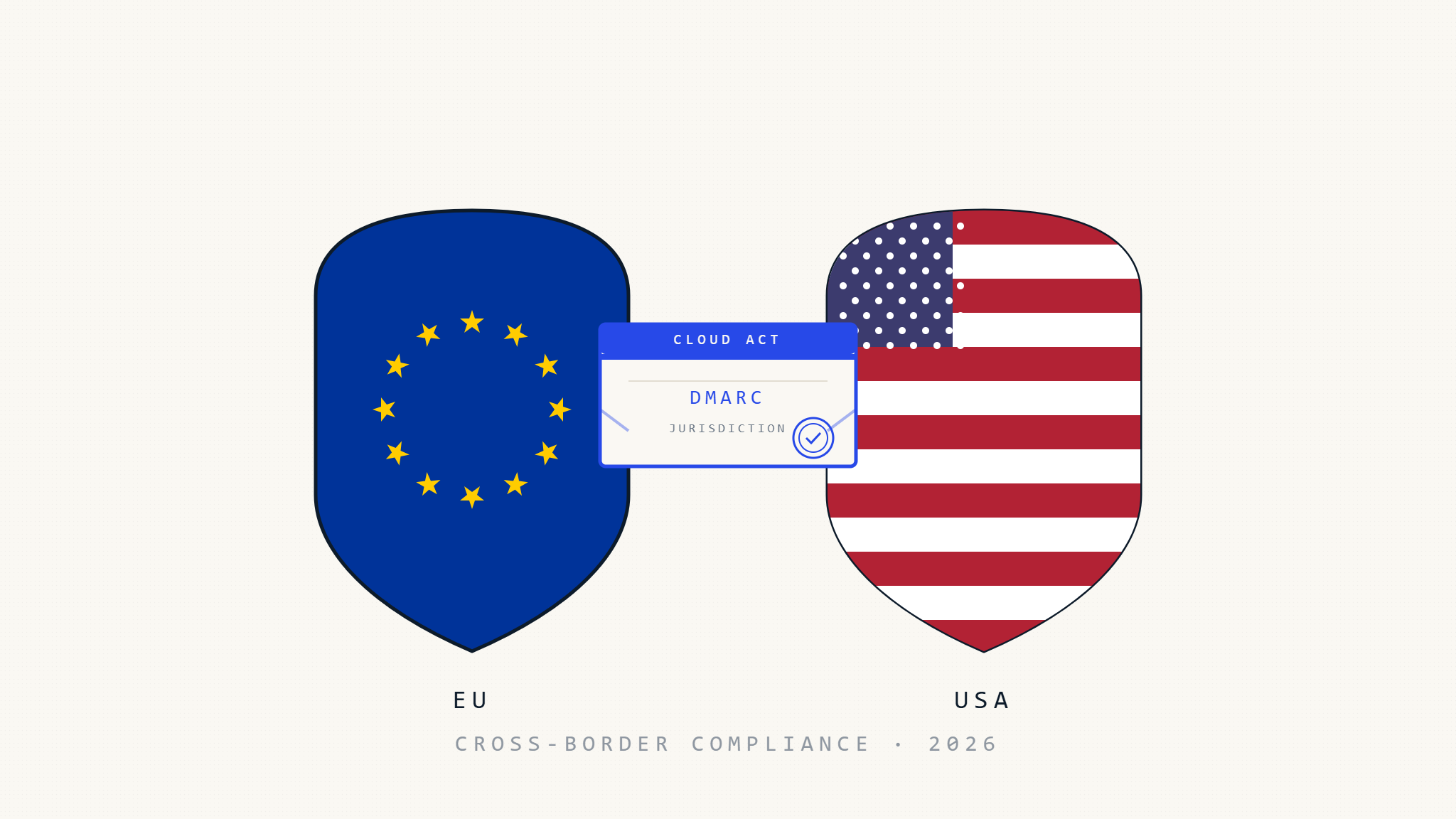
The CLOUD Act can require covered U.S. service providers to preserve, back up, or disclose certain data within their possession, custody, or control, even when the data is stored outside the United States. For EU organizations using U.S.-based or U.S.-controlled technology providers, this can create legal and jurisdictional questions that should be assessed before routing security telemetry to a third-party platform.
This does not mean EU companies cannot use U.S.-based providers.
It does mean they should understand what data is being processed, where it is stored, which legal transfer mechanism applies, what safeguards are in place, and how government access requests are handled.
DMARC protection and data protection should not be treated as separate conversations.
They are both part of the same trust architecture.
Disclaimer: This article provides general information and should not be considered legal advice. Organizations should consult qualified legal counsel for specific compliance requirements, transfer assessments, and regulatory obligations.
I. What the CLOUD Act Means in This Context
The U.S. CLOUD Act, enacted in 2018, clarified that certain U.S. service providers may be required to disclose data within their possession, custody, or control, regardless of whether that data is stored inside or outside the United States.
For DMARC services, the relevant question is not only whether the provider stores data in Europe.
The deeper question is:
Who controls the service, who can access the data, and which legal regimes may apply to the provider?
This matters because DMARC providers may process operational security telemetry that is useful for both defenders and attackers.
Depending on the implementation, a DMARC provider may process:
- DMARC aggregate reports
- DMARC failure or forensic reports, if enabled
- Sending IP addresses
- Authentication results
- SPF, DKIM, and DMARC alignment data
- Mail volume patterns
- Third-party sender information
- Domain configurations
- User account and administrator data
- Security analytics derived from reports
- Historical enforcement and policy data
This information may not always contain message content, especially in aggregate reports. But it can still reveal sensitive operational details about an organization’s email infrastructure.
That is why provider selection should be assessed through both a security and privacy lens.
II. Why DMARC Report Data Can Be Sensitive
DMARC reports are often described as technical logs.
That description is incomplete.
DMARC data can reveal how an organization sends email, which platforms are authorized, which vendors are misconfigured, which domains are not fully protected, and where spoofing attempts are occurring.
For example, DMARC aggregate data may show:
- Which IP addresses are sending on behalf of the domain
- Which providers are used for transactional email
- Which marketing platforms are active
- Which internal systems send mail
- Which sources fail SPF or DKIM alignment
- Which third parties are not properly configured
- Which subdomains are exposed
- Which receiving providers are seeing authentication failures
This information is valuable to security teams.
It can also be valuable to attackers.
A mature DMARC program should therefore avoid treating report data as harmless metadata. It should be governed as security telemetry.
III. GDPR and International Data Transfers
For EU organizations, GDPR becomes relevant when personal data is processed or transferred outside the European Economic Area.
GDPR Chapter V restricts transfers of personal data to third countries unless a valid transfer mechanism applies. These mechanisms may include an adequacy decision, Standard Contractual Clauses with any necessary supplementary measures, Binding Corporate Rules, or another permitted mechanism under GDPR.
The Schrems II decision increased scrutiny around transfers to providers subject to third-country surveillance or lawful access regimes. Since then, organizations have been expected to assess not only the contract, but also the legal environment and practical safeguards surrounding the transfer.
The EU-U.S. Data Privacy Framework, adopted in 2023, provides an adequacy mechanism for certified U.S. organizations. However, organizations still need to confirm whether a provider is certified, whether the relevant processing is covered, and whether additional contractual or technical safeguards are needed for their specific use case.
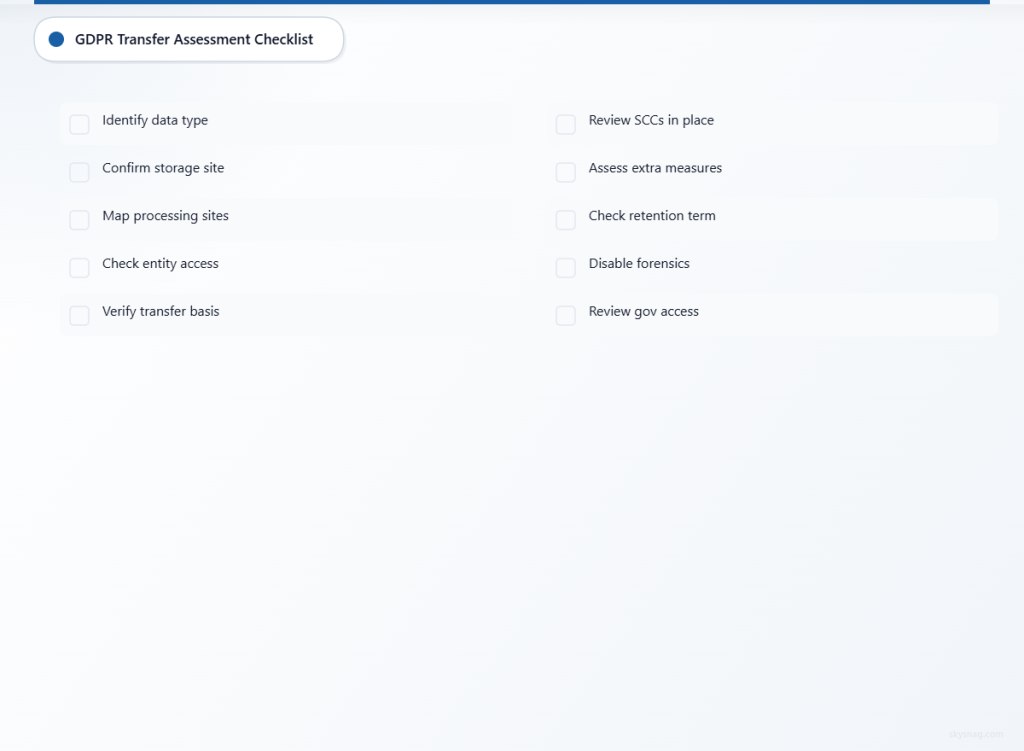
For DMARC provider selection, the practical assessment should include:
- Is DMARC report data personal data, security telemetry, or both?
- Where is the data stored?
- Where is the data processed?
- Which entities can access it?
- Is the provider EU-based, U.S.-based, or part of a wider corporate group?
- Is an international transfer taking place?
- Which transfer mechanism applies?
- Are Standard Contractual Clauses or another mechanism in place?
- Are supplementary measures needed?
- What retention period applies?
- Are forensic reports disabled by default?
- How does the provider handle government access requests?
This assessment should be documented, especially for regulated organizations or companies with strict data residency obligations.
IV. The CLOUD Act Does Not Automatically Mean Non-Compliance
It is important to avoid oversimplifying the issue.
Using a U.S.-based provider does not automatically mean GDPR non-compliance.
Using an EU data center does not automatically eliminate all jurisdictional risk.
The compliance question depends on the full context:
- Provider legal structure
- Data processing location
- Data access controls
- Encryption model
- Contractual safeguards
- Transfer mechanism
- Government access policy
- Transparency reporting
- Data minimization practices
- Retention limits
- Customer control over data
- Whether support or engineering access occurs outside the EU
A serious assessment looks at the complete operating model, not just the country where the server is hosted.
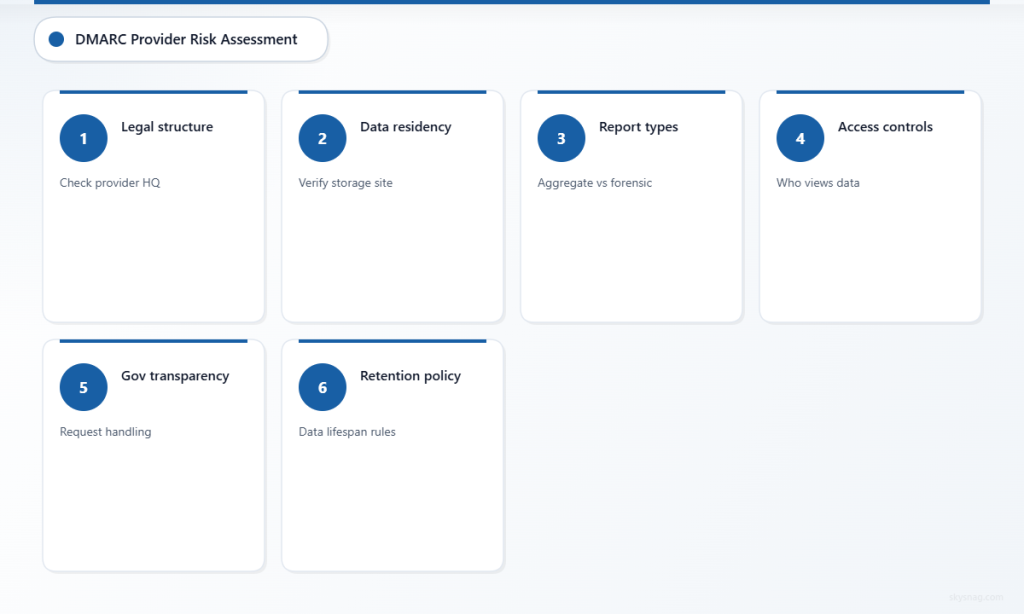
V. DMARC Provider Risk Areas EU Companies Should Review
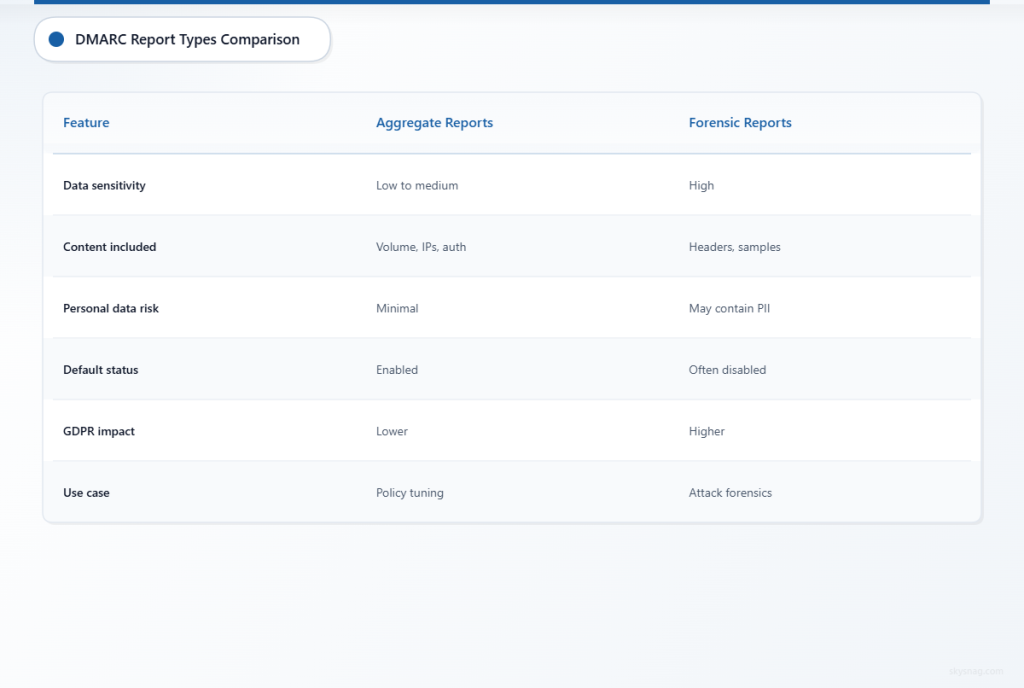
When selecting or reviewing a DMARC provider, EU organizations should assess several areas.
VI. 1. Legal Structure
Understand who the contracting entity is.
An EU-based vendor, a U.S.-based vendor, and an EU subsidiary of a U.S. group can present different legal and operational considerations.
Questions to ask:
- Which legal entity provides the service?
- Which entity signs the Data Processing Agreement?
- Which entities have access to customer data?
- Are support, engineering, or security operations performed outside the EU?
- Is the provider subject to U.S. lawful access rules?
- Are subprocessors involved?
The answer should be documented in vendor risk review.
VII. 2. Data Residency and Processing Location
Data residency is important, but it should be understood precisely.
A provider may store data in the EU while support or analytics access occurs elsewhere. Another provider may process reports outside the EU while offering EU billing or EU contracting.
Questions to ask:
- Where are DMARC reports stored?
- Where are reports parsed and analyzed?
- Where are backups kept?
- Where are logs stored?
- Can administrators restrict data processing to the EU?
- Does the provider use non-EU subprocessors?
- Does support access require cross-border access?
The goal is to understand the actual data path, not just the marketing claim.
VIII. 3. DMARC Report Types
Not all DMARC data has the same sensitivity.
Aggregate reports are generally less invasive than forensic or failure reports. Aggregate reports usually contain authentication results and sending-source information. Failure reports may contain message-level data depending on receiver implementation.
For EU organizations, the safest default is:
- Use aggregate reporting through
rua=for monitoring. - Avoid forensic reporting through
ruf=unless privacy, legal, and security teams approve it. - Apply data minimization and retention limits.
- Avoid collecting more than needed for authentication and enforcement.
Failure reporting has limited adoption among major receivers and can create additional privacy and retention obligations. It should not be enabled casually.
IX. 4. Access Controls
DMARC platforms can expose sensitive telemetry to internal users.
Organizations should review:
- Role-based access controls
- Administrator permissions
- MFA requirements
- Audit logs
- API access controls
- Session controls
- Export permissions
- Support access procedures
- Separation between customers
Security telemetry should not be broadly accessible without governance.
X. 5. Government Access and Transparency
EU organizations should understand how the provider handles lawful access requests.
Questions to ask:
- Does the provider publish transparency reports?
- Does the provider notify customers when legally permitted?
- Does the provider challenge overbroad or unlawful requests?
- Does the provider disclose subprocessors?
- Does the provider explain how it handles requests affecting EU customer data?
- Are contractual notification obligations included?
This does not eliminate all risk, but it improves transparency and accountability.
XI. 6. Retention and Deletion
The longer DMARC telemetry is retained, the larger the exposure surface becomes.
Organizations should confirm:
- Default retention period
- Customer-configurable retention
- Backup deletion timelines
- Export and deletion rights
- Log retention policies
- Account termination deletion process
Retention should match operational need.
For many organizations, indefinite storage of raw DMARC telemetry is unnecessary.
XII. DPIA and Transfer Impact Assessment
EU organizations should consider whether a Data Protection Impact Assessment or Transfer Impact Assessment is appropriate when implementing a DMARC provider.
This is especially relevant if:
- DMARC data is routed to a third-country provider.
- The organization operates in a regulated sector.
- The provider processes data outside the EEA.
- Failure reports are enabled.
- The domain is used for sensitive communications.
- The provider has access to detailed operational security telemetry.
- Customer or employee communication patterns may be inferred.
A practical assessment should cover:
- What data is collected
- Why the data is necessary
- Whether the data includes personal data
- Which transfer mechanism applies
- Which safeguards are in place
- Which subprocessors are involved
- How long data is retained
- Who can access the data
- How government access requests are handled
- Whether less intrusive alternatives are available
The purpose is not to create paperwork for its own sake.
The purpose is to make the data flow defensible.
XIII. Technical Safeguards That Reduce Risk
Legal safeguards matter, but technical safeguards are equally important.
EU organizations should look for DMARC providers that support:
- EU data residency options
- Data minimization
- Encryption in transit and at rest
- Strong access controls
- MFA enforcement
- Audit logging
- Customer-controlled retention
- Limited support access
- Subprocessor transparency
- Secure report ingestion
- Separation between tenants
- Clear deletion procedures
- API security controls
These safeguards reduce exposure and improve defensibility.
No single safeguard solves the CLOUD Act or GDPR transfer question by itself. The strength comes from the combination of contractual, technical, organizational, and governance controls.
XIV. Operational Governance for DMARC Data
DMARC should not be treated as a one-time DNS project.
It should be part of an ongoing governance program.
Organizations should maintain:
- Domain inventory
- Sender inventory
- DMARC reporting destination records
- Provider risk assessments
- Data Processing Agreements
- Transfer assessments where applicable
- Subprocessor reviews
- Retention decisions
- Access control reviews
- Incident response procedures
- Change management records
- Evidence of monitoring and remediation
This documentation helps prove that DMARC data is actively managed, not simply outsourced.
XV. Questions to Ask a DMARC Provider
Before choosing or renewing a DMARC provider, EU organizations should ask:
- Which legal entity provides the service?
- Where is DMARC report data stored?
- Where is DMARC report data processed?
- Which subprocessors are used?
- Can processing be restricted to the EU?
- Is customer data accessed by support or engineering teams outside the EU?
- What transfer mechanism applies if data leaves the EEA?
- Are Standard Contractual Clauses available where needed?
- Is the provider certified under the EU-U.S. Data Privacy Framework, if applicable?
- Are forensic reports disabled by default?
- What is the default data retention period?
- Can retention be shortened?
- What access controls are available?
- Are audit logs available?
- Does the provider publish transparency reports?
- Does the provider notify customers of government access requests where legally permitted?
- How is data deleted after termination?
- Can customers export their data?
- How are backups handled?
- Does the provider support EU-focused deployment requirements?
These questions help turn a vague data residency discussion into a practical vendor assessment.
XVI. Check Whether Your DMARC Provider Is EU or Non-EU
Many EU companies do not know where their DMARC reports are being sent.
A domain may have DMARC enabled, but the reporting destination may point to a non-EU provider, an old vendor, an unmanaged mailbox, or a third-party processor that has never been reviewed by legal, security, or compliance teams.
This matters because many DMARC providers are not EU-based.
For EU organizations, the location and legal structure of the DMARC provider should be part of the vendor risk review.
DMARC reports can reveal:
- Authorized senders
- Mail flows
- Authentication failures
- Third-party vendors
- Domain protection gaps
- Unauthorized sending attempts
That data should not be routed blindly.
Use Skysnag’s scanner to check whether your DMARC reporting destination points to an EU or non-EU provider:
The scanner helps identify your current DMARC record and reporting destination so your team can review whether your provider matches your GDPR, data residency, and internal compliance expectations.
A public scan cannot replace a full legal or transfer assessment. But it can quickly show whether your DMARC setup deserves deeper review.
XVII. How Skysnag Protect Helps
Skysnag Protect helps organizations implement DMARC while maintaining visibility and control over email authentication data.
For EU organizations, Skysnag Protect can support DMARC implementation with compliance-focused controls such as:
- DMARC monitoring
- Sender identification
- Unauthorized source detection
- SPF and DKIM alignment visibility
- Enforcement readiness tracking
- MTA-STS and TLS-RPT support
- Reporting for security and compliance teams
- Data governance support for DMARC telemetry
- European data residency options, where required
The objective is not only to publish a DMARC record.
The objective is to build a controlled email authentication program that supports security, privacy, and compliance expectations.
Organizations can learn more about Skysnag Protect here:
XVIII. Key Takeaways
The U.S. CLOUD Act is not a DMARC law, and it does not create specific DMARC requirements.
However, it can be relevant when EU organizations use U.S.-based or U.S.-controlled technology providers to process DMARC report data.
DMARC reports can reveal sensitive operational security telemetry, including senders, vendors, authentication failures, mail flows, and domain protection gaps.
EU organizations should assess DMARC providers through a GDPR, vendor risk, transfer, and data governance lens.
Important review areas include:
- Legal structure
- Data residency
- Processing location
- Subprocessors
- Transfer mechanisms
- Access controls
- Retention
- Forensic reporting
- Government access policies
Aggregate DMARC reporting should usually be the default. Forensic reporting should only be enabled after legal, privacy, and security review.
Using a U.S.-based provider does not automatically mean non-compliance, and using an EU data center does not automatically eliminate all risk. The full operating model matters.
A mature DMARC program should protect the domain while also controlling the data created by that protection.
For EU organizations, the right question is not only:
“Do we have DMARC?”
The stronger question is:
“Do we know where our DMARC data goes, who can access it, and whether that processing is defensible under our legal and compliance obligations?”
If you are an EU company, start by checking where your DMARC reports are going. Use Skysnag’s scanner to see whether your current DMARC provider appears to be EU or non-EU: