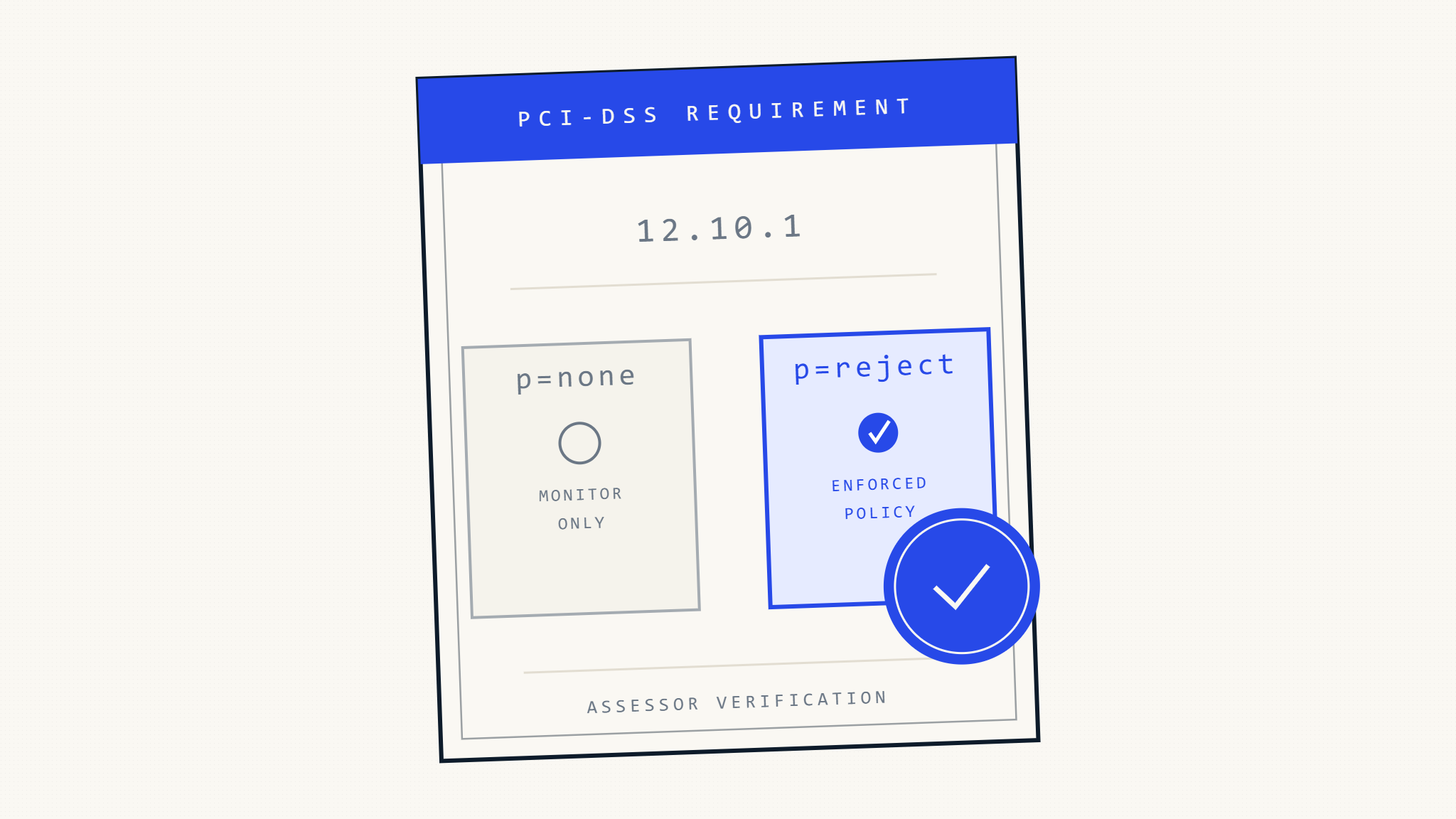
DMARC p=reject and p=none policies represent fundamentally different security postures when it comes to email authentication, and understanding this distinction is crucial for organizations undergoing PCI-DSS assessments. While PCI-DSS doesn’t explicitly mandate specific DMARC policy settings, assessors increasingly examine email authentication controls as part of comprehensive security evaluations.
The confusion around DMARC policy requirements in PCI-DSS contexts stems from the standard’s risk-based approach to security controls. Rather than prescribing specific technologies, PCI-DSS emphasizes protecting cardholder data through layered security measures, which can include email authentication protocols like DMARC.
I. Understanding DMARC Policy Levels
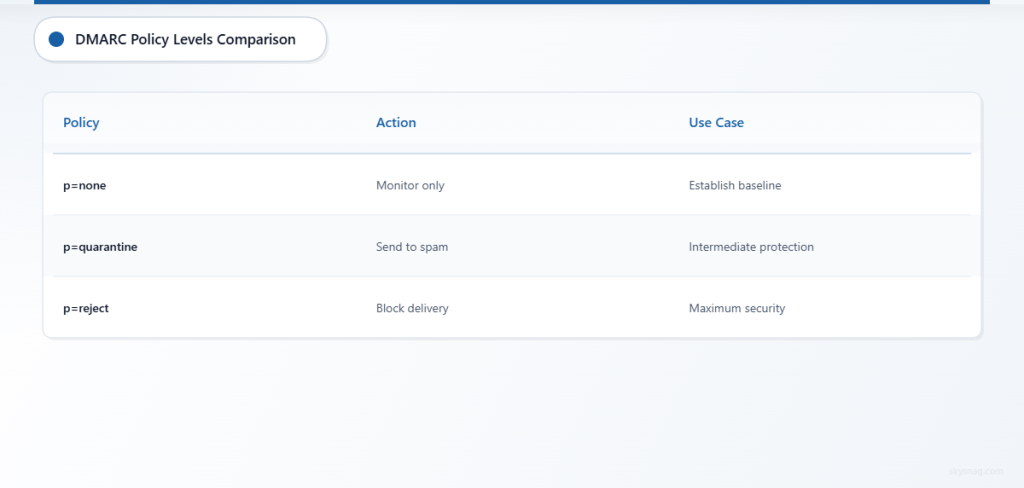
DMARC policies operate on three distinct levels, each providing different degrees of email security protection:
DMARC p=none serves as a monitoring-only policy that collects authentication data without taking action on failed messages. Organizations implementing p=none receive detailed reports about email authentication attempts but don’t block potentially fraudulent messages. This policy level helps establish baseline authentication patterns and identify legitimate sending sources before implementing stricter controls.
DMARC p=quarantine represents an intermediate security stance, directing receiving email servers to treat authentication failures with suspicion. Messages failing DMARC alignment checks typically land in spam folders rather than inboxes, reducing the likelihood of successful phishing attempts while maintaining message delivery for review.
DMARC p=reject provides the strongest protection by instructing receiving servers to completely block messages that fail authentication checks. This policy eliminates the possibility of fraudulent messages reaching end users but requires careful implementation to avoid blocking legitimate communications.
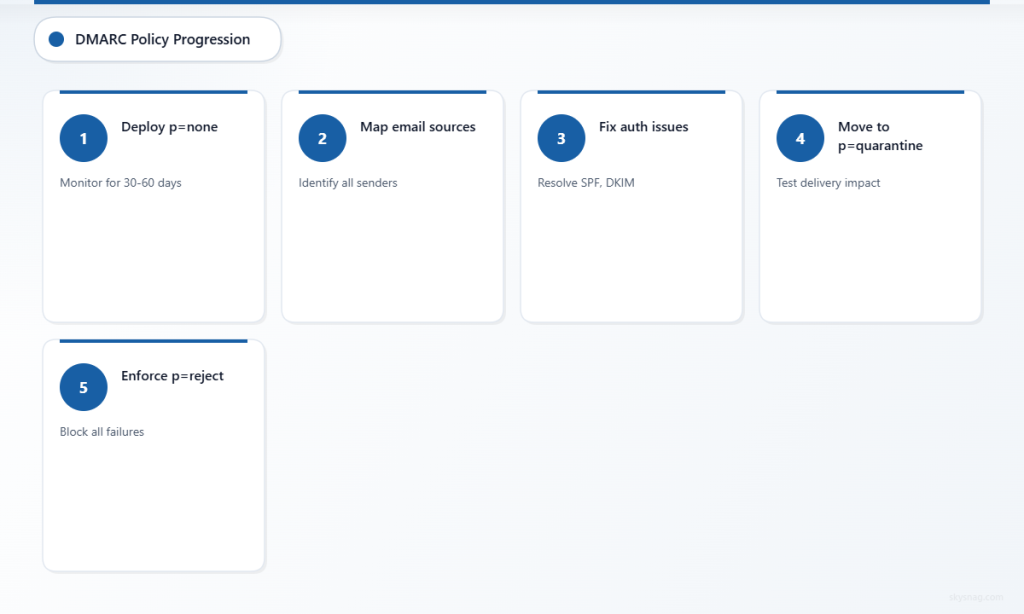
The progression from p=none to p=reject typically follows a phased approach, allowing organizations to identify and resolve authentication issues before implementing the most restrictive policy.
II. How PCI-DSS Addresses Email Security
PCI-DSS approaches email security through several interconnected requirements rather than mandating specific protocols. The standard emphasizes protecting against social engineering attacks and maintaining secure communication channels for cardholder data environments.
Requirement 2.3 addresses securing system parameters and emphasizes implementing security measures that prevent unauthorized access. Email authentication controls support this objective by reducing the likelihood of successful phishing attacks that could compromise system credentials.
Requirement 8 focuses on user identification and authentication, establishing the principle that access to system components requires proper verification. While not directly referencing email protocols, this requirement creates the foundation for implementing comprehensive authentication measures across all communication channels.
The connection between DMARC policies and PCI-DSS compliance becomes clearer when considering the standard’s emphasis on preventing unauthorized access to cardholder data environments. Phishing attacks frequently serve as initial attack vectors in payment card breaches, making email authentication a relevant security control.
III. What Assessors Actually Evaluate
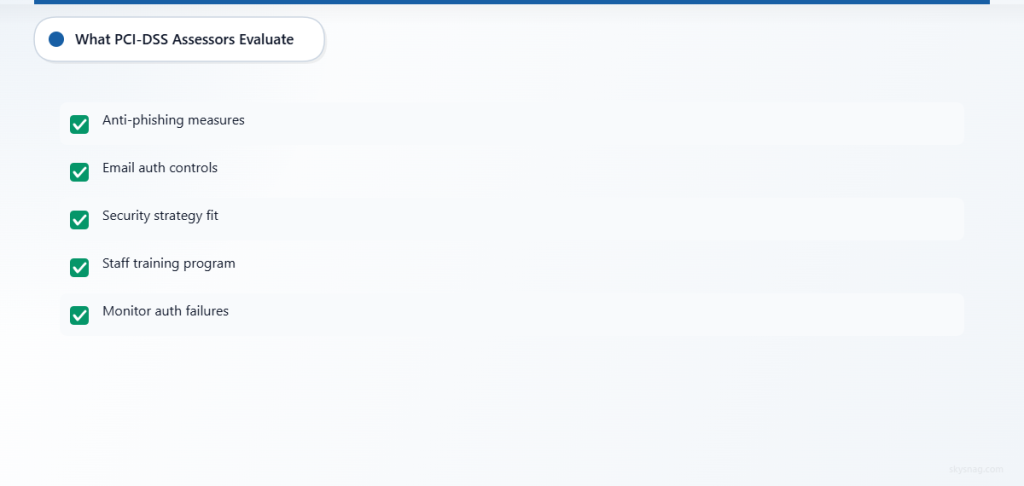
PCI-DSS assessors examine email security measures as part of their broader evaluation of an organization’s security posture. Rather than checking for specific DMARC policy settings, assessors focus on whether implemented controls effectively protect against threats that could compromise cardholder data.
During assessments, qualified security assessors (QSAs) typically evaluate:
- Whether organizations have implemented appropriate measures to prevent social engineering attacks
- How effectively email security controls protect against phishing attempts targeting employees with access to cardholder data
- Whether implemented authentication mechanisms align with the organization’s overall security strategy
- The completeness of security awareness training programs that address email-based threats
Assessors often ask organizations to demonstrate their email security controls and explain how these measures contribute to protecting cardholder data environments. Organizations with DMARC p=reject policies can more easily demonstrate proactive protection against email-based attacks compared to those using monitoring-only policies.
The assessment process typically includes reviewing email security documentation, examining implementation procedures, and validating that controls function as intended. Assessors may also evaluate whether organizations monitor and respond appropriately to authentication failures.
IV. Implementation Considerations for PCI-DSS Organizations
Organizations subject to PCI-DSS should approach DMARC implementation strategically, considering both security objectives and operational requirements. The choice between p=reject and p=none involves balancing protection levels against potential business disruption.
Planning Phase Considerations:
Start with comprehensive email flow mapping to identify all legitimate sending sources. Organizations often discover previously unknown email services, marketing platforms, or third-party applications that send messages on their behalf. Missing any legitimate source during DMARC implementation can result in blocked communications when moving to p=reject.
Establish baseline authentication metrics using p=none monitoring for at least 30-60 days before advancing to stricter policies. This monitoring period reveals authentication patterns and helps identify configuration issues that could cause problems with enforcement policies.
Technical Implementation Requirements:
Ensure proper SPF record configuration covering all authorized sending sources. SPF records form the foundation of DMARC authentication and must accurately reflect actual sending infrastructure. Organizations commonly underestimate the complexity of maintaining comprehensive SPF records as email infrastructure evolves.
Configure DKIM signing for all outbound email streams. While SPF provides IP-based authentication, DKIM offers cryptographic verification that remains valid even when messages pass through forwarding services or mailing lists.
Operational Readiness Factors:
Establish monitoring and incident response procedures for DMARC failures. Organizations implementing p=reject policies need mechanisms to quickly identify and resolve legitimate email authentication issues to prevent business disruption.
Create communication plans for stakeholders who might be affected by email authentication changes. Marketing teams, customer service departments, and external partners may need advance notice of policy changes that could affect their communications.
V. Risk Assessment Framework
PCI-DSS assessments evaluate risk management processes, making it important for organizations to document their DMARC policy decisions within their broader risk assessment framework.
Organizations should document their email threat assessment, including analysis of phishing risks specific to their environment. This documentation helps demonstrate to assessors that DMARC policy choices align with identified risks and organizational security objectives.
Risk assessments should address the potential business impact of implementing p=reject policies, including scenarios where legitimate emails might be blocked. Organizations can strengthen their compliance posture by demonstrating they’ve considered these risks and implemented appropriate mitigation measures.
The assessment should also evaluate the effectiveness of existing email security measures and identify gaps that DMARC policies might address. This analysis helps justify specific policy choices and demonstrates a systematic approach to email security.
VI. Monitoring and Reporting Best Practices
Effective DMARC implementation requires ongoing monitoring regardless of policy level. Organizations should establish regular reporting procedures that provide visibility into authentication patterns and potential security incidents.
DMARC aggregate reports provide valuable data about email authentication attempts, including information about legitimate and fraudulent sending sources. Organizations should analyze these reports regularly to identify trends, authentication failures, and potential security threats.
Forensic reports offer detailed information about specific authentication failures, helping organizations investigate potential phishing attempts or configuration issues. However, forensic reporting requires careful privacy consideration, as these reports can contain sensitive email content.

Skysnag Protect simplifies DMARC monitoring by automatically analyzing authentication reports and providing actionable insights about email security posture. The platform helps organizations maintain effective email authentication controls while reducing the administrative burden of manual report analysis.
VII. Documentation and Evidence Requirements
PCI-DSS assessments require comprehensive documentation of implemented security controls. Organizations should maintain detailed records of their email authentication implementation, including policy decisions, configuration changes, and monitoring activities.
Documentation should include:
- Email authentication policy decisions and justifications
- Implementation timelines and methodology
- Regular monitoring and review procedures
- Incident response procedures for authentication failures
- Training records for staff responsible for email security
This documentation helps assessors understand how email authentication controls contribute to the organization’s overall security strategy and compliance with PCI-DSS requirements.
Organizations should also maintain evidence of ongoing monitoring and maintenance activities, demonstrating that email authentication controls remain effective over time.
VIII. Key Takeaways
DMARC p=reject provides stronger protection against email-based attacks compared to p=none, but both policies can support PCI-DSS compliance objectives when implemented appropriately. The key factors for success include proper planning, comprehensive monitoring, and clear documentation of policy decisions within the organization’s risk management framework.
PCI-DSS assessors evaluate email security measures as part of their comprehensive review of organizational security controls. Organizations can strengthen their compliance posture by implementing DMARC policies that align with their risk assessment and by maintaining detailed documentation of their email authentication strategy.
Effective DMARC implementation requires ongoing attention to monitoring, incident response, and stakeholder communication. Organizations should view email authentication as part of their broader security strategy rather than a standalone compliance requirement.
Ready to strengthen your email authentication posture? Skysnag Protect provides comprehensive DMARC monitoring and management capabilities designed to support both security objectives and compliance requirements.