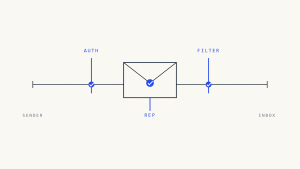
Traditional email security focuses on blocking threats—phishing, malware, spoofing. Brand-Verified Mark Indicators (BIMI) operate on a different principle: proving legitimacy before the user even opens the message. While conventional defenses filter what arrives in the inbox, BIMI establishes visual trust signals that recipients can see immediately, changing the calculus of email security from reactive filtering to proactive authentication.
The distinction matters because traditional email security operates invisibly. Users cannot see SPF checks, DKIM signatures, or spam filter scores. They make trust decisions based on visible cues—sender name, subject line, and in BIMI’s case, the brand logo displayed next to the message. This visual layer addresses a gap that technical controls alone cannot fill: teaching users to distinguish legitimate mail from sophisticated impersonation attempts.
I. What Traditional Email Security Accomplishes (and Where It Stops)
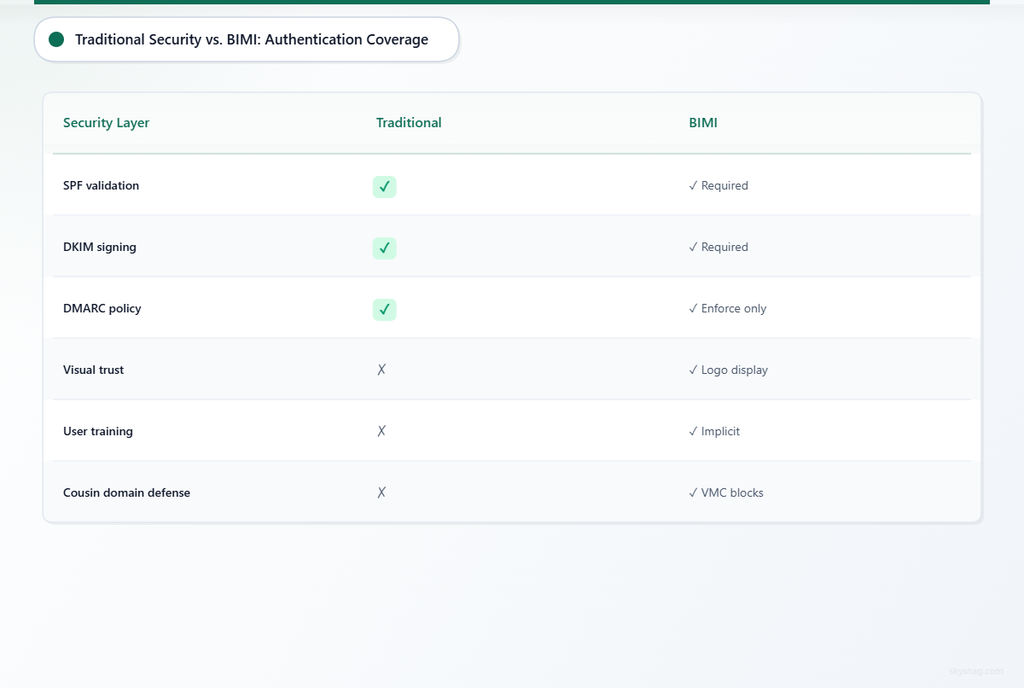
Traditional email security layers—SPF, DKIM, DMARC, spam filtering, malware scanning—authenticate messages at the server level. These protocols verify technical properties: the sending IP matches DNS authorization records, cryptographic signatures validate message integrity, reputation systems flag suspicious patterns.
What these controls achieve:
- SPF validation: Confirms the sending mail server is authorized to send from the domain
- DKIM signing: Cryptographically proves the message originated from the claimed domain and has not been tampered with
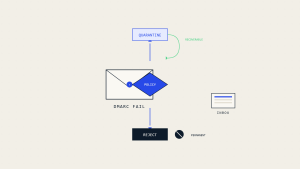
- DMARC enforcement: Ensures alignment between authenticated identifiers and visible sender fields, with policy-driven handling of failures
- Content filtering: Scans attachments and URLs for known malware signatures and phishing indicators
- Behavioral analysis: Identifies anomalies in sending patterns, volume spikes, or unusual recipient targeting
These mechanisms work well against untargeted attacks. Mass phishing campaigns using unregistered domains or compromised infrastructure typically fail authentication checks. Reputation-based filtering catches much of the remaining volume based on historical sender behavior patterns.
Where traditional security reaches its limit:
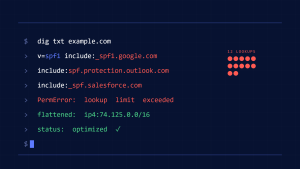
Traditional email authentication can fail silently in several critical scenarios. When a legitimate third-party service sends mail on behalf of a brand without proper SPF includes or DKIM signing delegation, authentication passes but alignment fails—DMARC registers a technical pass, but the visible “From” address does not match authenticated identifiers. Recipients see what appears to be a legitimate sender, while DMARC fails to enforce policy due to misalignment.
Sophisticated attackers exploit this gap through “cousin domain” attacks—registering domains visually similar to the target brand (gooogle.com instead of google.com). These messages pass all authentication checks because the attacker legitimately owns the sending domain. Technical controls see valid SPF, DKIM, and DMARC authentication. Users see a familiar-looking sender name and make split-second trust decisions without scrutinizing the actual domain.
The problem compounds when authentication passes but context fails. Marketing agencies, partner platforms, and SaaS providers routinely send mail “on behalf of” brands. Even with proper authentication, recipients cannot visually distinguish between an authorized partner sending a legitimate campaign and an attacker who has compromised that partner’s infrastructure. The authentication infrastructure works as designed, but provides no mechanism for recipients to verify visual legitimacy.
Traditional security also struggles with zero-day social engineering. When attackers use novel pretexts, unexpected sender combinations, or emerging manipulation tactics that reputation systems have not yet learned to recognize, content filtering provides limited protection. The message contains no malicious attachments, no known phishing URLs—just carefully crafted social engineering that exploits human trust rather than technical vulnerabilities.
II. How BIMI Extends Authentication Into the Visual Layer
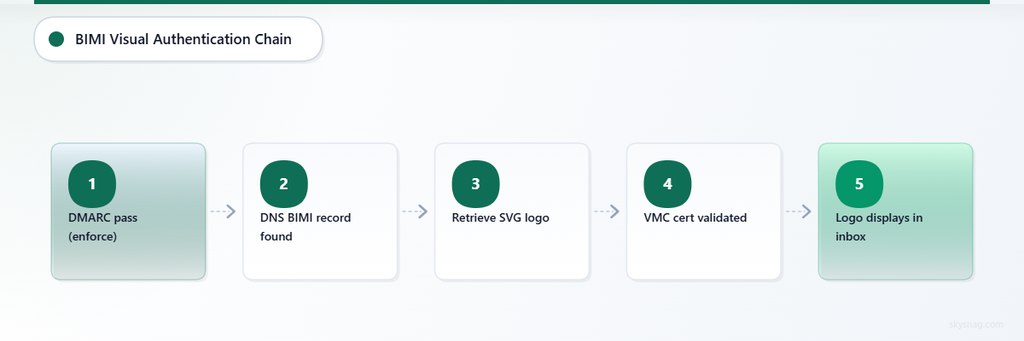
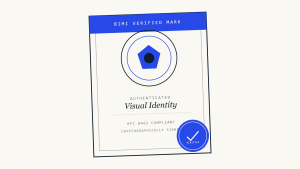
BIMI (Brand Indicators for Message Identification) adds a visual authentication component to the technical validation infrastructure. When all authentication checks pass—SPF, DKIM, and DMARC at enforcement policy—participating email clients display the brand’s verified logo next to the message in the inbox.
BIMI operates as a visual trust signal through a specific technical implementation:
The brand publishes a BIMI record in DNS pointing to a hosted SVG logo file. When mail arrives from that domain with DMARC enforcement policy (quarantine or reject), BIMI-compatible clients retrieve and display the logo if the domain meets verification requirements. For mailbox providers that require Verified Mark Certificates (VMCs), the brand must obtain a certificate from an authorized Certificate Authority that cryptographically binds the logo to domain ownership and trademark rights.
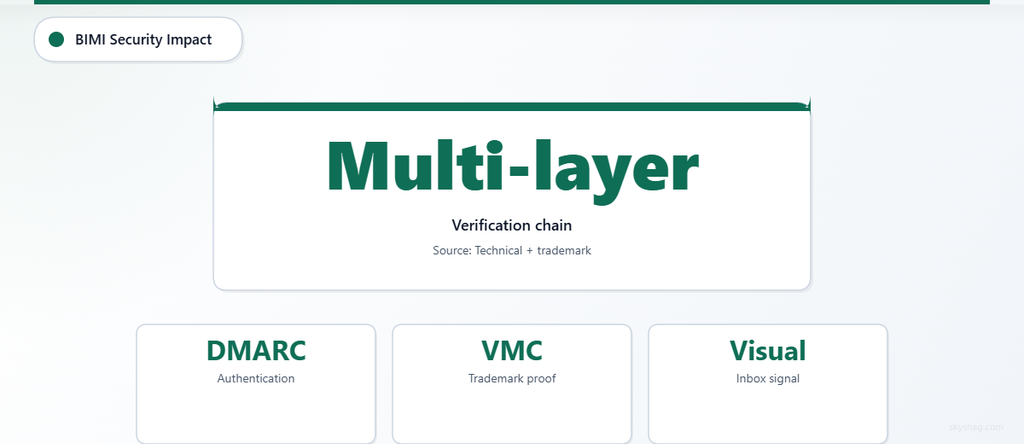
This creates a multi-layered verification chain: technical authentication (DMARC pass with alignment) → domain control validation (DNS record ownership) → trademark verification (VMC issuance by CA) → visual display (logo rendered in inbox).
BIMI benefits extend beyond simple logo display:
The primary security value lies in creating a visually distinguishable difference between authenticated and unauthenticated mail. When recipients consistently see the brand logo on legitimate mail, messages without the logo become immediately suspect. This trains users to look for the visual indicator rather than relying solely on sender name text, which attackers can easily spoof.
BIMI also raises the cost of attack for sophisticated threat actors. Registering a cousin domain (paypa1.com) and configuring SPF/DKIM authentication is straightforward. Obtaining a VMC for that domain requires proving trademark rights—a legal boundary most attackers will not cross because it generates prosecutable evidence of intent to defraud. The combination of technical and legal validation creates a meaningful barrier.
For organizations sending high volumes of mail, BIMI improves engagement metrics measurably. Multiple brands report 5-10% increases in email open rates after BIMI implementation, likely because the logo serves as both a trust signal and a visual attractor that makes the message stand out in crowded inboxes. While engagement is not strictly a security outcome, higher open rates on legitimate mail reduce the relative effectiveness of phishing attempts targeting the same audience.
Where BIMI can fail despite authentication passing:
BIMI displays only when all authentication checks pass, but authentication passing does not guarantee the message is legitimate. If an attacker compromises a sending infrastructure that properly authenticates mail—a marketing platform, email relay service, or internal mail server—messages may pass SPF, DKIM, and DMARC while still delivering malicious content. BIMI will display because technical validation succeeds, but the trust signal becomes misleading.
BIMI also fails when organizations implement authentication but do not enforce DMARC policy at “quarantine” or “reject.” Many domains publish “p=none” policies indefinitely while monitoring reports. BIMI requires enforcement, creating a chicken-and-egg problem: organizations want BIMI’s brand protection but hesitate to enforce DMARC due to delivery concerns, while BIMI’s security value depends on enforcement that prevents unauthorized use of the brand identifier.
The Verified Mark Certificate requirement, while strengthening validation, introduces operational complexity. VMCs typically cost $1,000-$1,500 annually and require trademark documentation. Not all organizations have registered trademarks for their primary brands, particularly smaller businesses, nonprofits, or organizations operating in jurisdictions with complex trademark systems. This creates a two-tier implementation where large enterprises with legal resources gain BIMI benefits while smaller organizations remain locked out despite having equivalent authentication configurations.
Inconsistent client support also undermines BIMI’s effectiveness. As of 2026, Gmail, Yahoo, and Fastmail support BIMI with varying VMC requirements, but Outlook, Apple Mail, and many smaller providers do not. Recipients using unsupported clients never see the logo, regardless of proper configuration. This fragmentation means BIMI benefits apply inconsistently across recipient populations—effective for Gmail users, invisible to Outlook users checking the same inbox side-by-side.
III. Engagement and Deliverability: The Second-Order BIMI Benefits
Beyond visual authentication, BIMI influences deliverability through behavioral signals that mailbox providers track and incorporate into filtering decisions.
BIMI implementation commonly correlates with improved engagement metrics:
- Higher open rates: Recipients are more likely to open mail with familiar brand logos displayed prominently
- Lower spam complaint rates: Visual trust signals reduce the likelihood recipients will mark legitimate mail as spam
- Increased click-through rates: The combination of trust and visual prominence drives more interaction with message content
These engagement signals feed into reputation systems that determine inbox placement. Mailbox providers track how recipients interact with mail from specific domains and IPs. Consistently high open rates and low complaint rates improve sender reputation, which increases the probability that future messages will bypass spam filtering and land in the primary inbox rather than promotions or spam folders.
The causality chain:
BIMI → logo display → increased user trust → higher engagement → improved reputation signals → better inbox placement → higher effective delivery rates
However, this chain depends on BIMI actually displaying, which requires both proper configuration and recipient use of compatible clients. The effect also compounds over time—reputation improvements accumulate gradually as engagement patterns establish statistical significance across thousands of messages.
BIMI’s impact on deliverability should not be overstated. Authentication and reputation remain the primary determinants of inbox placement. BIMI enhances those factors but does not replace them. Domains with poor sending practices, high spam complaint rates, or authentication failures will not achieve good deliverability solely by implementing BIMI.
IV. Traditional Security Tools BIMI Cannot Replace
BIMI addresses visual authentication and brand trust but does not replace core security controls that detect and block malicious content.
BIMI provides no protection against:
- Malware attachments: BIMI displays based on authentication, not content analysis. A message can pass all authentication checks, display the logo, and still contain malicious payloads in attachments that content filters must detect and block.
- Phishing URLs: Authenticated mail can include links to credential harvesting sites. BIMI confirms the sending domain is legitimate but cannot validate destination URLs embedded in the message body.
- Account compromise: When an attacker gains access to a legitimate mail account with proper authentication, all messages sent from that account will pass authentication checks and trigger BIMI display. Traditional anomaly detection systems that monitor for unusual sending patterns, off-hours activity, or suspicious recipient targeting remain essential.
- Zero-day exploits: Content-based threats exploiting previously unknown vulnerabilities in email clients, document formats, or web renderers require sandboxing, behavioral analysis, and rapid threat intelligence integration that operate independently of authentication status.
- Internal threats: BIMI authenticates external mail but does not address risk from internal accounts sending unauthorized communications or exfiltrating data through email channels.
Effective email security requires layered controls: authentication (SPF, DKIM, DMARC), content filtering (malware scanning, URL analysis), behavioral monitoring (anomaly detection, data loss prevention), and user training (security awareness, phishing simulations). BIMI strengthens the authentication layer but does not eliminate the need for complementary defenses.
Organizations implementing BIMI still need:
- Gateway-level content filtering to scan attachments and URLs
- Advanced threat protection for zero-day and targeted attacks
- Security awareness training to help users recognize social engineering tactics
- Incident response capabilities to investigate and contain compromises
- Data loss prevention to monitor outbound mail for sensitive information leakage
V. Implementation Complexity: BIMI Requires DMARC Enforcement
BIMI’s security value depends entirely on DMARC enforcement, which introduces implementation challenges that traditional security tools do not impose.
BIMI requires:
- SPF and DKIM authentication: Both protocols must be properly configured for all legitimate sending sources
- DMARC enforcement policy: The domain’s DMARC record must specify
p=quarantineorp=reject(notp=none) - Consistent alignment: All mail must pass DMARC alignment checks (matching authenticated identifiers with visible sender fields)
- SVG logo hosting: A properly formatted SVG logo file hosted on an HTTPS endpoint
- BIMI DNS record: A DNS TXT record at
default._bimi.[domain]pointing to the logo location - Verified Mark Certificate (for most providers): A certificate from an authorized CA validating trademark ownership and logo rights
The DMARC enforcement requirement creates the highest barrier. Many organizations operate with p=none policies indefinitely because enforcing quarantine or reject risks blocking legitimate mail from unidentified sending sources—marketing platforms, partner systems, employee personal devices configured to send through corporate domains.
DMARC enforcement can fail silently when:
- Third-party services lack proper delegation: A marketing platform sends mail with the brand’s “From” address but does not align SPF or DKIM with the organizational domain
- Cloud services use default configurations: SaaS applications send notification mail using the customer domain without proper authentication delegation, causing alignment failures
- Legacy systems lack modern authentication: Internal mail servers or appliances that predate DKIM support send mail that fails authentication checks
- Forwarding breaks authentication: Mail that users auto-forward to personal accounts can fail SPF checks at the final destination, causing DMARC failures despite legitimate origin
These failures affect deliverability directly when DMARC enforcement policies apply. Messages that would previously deliver to the inbox get quarantined (sent to spam) or rejected (bounced) entirely. The operational risk of enforcing DMARC before identifying and fixing all legitimate sending sources explains why many organizations delay enforcement—and therefore cannot implement BIMI.
BIMI’s VMC requirement adds legal complexity. Obtaining a certificate requires providing trademark registration documentation to the Certificate Authority. Organizations must:
- Have an active trademark registration for the logo being used
- Provide the registration number and authority to the CA
- Undergo validation that can take several weeks
- Renew the certificate annually at significant cost
This process excludes organizations without formal trademark registrations, including many small businesses, nonprofits operating under common law marks, and international organizations navigating complex multi-jurisdiction trademark systems.
VI. When BIMI Delivers Measurable Value vs. Where Traditional Security Suffices
BIMI provides the greatest value for organizations with specific risk profiles and operational characteristics:
BIMI benefits are most significant when:
- Brand impersonation is a primary threat: Financial services, e-commerce, and other brands commonly targeted by phishing campaigns gain meaningful protection from visual authentication that helps recipients distinguish legitimate mail
- Email volume is substantial: Organizations sending millions of messages monthly see engagement improvements (5-10% open rate increases) that translate to measurable business impact and improved sender reputation
- User education has limited effectiveness: In environments where recipients routinely ignore or fail to apply security training, visual trust signals provide a more intuitive authentication mechanism than instructing users to inspect sender addresses or authentication headers
- Third-party sending is well-controlled: Organizations that maintain strict governance over which services can send mail on their behalf can more easily achieve DMARC enforcement without breaking legitimate workflows
- Trademark ownership is clear: Brands with registered trademarks can obtain VMCs without legal ambiguity or additional documentation requirements
Traditional security remains sufficient when:
- Threat landscape is not dominated by targeted impersonation: Organizations not commonly impersonated by attackers gain limited incremental protection from BIMI compared to traditional authentication and filtering
- Email volume is modest: Smaller senders may not see statistically significant engagement improvements or reputation benefits from BIMI implementation given the operational investment required
- Third-party sending is fragmented: Organizations using dozens of unmanaged marketing platforms, SaaS tools, or partner systems face prohibitive complexity in achieving DMARC enforcement across all sending sources
- VMC requirements cannot be met: Organizations without registered trademarks or unable to navigate the certificate issuance process cannot implement BIMI on major platforms regardless of authentication posture
BIMI is not a replacement for traditional email security—it is a complementary control that extends authentication into the user-visible layer. Organizations with mature authentication infrastructures, well-controlled sending ecosystems, and high impersonation risk gain measurable value from BIMI. Those still working toward consistent DMARC enforcement should prioritize baseline authentication before investing in visual brand indicators.
VII. Skysnag Certify: Accelerating BIMI Implementation While Maintaining Security
Implementing BIMI manually requires coordinating authentication infrastructure, SVG logo optimization, VMC acquisition, and DNS record management. Skysnag Certify streamlines this process while maintaining the security validation that gives BIMI its defensive value.
Skysnag Certify automates:
- Authentication infrastructure audit: Identifying SPF, DKIM, and DMARC configuration gaps that prevent BIMI eligibility before investing in logo preparation or VMC acquisition
- Enforcement readiness validation: Testing DMARC policies against production mail flow to identify legitimate sources that would break under enforcement, preventing delivery disruptions when moving to
p=quarantineorp=reject - SVG logo compliance verification: Validating that brand logos meet BIMI specification requirements (size limits, secure hosting, proper formatting) before publication
- VMC acquisition coordination: Guiding organizations through Certificate Authority validation requirements and trademark documentation to streamline certificate issuance
- Multi-domain deployment: Managing BIMI records across parent domains and subdomains for organizations with complex sending infrastructure
- Monitoring and alerting: Tracking BIMI display rates across mailbox providers, authentication failures that prevent logo display, and VMC expiration to maintain continuous coverage
For organizations already enforcing DMARC, Skysnag Certify reduces BIMI deployment from weeks to days. For those still working toward enforcement, the platform provides visibility into what must be fixed before BIMI becomes viable—preventing premature implementation that delivers no security value.
The platform also addresses ongoing maintenance requirements that undermine BIMI effectiveness post-deployment