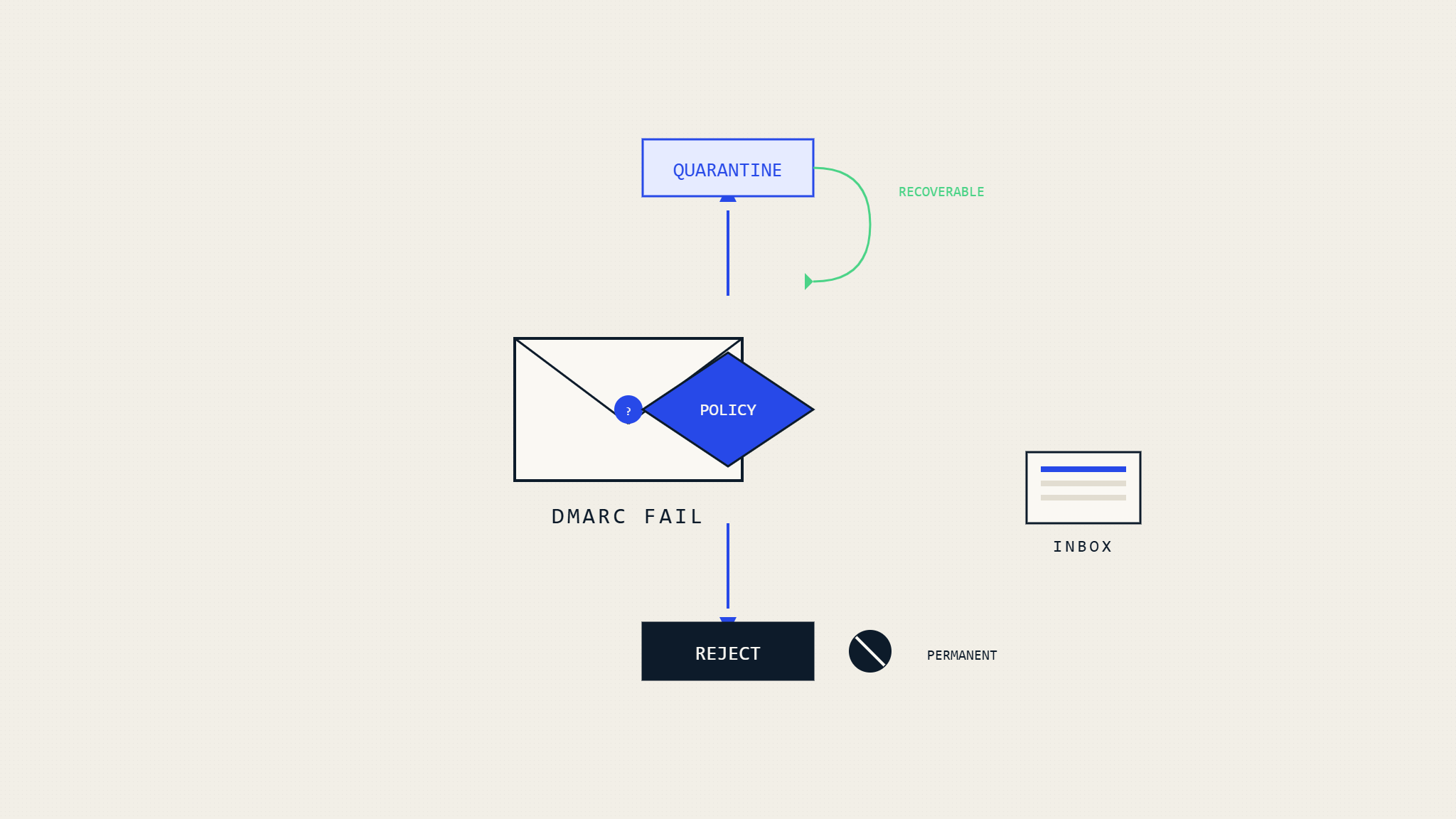
DMARC policy enforcement represents one of the most consequential decisions in email security strategy. The choice between quarantine (p=quarantine) and reject (p=reject) fundamentally alters how receiving mail servers handle authentication failures, directly impacting both security posture and legitimate email delivery.
This analysis examines the real-world implications of each enforcement level, helping security teams navigate the complex tradeoffs between maximum protection and operational reliability.
I. Understanding DMARC Policy Enforcement Mechanics
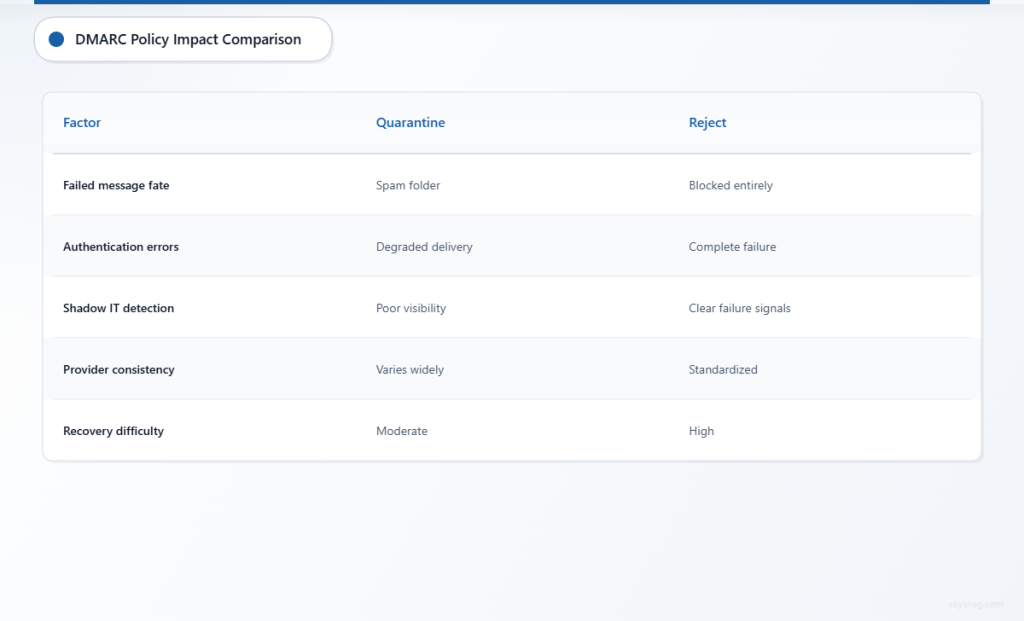
DMARC policies instruct receiving mail servers on how to handle messages that fail authentication alignment. However, the relationship between policy setting and actual enforcement varies significantly across email providers.
Quarantine Policy (p=quarantine)
Signals receiving servers to treat failing messages as suspicious, typically routing them to spam folders or applying additional scrutiny. The quarantine directive allows messages to reach recipients but flags them as potentially fraudulent.
Critical failure condition: Many receiving servers interpret quarantine policies inconsistently. Some providers may deliver quarantined messages normally, while others apply aggressive filtering that effectively blocks delivery.
Reject Policy (p=reject)
Instructs receiving servers to refuse delivery entirely for messages failing DMARC alignment. Reject policies provide the strongest anti-spoofing protection by preventing fraudulent messages from reaching any folder.
Critical failure condition: Reject policies create an all-or-nothing scenario where legitimate email misconfigurations result in complete delivery failure rather than degraded delivery.
II. Deliverability Impact Analysis
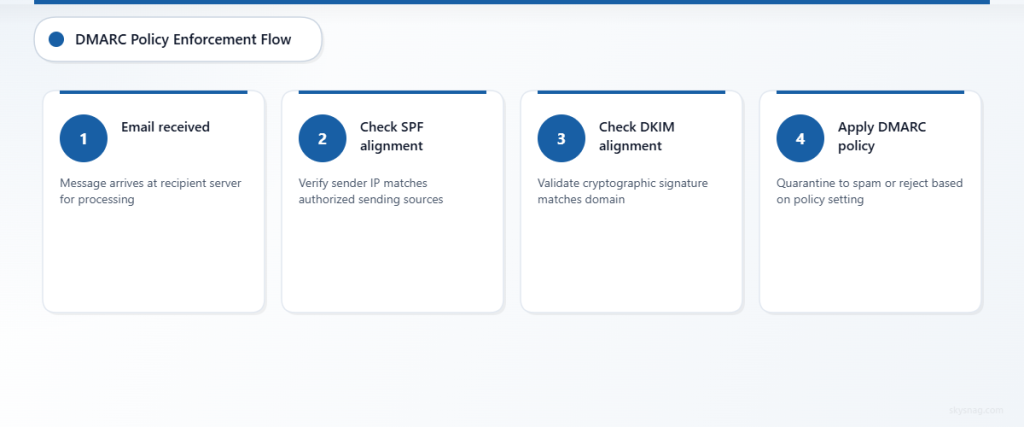
Quarantine Policy Delivery Patterns
Organizations implementing quarantine policies typically observe mixed delivery outcomes that depend heavily on recipient provider behavior.
Positive Delivery Outcomes:
- Legitimate emails with minor authentication issues often reach spam folders rather than disappearing entirely
- Gradual reputation building as providers observe consistent authentication patterns
- Recovery path for misconfigured third-party services through recipient folder checking
Delivery Risk Factors:
Quarantine policies can trigger unpredictable filtering behavior where some providers treat quarantined messages more aggressively than others. Additionally, recipients may not check spam folders regularly, creating effective delivery failures despite technical message acceptance.
Shadow IT Vulnerability:
Unauthorized sending services frequently remain undetected under quarantine policies, as failed authentication results in spam folder delivery rather than obvious rejection that would prompt investigation.
Reject Policy Delivery Characteristics
Reject enforcement creates binary delivery outcomes that eliminate ambiguity but increase configuration sensitivity.
Delivery Advantages:
- Complete elimination of domain spoofing attempts
- Clear feedback mechanism for authentication failures through bounce messages
- Consistent enforcement across all receiving providers
Operational Challenges:
Authentication misconfigurations under reject policies result in complete delivery failure rather than degraded performance. DNS propagation delays, third-party service changes, or DKIM key rotations can create temporary but total email outages.
Failure Visibility Paradox:
While reject policies provide clearer failure feedback, they also create higher stakes for authentication accuracy. Organizations may experience sudden delivery disruptions when previously unnoticed configuration drift triggers wholesale rejection.
III. Security Effectiveness Comparison
Quarantine Policy Protection Gaps
Quarantine policies provide moderate anti-spoofing protection but introduce several security limitations that attackers can exploit.
Exploitable Weaknesses:
Sophisticated phishing campaigns may target users who regularly check spam folders, knowing that quarantined spoofed messages still reach recipient environments. Additionally, business email compromise attacks often succeed when spoofed executive communications land in spam folders but appear legitimate to targeted employees.
Reputation Manipulation:
Threat actors can potentially influence domain reputation by generating authentication failures that trigger quarantine actions, creating a form of denial-of-service attack against email delivery.
Reject Policy Security Benefits
Reject enforcement eliminates entire categories of domain spoofing attacks by preventing fraudulent messages from reaching any recipient folder.
Protection Scope:
Complete domain impersonation protection ensures that spoofed messages never enter recipient environments, removing the risk of users encountering convincing fraudulent communications in spam folders.
Attack Surface Reduction:
Reject policies force attackers toward more sophisticated techniques like cousin domains or display name spoofing, which typically have lower success rates than direct domain impersonation.
IV. Implementation Risk Assessment
Quarantine Migration Considerations
Organizations implementing quarantine policies face lower immediate operational risk but potentially extended security exposure periods.
Deployment Safety:
Quarantine policies allow gradual authentication refinement without risking complete delivery failure. Teams can identify and address third-party sending sources while maintaining email functionality.
Timeline Implications:
Extended quarantine periods may create false confidence in authentication coverage while leaving domains vulnerable to spoofing attacks that succeed through spam folder delivery.
Reject Policy Deployment Challenges
Reject implementation requires comprehensive authentication audit and strong operational readiness but provides immediate maximum protection.
Pre-Deployment Requirements:
- Complete inventory of legitimate sending sources
- Verification of SPF record accuracy and include limits
- DKIM signature validation across all sending platforms
- Third-party service authentication configuration
- Change management processes for sender additions
Failure Recovery Planning:
Organizations must establish rapid response procedures for authentication issues that could trigger widespread delivery failures under reject policies.
V. Provider-Specific Enforcement Variations
Major Provider Quarantine Handling
Email providers implement quarantine policies with significant variation in actual message treatment.
Microsoft 365 Behavior:
Typically delivers quarantined messages to Junk Email folders with clear marking, providing reasonable user visibility for legitimate messages caught by policy failures.
Google Workspace Patterns:
May apply additional reputation factors to quarantined messages, potentially resulting in delivery blocking that resembles reject enforcement despite quarantine policy settings.
Provider-Specific Failure Modes:
Some providers implement “graduated quarantine” where repeated authentication failures from the same domain trigger increasingly aggressive filtering, even under quarantine policies.
Reject Policy Consistency
Reject enforcement generally provides more consistent behavior across receiving providers, though implementation details vary.
Bounce Message Reliability:
Not all providers generate meaningful bounce notifications for rejected messages, potentially creating silent delivery failures that complicate troubleshooting efforts.
VI. Strategic Decision Framework
Choose Quarantine When:
- Learning Phase: Organizations need time to discover and configure unknown sending sources
- Risk Tolerance: Business operations cannot tolerate any legitimate email delivery disruption
- Gradual Migration: Moving from no DMARC policy toward eventual reject enforcement
- Complex Infrastructure: Multiple subsidiaries, acquisitions, or decentralized email management
Choose Reject When:
- Maximum Security: Complete protection against domain spoofing takes priority over operational convenience
- Mature Authentication: Comprehensive inventory and configuration of all legitimate sending sources
- Regulatory Requirements: Compliance frameworks mandate maximum anti-phishing protection
- Brand Protection: High-value domains requiring absolute spoofing prevention
VII. Monitoring and Adjustment Strategies
Quarantine Policy Optimization
Organizations using quarantine policies should implement enhanced monitoring to identify both security gaps and delivery issues.
Key Metrics:
- Authentication failure rates by sending source
- User reports of legitimate emails in spam folders
- Successful spoofing attempts despite quarantine policy
- Provider-specific quarantine handling variations
Reject Policy Validation
Reject enforcement requires continuous validation that legitimate senders maintain proper authentication configuration.
Monitoring Requirements:
- Real-time authentication failure alerting
- Bounce message analysis and categorization
- Third-party service authentication status
- Change management compliance for new senders
VIII. Winner: Strategic Hybrid Approach
The most effective DMARC strategy typically involves quarantine as a migration phase toward reject enforcement, rather than treating these policies as permanent alternatives.
Recommended Implementation Path:
- Phase 1 (3-6 months): Deploy quarantine policy while building comprehensive sender inventory and authentication infrastructure
- Phase 2 (1-3 months): Achieve consistent authentication success rates above 99% under quarantine monitoring
- Phase 3 (Ongoing): Implement reject policy with robust monitoring and rapid response procedures
Long-term Optimization:
Organizations with mature email authentication should prioritize reject policies for maximum security, while those early in their DMARC journey benefit from quarantine policies that enable gradual improvement without operational disruption.
The key insight is recognizing that quarantine policies serve as valuable stepping stones rather than permanent destinations, providing the operational safety needed to build toward reject-level protection.
IX. Key Takeaways
- Quarantine policies provide moderate protection with lower operational risk but inconsistent provider enforcement and continued spoofing vulnerability
- Reject policies deliver maximum security through complete spoofing prevention but require comprehensive authentication management and create higher deployment risk
- Provider behavior varies significantly under quarantine policies, while reject enforcement offers more consistent cross-provider results
- Strategic progression from quarantine to reject maximizes both security outcomes and operational stability
- Success depends heavily on authentication infrastructure maturity and organizational change management capabilities

Ready to implement DMARC enforcement that balances security and deliverability? Skysnag Protect provides comprehensive policy management with real-time monitoring to support both quarantine optimization and reject policy deployment.