I. Key Takeaways
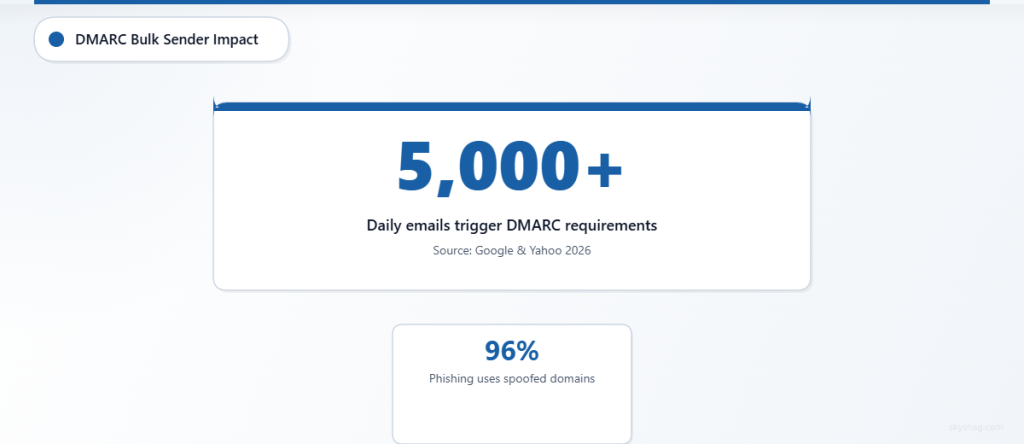
- DMARC requirements now apply to bulk senders (5,000+ emails/day) from Google and Yahoo, with stricter enforcement starting in 2026.
- Government agencies and regulated industries worldwide are mandating DMARC implementation for email security.
- Technical requirements include SPF and/or DKIM authentication plus proper domain alignment.
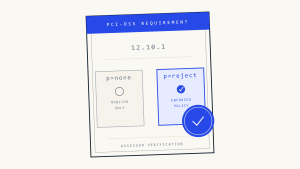
- Organizations must gradually move from p=none to p=reject policies while monitoring email deliverability.
DMARC requirements are no longer just technical recommendations. They are now shaped by a growing mix of global regulations, industry compliance frameworks, and mailbox provider rules. Governments and public-sector bodies in multiple regions have made DMARC a formal requirement for protecting official domains, while standards such as PCI DSS increasingly treat email authentication as part of broader security compliance. At the same time, providers like Google, Yahoo, and Microsoft now expect stronger authentication from senders, especially those sending at scale.
That shift means DMARC is no longer only about preventing spoofing. It now plays a direct role in email deliverability, brand protection, customer trust, and regulatory readiness. For many organizations, failing to meet DMARC requirements can lead to rejected emails, increased phishing risk, and compliance gaps that are harder to ignore.
This guide explains DMARC requirements from that broader perspective. It covers the global rules and mandates driving adoption, the provider-level requirements senders must meet, and the technical foundations, including SPF, DKIM, and alignment, needed to support compliance.
II. What are DMARC Requirements?
DMARC requirements refer to the technical and policy standards that domain owners must meet to correctly implement Domain-based Message Authentication, Reporting, and Conformance.
They exist across three layers: regulatory mandates, provider requirements, and the technical standards needed to implement DMARC correctly.
At its foundation, DMARC is an email authentication protocol that builds on Sender Policy Framework (SPF) and DomainKeys Identified Mail (DKIM) to verify that outgoing messages genuinely originate from the domain they claim to represent.
When a message fails those authentication checks, your DMARC policy tells receiving mail servers what to do with it.
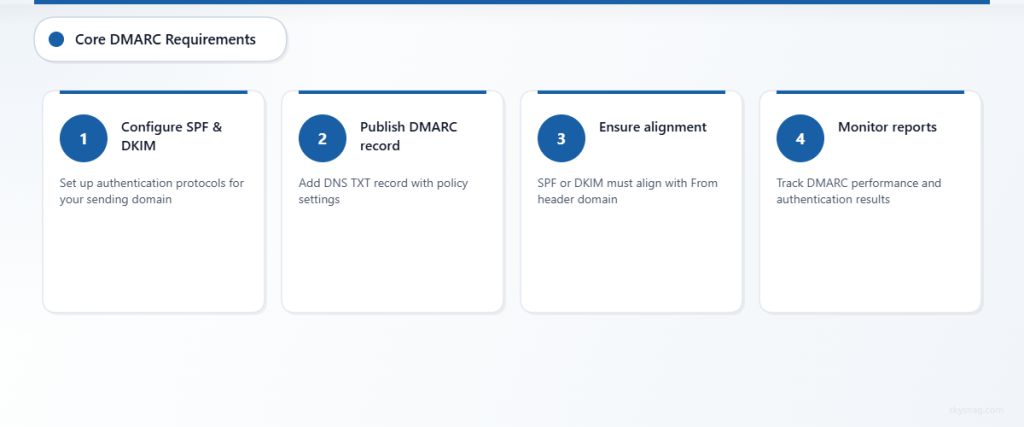
A domain meets DMARC requirements when:
- SPF and DKIM are correctly configured for the sending domain
- A valid DMARC DNS TXT record is published
- At least one of SPF or DKIM passes and aligns with the From header domain
- DMARC reports are actively monitored
What has changed is the stakes. DMARC requirements are now mandated or enforced across multiple countries and regulatory frameworks worldwide. It is also enforced by Google, Yahoo, Microsoft, and PCI DSS, and non-compliance has direct consequences for email deliverability, brand trust, and regulatory standing.
III. Consequences of Not Implementing or Configuring DMARC
Organizations that fail to enforce or properly configure DMARC face significant risks across multiple areas:
Email Deliverability Issues
Without DMARC enforcement, legitimate emails are more likely to be marked as spam or rejected entirely by major email providers. Google and Yahoo now actively penalize senders who lack proper authentication, especially bulk senders sending over 5,000 emails per day. This can result in:
- Complete email blocking: Messages may be rejected at the gateway level, never reaching the recipient’s inbox
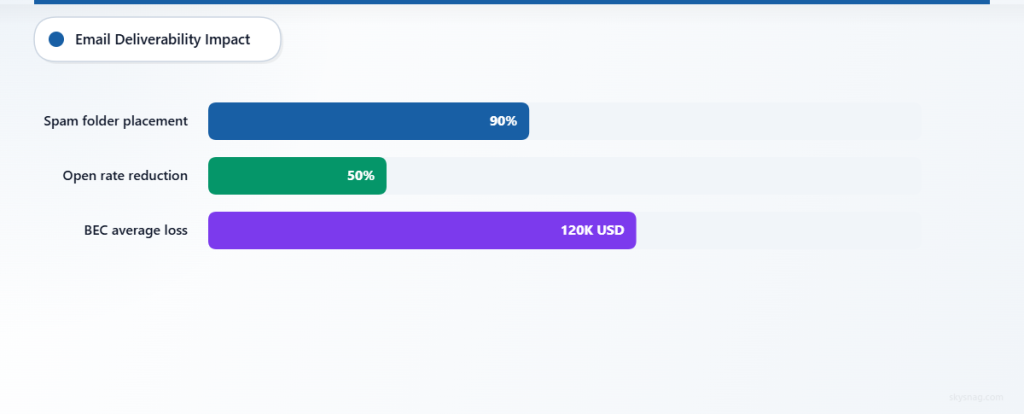
- Spam folder placement: Emails bypass the inbox entirely, reducing open rates by 50-90%
- Sender reputation degradation: Domain reputation scores decline progressively, affecting all future emails
- Cascading deliverability failures: Poor reputation spreads across email service providers, creating widespread delivery issues
- Revenue impact from transactional emails: Critical communications like password resets, order confirmations, and billing notices fail to reach customers
- Customer service strain: Increased support tickets from customers not receiving important emails
Increased Security Vulnerabilities
Domains without enforced DMARC policies become easy targets for cybercriminals:
- Domain spoofing attacks: Criminals can easily impersonate your domain to send phishing emails, with 96% of phishing attacks using spoofed domains
- Business Email Compromise (BEC): Attackers can pose as executives or trusted partners, with average losses of $120,000 per incident according to FBI data
- Brand impersonation at scale: Malicious actors can damage your reputation by sending thousands of fraudulent emails daily
- Customer trust erosion: Recipients may lose confidence in all communications from your domain, affecting legitimate business
- Supply chain attacks: Cybercriminals can impersonate your organization to target your customers, partners, and vendors
- Regulatory breach notifications: Organizations may be required to report security incidents involving domain impersonation
Regulatory and Compliance Risks
Organizations subject to DMARC mandates face serious consequences for non-compliance:
- Government contract disqualification: Federal agencies may exclude non-compliant vendors from procurement opportunities worth millions
- Regulatory penalties: Fines ranging from $10,000 to $2.3 million depending on the jurisdiction and violation severity
- Audit failures: Compliance audits may flag missing email authentication controls as critical findings
- Insurance implications: Cyber insurance claims may be denied for failing to implement basic protections, with premium increases of 20-50%
- License revocation threats: Regulated industries may face operational license reviews for cybersecurity non-compliance
- Legal liability exposure: Organizations may face lawsuits from customers affected by domain spoofing attacks
- Export control violations: Government contractors may lose security clearances required for sensitive projects
Operational Blind Spots
Without DMARC reporting, organizations lack visibility into:
- Unauthorized email sources: Unknown third parties sending emails claiming to be from your domain
- Infrastructure misconfigurations: Authentication failures that indicate SPF or DKIM setup problems
- Attack volume and patterns: The scale and frequency of domain abuse attempts targeting your organization
- Third-party service compliance: Whether email service providers are properly authenticating on your behalf
- Geographic threat intelligence: Understanding where malicious emails claiming to be from your domain originate
- Incident response delays: Missing early warning indicators that could prevent larger security breaches
Financial and Business Impact
The cumulative cost of DMARC non-compliance extends beyond immediate technical issues:
- Lost revenue opportunities: Failed email marketing campaigns and transactional communications directly impact sales
- Increased cybersecurity costs: Reactive security measures cost 3-5x more than proactive implementations
- Brand reputation damage: Rebuilding customer trust after domain spoofing incidents can take years and significant marketing investment
- Competitive disadvantage: Organizations with better email deliverability gain market advantages in digital communications
- Partnership complications: B2B relationships may suffer when business-critical emails fail to reach partners
- Compliance remediation costs: Emergency DMARC implementation under regulatory pressure typically costs 2-3x normal deployment
IV. Types of DMARC Requirements
DMARC requirements can be grouped into three categories:
- Regulatory requirements: Mandates from governments and compliance bodies such as CISA (US), NCSC (UK), and NIS2 (EU), which require organizations to implement and enforce DMARC as part of broader cybersecurity standards.
- Provider requirements: Enforcement rules from mailbox providers like Google, Yahoo, and Microsoft, especially for bulk senders, where authentication and policy adherence directly impact email deliverability.
- Technical requirements: The foundational setup needed to implement DMARC correctly, including SPF, DKIM, DMARC policies, and proper domain alignment.
Understanding how these layers work together is essential to achieving and maintaining full DMARC compliance.
V. Why DMARC Requirements Matter More Than Ever
Email remains the primary attack vector for cybercriminals, with business email compromise (BEC) attacks causing billions in losses annually according to FBI Internet Crime Complaint Center data. Traditional security controls often fail against sophisticated spoofing attacks that impersonate trusted domains.
DMARC (Domain-based Message Authentication, Reporting and Conformance) provides the technical framework to prevent domain spoofing, but regulatory bodies have recognized that voluntary adoption isn’t sufficient. Mandatory requirements ensure organizations implement baseline protections against email fraud.
The business impact extends beyond security. Organizations failing to meet DMARC requirements face regulatory penalties, compliance audit failures, and exclusion from government contracts. Email deliverability also suffers when major providers like Gmail and Yahoo enforce their own DMARC expectations for bulk senders.
VI. Global DMARC Requirements by Region
DMARC is now mandated or enforced across multiple countries and regulatory frameworks, making it a baseline requirement for secure email infrastructure. Here is where the major mandates stand today.
| Region | Mandate Status | Enforcing Body | Minimum Policy |
|---|---|---|---|
| United States | Mandatory (federal) | CISA/DHS | p=reject |
| United Kingdom | Mandatory (public sector) | NCSC | p=reject |
| European Union | Required (critical sectors) | NIS2/national authorities | p=quarantine minimum |
| Australia | Mandatory (government) | ACSC | p=reject |
| Canada | Mandatory (federal) | Treasury Board | p=reject |
| Saudi Arabia | Mandatory (gov + telecom) | CITC/NCA | p=quarantine |
| UAE | Mandatory (government) | TDRA | p=none minimum |
| India | Required (commercial) | TRAI | p=reject |
| New Zealand | Strongly recommended | NCSC NZ | p=reject (encouraged) |
United States Federal Requirements
CISA Binding Operational Directive 18-01 mandates federal agencies implement DMARC at enforcement policy within specific timeframes. The directive requires:
- SPF and DKIM authentication configured for all domains
- DMARC policy implementation with incremental enforcement
- Regular monitoring and reporting of DMARC aggregate data
- Coordination with .gov domain management requirements
Federal contractors often inherit these requirements through contract terms, extending the mandate beyond direct government agencies.
FedRAMP Authorization increasingly evaluates DMARC implementation as part of cloud service provider assessments, making it effectively mandatory for organizations serving federal customers.
European Union Directives
NIS2 Directive implementation across EU member states includes email security requirements that encompass DMARC deployment for essential and important entities. While not explicitly naming DMARC, the directive’s email security provisions support DMARC implementation as a recognized control.
GDPR Article 32 requires appropriate technical measures to protect personal data, which email authentication controls help demonstrate, particularly for organizations processing personal data via email communications.
Industry-Specific Mandates
Financial Services: Regulatory guidance from financial authorities increasingly references email authentication as part of operational resilience frameworks. Organizations subject to payment card industry standards commonly implement DMARC as part of comprehensive anti-fraud programs.
Healthcare: While not explicitly mandating specific email authentication protocols, healthcare organizations implementing DMARC demonstrate due diligence in protecting patient information transmitted via email.
Critical Infrastructure: Sectors designated as critical infrastructure face heightened scrutiny around email security, with DMARC serving as a foundational control in cybersecurity frameworks.
Regional Variations and Emerging Requirements
United Kingdom: The National Cyber Security Centre (NCSC) strongly recommends DMARC implementation, with government agencies following directive-style guidance similar to US federal requirements.
Australia: The Australian Cyber Security Centre (ACSC) includes DMARC in its Essential Eight mitigation strategies, influencing procurement and compliance expectations.
Asia-Pacific: Individual countries are developing email security frameworks that reference international best practices, including DMARC implementation guidance.
VII. Compliance Framework Alignment
ISO 27001 and Email Authentication
ISO 27001:2022 control A.13.2.3 addresses electronic messaging security. Organizations commonly implement DMARC to demonstrate technical controls for protecting information in electronic messages, particularly when email serves as a communication channel for sensitive data.
SOC 2 Considerations
Service organizations undergo SOC 2 examinations often implement DMARC as part of their security control environment. While SOC 2 doesn’t prescribe specific technologies, email authentication supports the security criteria around logical access controls and system operations.
NIST Cybersecurity Framework
The NIST CSF Protect function includes identity management and access control categories where email authentication fits naturally. Organizations using the framework incorporate DMARC as a protective technology supporting overall cybersecurity posture.
VIII. Implementation Requirements and Technical Specifications
Minimum Technical Standards
Most regulatory frameworks and industry guidance specify similar technical baseline requirements:
Domain Coverage: All organizational domains and subdomains must have appropriate email authentication policies configured, including non-email domains to prevent subdomain abuse.
Authentication Alignment: DMARC requires either SPF or DKIM alignment (preferably both) to pass authentication checks before applying policy actions.
Policy Progression: Organizations typically start with monitoring policies (p=none) before progressing to enforcement (p=quarantine or p=reject) based on authentication results and operational requirements.
Reporting Configuration: Aggregate reports (RUA) and forensic reports (RUF) must be configured to enable ongoing monitoring and incident response capabilities.
Enforcement Expectations
While specific enforcement timelines vary, common patterns emerge across requirements:
- Phase 1: Initial DMARC record deployment with monitoring policy
- Phase 2: Analysis of authentication failures and infrastructure remediation
- Phase 3: Progressive enforcement starting with percentage-based policies
- Phase 4: Full enforcement at organizational tolerance levels
Organizations should document their DMARC implementation approach, including risk assessments that justify policy decisions and remediation timelines.
IX. Organizational Compliance Strategies
Assessment and Planning
Begin with comprehensive domain discovery to identify all organizational domains requiring DMARC policies. This includes:
- Primary organizational domains and email-sending subdomains
- Legacy domains that may no longer send email but remain owned
- Third-party domains used for specific business functions
- Subsidiary and acquisition domains that may lack consistent policies
Map existing email infrastructure to understand current SPF and DKIM deployment. Many organizations discover authentication gaps during DMARC implementation that require infrastructure updates.
Risk-Based Implementation
Develop implementation timelines based on domain risk profiles and business requirements. High-visibility domains used for executive communications or customer-facing operations may require faster progression to enforcement policies.
Consider operational impact when setting enforcement percentages. Organizations with complex email infrastructure may need gradual policy deployment to avoid disrupting legitimate email flows.
Monitoring and Maintenance
Establish processes for ongoing DMARC report analysis and policy optimization. This includes:
- Regular review of aggregate reports to identify authentication failures
- Investigation of forensic reports for potential security incidents
- Coordination with third-party email service providers on authentication alignment
- Documentation of policy decisions and changes for audit purposes
X. Skysnag Protect: Streamlined DMARC Compliance

Skysnag Protect simplifies DMARC compliance across complex regulatory requirements. The platform provides automated policy management, comprehensive reporting analysis, and guided implementation workflows that help organizations meet various regulatory expectations efficiently.
Key compliance features include:
- Multi-domain policy management for organizations with extensive domain portfolios
- Automated report processing that identifies authentication issues and policy violations
- Compliance reporting that maps DMARC implementation to specific regulatory frameworks
- Risk assessment tools that help prioritize domain protection based on business impact
The platform’s centralized approach reduces the administrative burden of managing DMARC across multiple domains while providing the documentation and reporting capabilities required for regulatory compliance.
XI. Implementation Checklist
Use the checklist below as a practical starting point for DMARC compliance. The exact requirements will depend on your regulatory scope, industry sector, and organizational risk tolerance.
- [ ] Conduct comprehensive domain inventory including all organizational domains and subdomains.
- [ ] Assess current SPF and DKIM deployment across identified domains.
- [ ] Identify applicable regulatory requirements and compliance frameworks for your organization.
- [ ] Develop risk-based implementation timeline with enforcement milestones.
- [ ] Configure initial DMARC policies with monitoring settings (p=none) for all domains.
- [ ] Establish aggregate report processing and analysis procedures.
- [ ] Create documentation process for policy decisions and implementation progress.
- [ ] Plan infrastructure updates required for authentication alignment.
- [ ] Define escalation procedures for investigating authentication failures and security incidents.
- [ ] Schedule regular policy reviews and optimization cycles.
XII. Key Takeaways
DMARC requirements in 2026 reflect a global shift toward mandatory email authentication as a baseline cybersecurity control. Organizations must navigate varying regional requirements while implementing technical solutions that protect against email fraud and support compliance objectives.
Success requires understanding both the regulatory landscape and technical implementation requirements. Organizations that approach DMARC strategically with proper planning, risk assessment, and ongoing monitoring can meet compliance requirements while significantly improving their email security posture.
The complexity of managing DMARC across multiple domains and regulatory requirements makes specialized tools like Skysnag Protect valuable for maintaining ongoing compliance and security effectiveness.