BIMI can make authenticated email more recognizable in the inbox, but does it actually improve inbox placement?
That distinction matters.
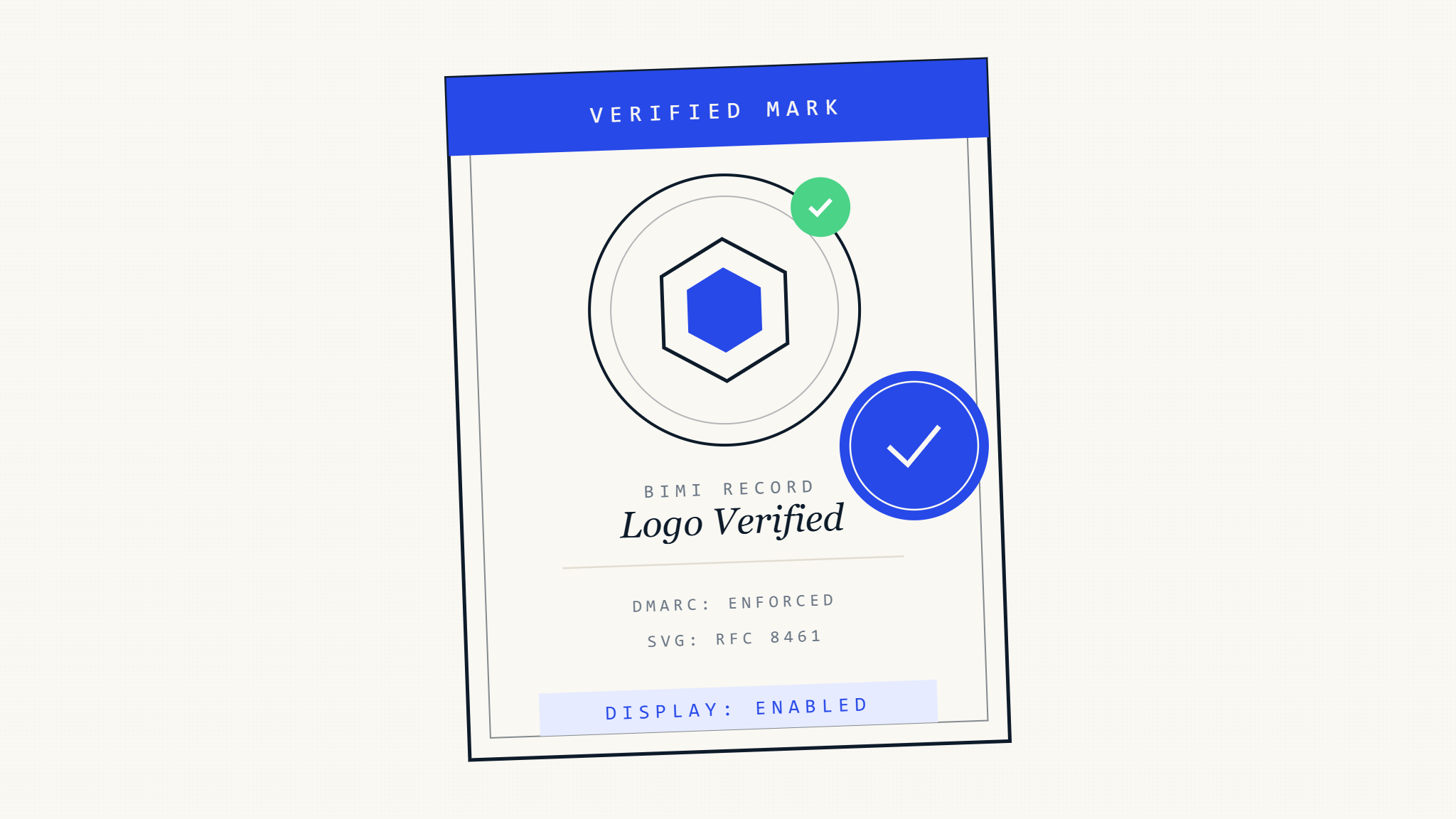
Brand Indicators for Message Identification (BIMI) allows supporting mailbox providers to display a brand-controlled logo alongside authenticated email. To qualify, the sending domain must already meet strong email authentication requirements, including enforced DMARC. Some mailbox providers also require or recognize a third-party Mark Certificate that validates the organization’s right to use the logo.
Because BIMI is often deployed at the same time as stronger DMARC enforcement, organizations may see better email performance after implementation and assume the logo itself improved deliverability.
The reality is more nuanced.
There is no clear public evidence from major mailbox providers that BIMI itself operates as a direct inbox-placement ranking signal.
The stronger deliverability benefits usually come from the authentication, reputation, and sending practices required around BIMI. The logo can then add a second layer of value through brand recognition and recipient trust.
This article separates those effects.
I. What BIMI Actually Does
BIMI is a specification that allows supporting mailbox providers to display a brand-controlled logo next to authenticated email.
BIMI does not replace SPF, DKIM, or DMARC.
Instead, it builds on them.
The BIMI Group states that BIMI relies on DMARC authentication and requires DMARC to be at enforcement. Its implementation guidance requires p=quarantine or p=reject; p=none is not accepted for BIMI eligibility.
At a high level, BIMI requires:
- A properly authenticated sending domain
- DMARC enforcement
- A BIMI DNS record
- A compliant SVG Tiny Portable/Secure logo
- Where required by the mailbox provider, a valid Mark Certificate
- Sufficient sender reputation and provider-specific eligibility for logo display
BIMI therefore adds a visible identity layer after the sender has established the underlying authentication foundation.
II. BIMI Does Not Authenticate the Message
One misconception is that BIMI performs email authentication.
It does not.
SPF evaluates whether sending infrastructure is authorized for the envelope domain.
DKIM validates a cryptographic signature associated with a signing domain and the signed message content.
DMARC determines whether a passing SPF or DKIM identity aligns with the domain visible in the From header.
BIMI uses that authenticated foundation to enable brand-logo display.
The BIMI Group describes BIMI as leveraging the DMARC protection already deployed by the organization rather than replacing it.
That means:
DMARC protects the domain identity. BIMI makes that authenticated identity visible.
III. VMC vs CMC: The Current BIMI Certificate Model
BIMI certificate terminology has evolved.
The two important certificate types are now:
Verified Mark Certificate (VMC)
A VMC validates an organization’s right to use an eligible trademarked logo.
Google recommends VMCs where possible and notes that Gmail displays a verification checkmark next to senders verified with a VMC.
Common Mark Certificate (CMC)
A CMC allows organizations that do not have the trademark status required for a VMC to use a validated logo under different eligibility rules.
Google added CMC support to Gmail, expanding BIMI participation beyond organizations eligible for VMCs.
This distinction is important because BIMI is no longer accurately described as universally requiring a VMC.
Different mailbox providers apply different certificate and reputation requirements.
IV. Mailbox Provider Requirements Are Not Identical
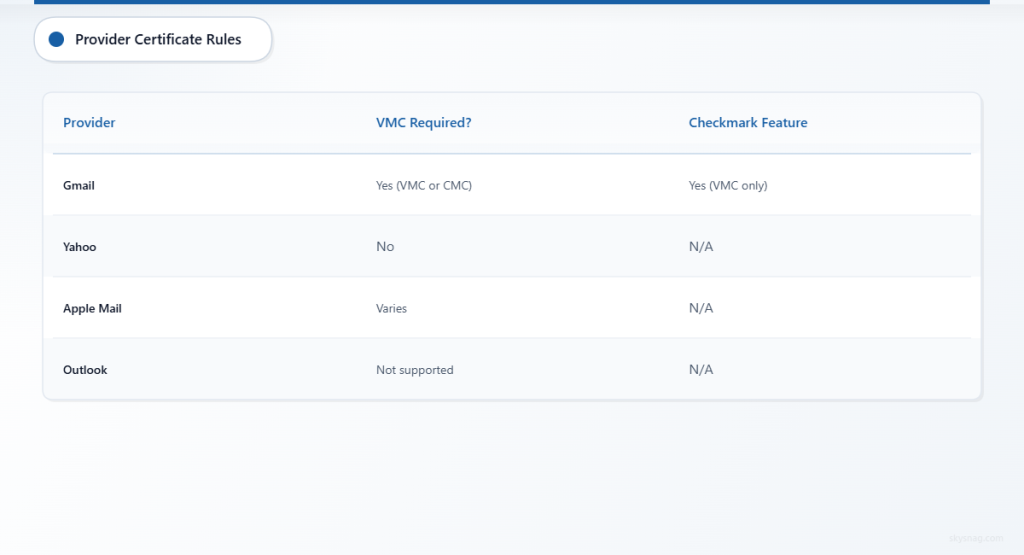
BIMI support varies across providers.
Gmail
Google requires a VMC or CMC for Gmail BIMI implementation. Gmail also requires DMARC enforcement at p=quarantine or p=reject, with the applicable policy percentage set to 100%. Gmail shows an additional verification checkmark for senders verified with a VMC. (Google Workspace Help)
Yahoo
Yahoo supports BIMI but explicitly states that it does not currently require a VMC for BIMI logos to appear in Yahoo applications. Yahoo may, however, use a VMC as part of its overall BIMI eligibility assessment. (Senders)
Apple Mail
Apple Mail supports BIMI on supported versions of iOS, iPadOS, macOS, and iCloud.com. Apple states that BIMI senders must satisfy strong authentication requirements and demonstrate control over their brand logos. (Apple Support)
Microsoft
Microsoft’s current documentation says Exchange Online does not yet support BIMI in the same way as receiving platforms such as Gmail and Yahoo. Microsoft does support BIMI-related sending capabilities through Dynamics 365 Customer Insights, but Exchange Online itself does not currently provide general BIMI rendering.
This is why organizations should not assume universal logo display after publishing BIMI.
V. Where BIMI Can Fail
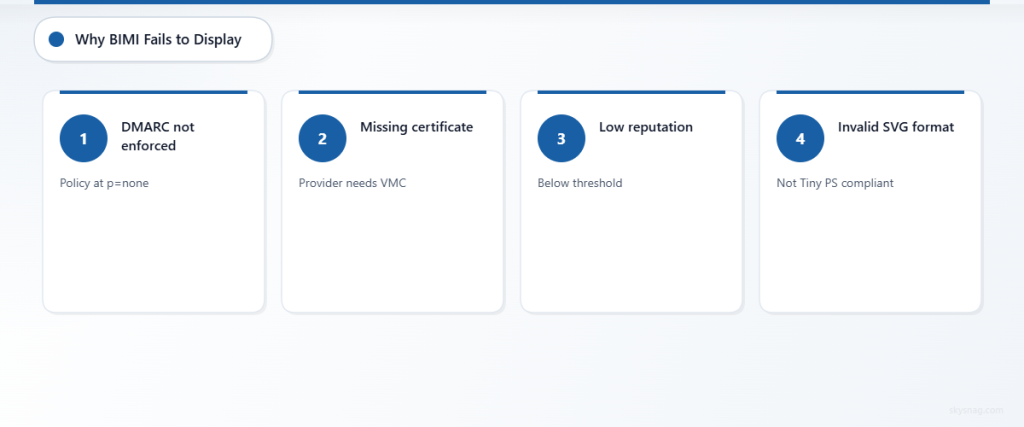
A BIMI deployment can be technically configured and still fail to display.
Common failure conditions include:
DMARC Is Not at Enforcement
BIMI does not support p=none.
The organizational domain must meet BIMI’s DMARC enforcement requirements.
DMARC Fails on the Individual Message
BIMI eligibility is evaluated against authenticated mail.
If a particular message fails DMARC because neither SPF nor DKIM passes with alignment, the logo may not display even if the domain’s BIMI DNS record is correct.
Mark Certificate Problems
Where a VMC or CMC is required, certificate expiration, an inaccessible PEM file, logo mismatches, or certificate validation problems can prevent display. Google’s BIMI troubleshooting guidance specifically recommends checking certificate validity, the PEM file, and the associated SVG when logos do not appear.
SVG Problems
BIMI uses SVG Tiny Portable/Secure, not a normal web-exported SVG.
Invalid SVG structure, unsupported elements, external references, scripts, or incorrect dimensions can prevent logo validation. Google also publishes additional BIMI SVG requirements for Gmail.
Reputation or Provider Eligibility
A valid certificate is not a guarantee that the logo will appear.
The BIMI Group notes that mailbox providers can consider reputation and other eligibility signals when deciding whether to display a BIMI logo.
Unsupported Mailbox Provider
If the receiving provider does not support BIMI, the email can authenticate and deliver normally without displaying the BIMI logo.
The usual failure is therefore silent:
The email delivers, but the logo does not appear.
VI. Does BIMI Directly Improve Inbox Placement?
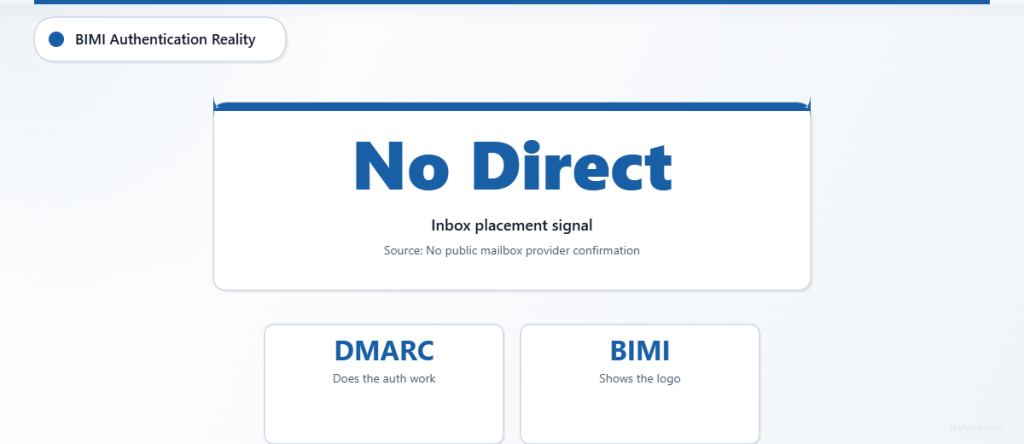
The safest answer is:
There is no established public evidence that BIMI itself is a direct inbox-placement ranking factor across major mailbox providers.
Mailbox providers publicly discuss authentication, reputation, user complaints, sending behavior, content, abuse signals, and related factors when describing sender requirements.
BIMI is primarily documented as a mechanism for authenticated brand-logo display.
That distinction matters.
A sender should not implement BIMI expecting:
“We added a VMC, therefore Gmail will place more of our email in the inbox.”
There is no reliable basis for making that promise.
VII. Why BIMI and Better Deliverability Often Appear Together
There is a strong reason organizations may observe better email performance around a BIMI project:
BIMI forces the organization to improve the authentication foundation first.
To become BIMI-ready, organizations typically have to:
- Discover legitimate senders
- Correct SPF problems
- Deploy DKIM consistently
- Fix DMARC alignment
- Move away from
p=none - Reach DMARC enforcement
- Remove unauthorized sources
- Resolve third-party sender problems
- Improve domain governance
Those improvements can make the email environment healthier independently of the BIMI logo.
A company might therefore observe:
Before BIMI
p=none- Unknown sending sources
- Weak DKIM coverage
- Spoofing activity
- Authentication failures
After BIMI preparation
p=reject- Legitimate senders identified
- Aligned DKIM
- Unauthorized sources blocked
- Stable authentication
If inbox placement improves, attributing all of that improvement to the logo would be misleading.
Much of the improvement may come from fixing the underlying email authentication environment.
VIII. BIMI Can Still Influence Recipient Behavior
Where BIMI becomes interesting is the human layer.
A recognizable logo may help recipients identify familiar legitimate communications more quickly.
That can potentially influence:
- Brand recognition
- Recipient confidence
- Opens
- Click behavior
- Spam complaints
- User trust
Microsoft’s own BIMI documentation, for example, describes increased brand recognition and engagement as potential benefits of BIMI, while also emphasizing the underlying authentication foundation.
This creates a plausible indirect relationship:
BIMI visibility → stronger brand recognition → better recipient behavior → stronger reputation signals over time
But that should be described as an indirect pathway, not as a guaranteed deliverability improvement.
IX. Be Careful With Open-Rate Claims
Open rate is not a perfect BIMI measurement metric.
Privacy features, especially Apple Mail Privacy Protection, can distort traditional open tracking. That makes it difficult to attribute changes in open rates directly to logo display.
Organizations assessing BIMI should therefore use multiple metrics rather than relying on opens alone.
Consider:
- Complaint rate
- Click-through rate
- Conversion rate
- Inbox placement testing
- Spam-folder placement
- Unsubscribe rate
- Domain reputation
- Authentication failure rate
- Campaign-level engagement
- Provider-specific performance
The goal is to determine whether recipients behave differently where the BIMI logo is actually visible.
X. Scenario 1: BIMI Added at the Same Time as DMARC Enforcement
Imagine a company moves from:
p=none
to:
p=reject
while also launching BIMI.
Afterward:
- Spoofing decreases
- Authentication improves
- Inbox placement improves
- The logo appears in supported inboxes
It would be tempting to credit BIMI.
But multiple variables changed simultaneously.
The improved deliverability may primarily reflect stronger authentication and cleaner sending infrastructure.
BIMI may still contribute additional brand visibility, but the effects cannot be cleanly separated.
XI. Scenario 2: BIMI Added to an Already Mature Domain
Now consider an organization already operating at:
p=reject
with:
- High DKIM alignment
- Clean sender inventory
- Stable reputation
- Strong inbox placement
The organization adds BIMI.
In this case, the most likely immediate change is visual:
The brand logo appears where the receiving provider supports BIMI.
A large filtering improvement should not be assumed because the authentication environment itself has not materially changed.
Any measurable benefit is more likely to appear in recipient recognition and engagement.
XII. Scenario 3: BIMI Record Published Without Proper DMARC Enforcement
A company publishes:
v=BIMI1; l=https://example.com/logo.svg;but remains at:
v=DMARC1; p=none;The domain does not meet BIMI enforcement requirements.
The BIMI record may exist, but the domain is not BIMI-ready.
Google explicitly requires p=quarantine or p=reject, with the applicable percentage at 100%, for Gmail BIMI.
This is a common example of why publishing BIMI DNS alone is not enough.
XIII. Why Organizations Still Implement BIMI
BIMI can be valuable even without promising a direct deliverability boost.
Brand Recognition
A verified logo creates additional visual identity inside supported inboxes.
Visible Trust
BIMI connects the brand shown to the recipient with an authenticated sending environment.
DMARC Maturity
BIMI provides organizations with a business incentive to complete DMARC enforcement rather than remaining indefinitely at monitoring.
Brand Verification
VMC and CMC issuance adds independent validation around the organization and use of the displayed mark.
Gmail Verification Indicator
For eligible VMC-based implementations, Gmail can display a verification checkmark alongside the sender.
Future Readiness
Mailbox-provider support continues to evolve. Organizations that establish BIMI correctly are positioned to benefit as additional providers expand support.
XIV. What BIMI Does Not Fix
BIMI should not be treated as a solution for:
- Poor list hygiene
- High complaint rates
- Purchased lists
- Spam traps
- Weak domain reputation
- Weak IP reputation
- Excessive sending volume
- Suspicious content
- Unsafe URLs
- Poor segmentation
- Unwanted marketing email
BIMI does not override these problems.
A beautifully verified logo does not make unwanted email wanted.
XV. How to Measure BIMI’s Real Impact
The cleanest way to evaluate BIMI is to separate authentication improvements from logo deployment.
Step 1: Establish the Authentication Baseline
Measure:
- DMARC pass rate
- DKIM alignment
- SPF alignment
- Unauthorized sources
- Domain reputation
- Inbox placement
- Complaint rate
Step 2: Reach DMARC Enforcement
Fix authentication issues and reach a stable enforcement posture before evaluating BIMI.
This prevents the effects of DMARC remediation from being confused with BIMI itself.
Step 3: Establish a Pre-BIMI Performance Baseline
Measure performance across a representative sending period.
Avoid treating a fixed 30-day window as mandatory. Use a period long enough to capture normal sending cycles and campaign variation.
Step 4: Deploy BIMI
Configure:
- BIMI DNS
- SVG Tiny-PS logo
- VMC or CMC where required
- Certificate hosting
- Provider-specific requirements
Step 5: Verify Actual Logo Display
Test against mailbox providers that support BIMI.
Do not assume DNS validity means the logo is displaying.
Step 6: Segment Performance by Provider
Compare performance between environments where BIMI displays and those where it does not.
If engagement improves only among recipients using supporting providers, BIMI may be contributing.
If inbox placement improves equally everywhere, the cause is likely elsewhere.
XVI. Skysnag Certify: BIMI Without Guesswork
BIMI implementation involves more than publishing a logo.
Organizations must coordinate:
- DMARC enforcement
- SPF and DKIM alignment
- SVG Tiny-PS preparation
- Trademark or mark eligibility
- VMC or CMC requirements where applicable
- Certificate issuance
- BIMI DNS
- Mailbox-provider eligibility
- Ongoing certificate and logo monitoring
Skysnag Certify brings these pieces into a managed implementation process.
Certify helps organizations establish the authentication and verification foundation required for trusted brand display while reducing the operational work involved in coordinating DNS, certificate, logo, and validation requirements.
For organizations pursuing VMC-based verification, Skysnag Certify can also support the broader trademark, validation, certificate, and BIMI deployment process.
Learn more about Skysnag Certify:
XVII. Key Takeaways
- BIMI does not replace SPF, DKIM, or DMARC. It builds on an authenticated email environment.
- BIMI requires DMARC enforcement.
p=noneis not sufficient. - Gmail currently supports both VMC and CMC certificates for BIMI. VMC-verified senders can receive Gmail’s additional verification checkmark.
- Yahoo supports BIMI without universally requiring a VMC, although certificates can contribute to eligibility decisions.
- Apple Mail supports BIMI on supported Apple platforms, while Microsoft Exchange Online does not currently provide general BIMI rendering.
- There is no established public evidence that BIMI itself is a direct inbox-placement ranking signal across major mailbox providers.
- Deliverability improvements observed during BIMI projects often come from the DMARC enforcement and authentication remediation required before BIMI can be deployed.
- BIMI may provide an indirect benefit through brand recognition, recipient trust, and engagement where supported, but those effects should be measured rather than assumed.
- BIMI cannot compensate for poor reputation, complaints, bad list hygiene, or unwanted content.
- The strongest reason to implement BIMI is verified brand visibility on top of a mature email authentication program, not a promise of automatic inbox placement.