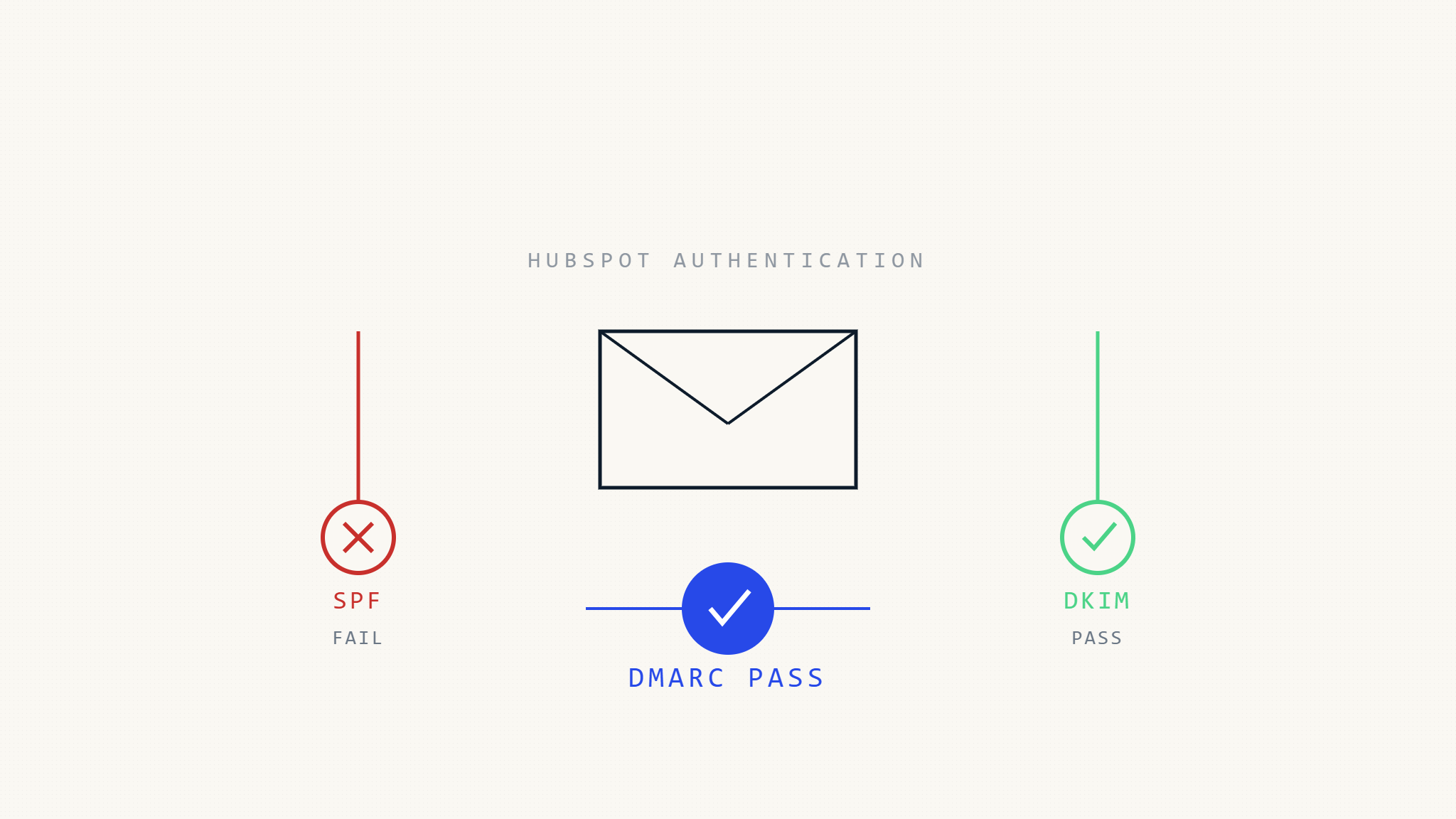
HubSpot email authentication can look healthy inside the platform while still showing SPF alignment failures in DMARC reports.
This is one of the most common blind spots for organizations using HubSpot for marketing, sales automation, CRM communication, customer onboarding, and lifecycle campaigns.
A domain may appear connected, verified, or authenticated in HubSpot. DKIM may be configured. DMARC may be passing for most messages. Delivery may look stable.
But when the domain owner reviews DMARC aggregate reports, the HubSpot stream may show a different picture:
- SPF may pass technically but fail DMARC alignment
- SPF alignment may be very low across HubSpot traffic
- DMARC may pass mainly through DKIM
- DKIM may be the only reliable authentication path
- A small percentage of HubSpot messages may fail DMARC when DKIM fails or is not applied correctly
This does not always mean HubSpot is broadly failing.
It means the organization needs to understand how HubSpot authentication works in real receiver-side data, not only inside the HubSpot interface.
I. The Core Issue: HubSpot May Pass DMARC Through DKIM, Not SPF
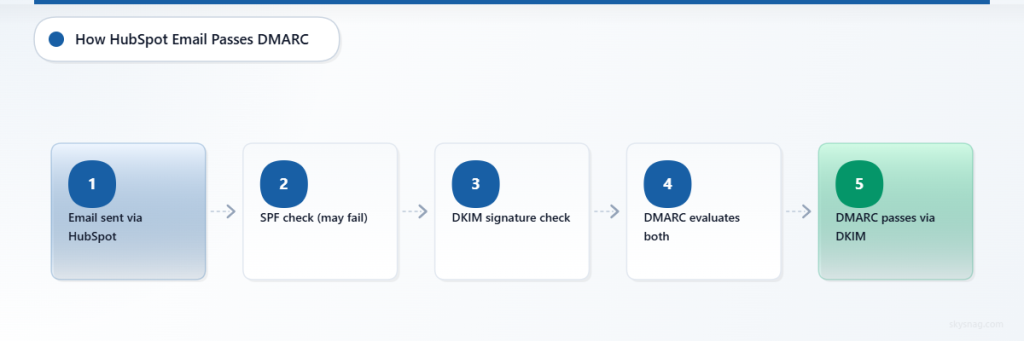
DMARC does not require both SPF and DKIM to pass.
DMARC passes when at least one authentication method passes and aligns with the visible From domain:
- SPF passes and aligns
- DKIM passes and aligns
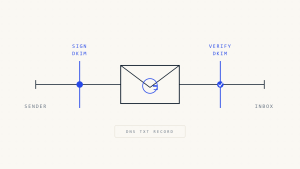
If HubSpot signs email with aligned DKIM, DMARC can pass even when SPF does not align.
That is why many organizations see HubSpot traffic passing DMARC overall while still showing weak SPF alignment.
The issue appears when DKIM does not hold.
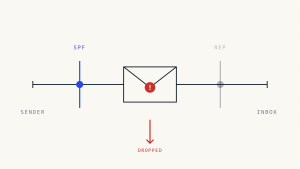
If DKIM fails and SPF is not aligned, DMARC has no fallback authentication method. That specific message can fail DMARC.
This is why a small failure rate can still matter.
A domain may show only 0.31% failed HubSpot traffic, but that failure may reveal a deeper dependency: HubSpot email is passing mainly through DKIM, while SPF is not acting as a reliable backup.
II. SPF Pass Is Not the Same as SPF Alignment
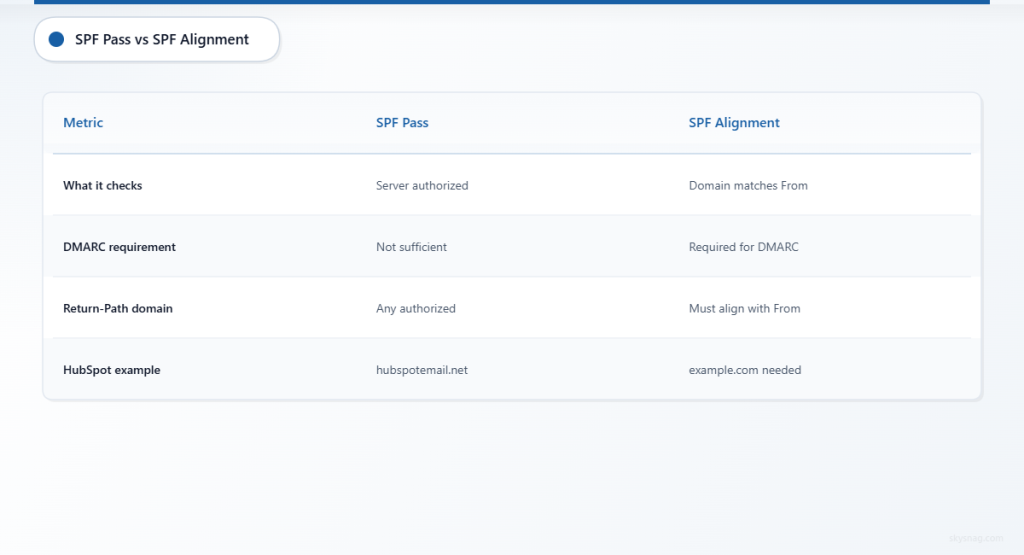
SPF checks whether the sending server is authorized to send for the return-path domain.
DMARC does something more specific.
For SPF to help DMARC pass, the SPF-authenticated return-path domain must align with the visible From domain.
That difference matters.
A simplified HubSpot example:
Visible From: [email protected]
Return-Path: [email protected]
SPF result: pass
SPF alignment with example.com: fail
DKIM result: pass with d=example.com
DMARC result: pass through DKIM
In this case, SPF may pass technically, but it does not help DMARC because the SPF domain does not align with the visible From domain.
DKIM is carrying the DMARC result.
That can be acceptable if DKIM is stable, but it creates a dependency.
III. Why Many HubSpot Customers Miss This
Many HubSpot customers do not know that platform authentication and DMARC alignment are not the same thing.
Inside HubSpot, the sending domain may appear authenticated. That can create the impression that SPF, DKIM, and DMARC are fully aligned across all sending scenarios.
But DMARC reports may show a more detailed reality.
Customers often assume:
- HubSpot says the domain is authenticated, so SPF and DKIM are both aligned
- A connected sending domain means all HubSpot traffic is protected
- Low DMARC failure volume means there is no risk
- SPF failures do not matter if DMARC is passing
- Shared infrastructure has no impact on authentication visibility
- Dedicated IP automatically fixes all authentication issues
- DKIM pass means there is no need to monitor SPF alignment
Those assumptions can be wrong.
A HubSpot domain can appear authenticated while DMARC reports still show that SPF is not aligned for much of the actual sending stream.
IV. Why This Can Have Sending Repercussions
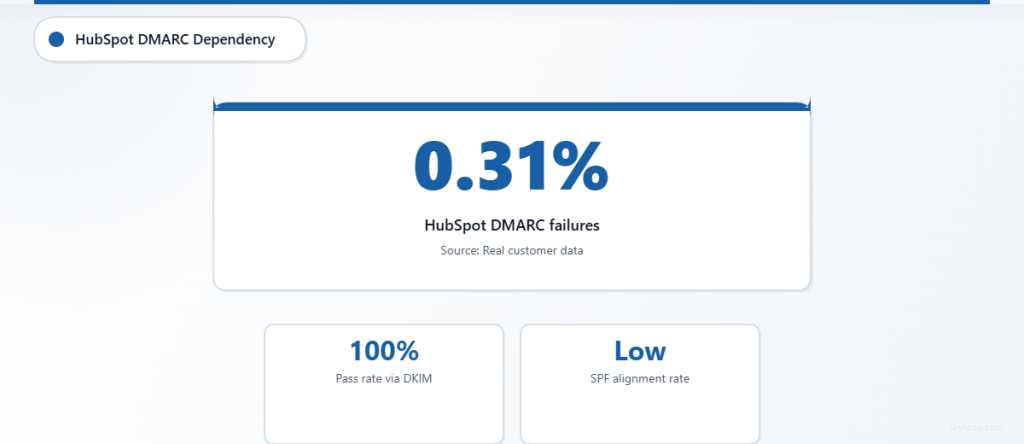
Low SPF alignment does not automatically mean HubSpot email will fail delivery.
But it can create sending risk.
The risk appears when HubSpot messages rely almost entirely on DKIM to pass DMARC. If DKIM remains healthy, the messages pass. If DKIM fails, breaks, or is missing on a specific stream, there may be no aligned SPF result to keep DMARC passing.
This can lead to:
- Higher DMARC failure rates on specific HubSpot campaigns
- Filtering or rejection when the domain is at
[p=quarantine]orp=reject - Reduced resilience during forwarding or message modification
- Harder troubleshooting because HubSpot may look authenticated while receiver-side reports show failures
- Confusion between HubSpot’s domain authentication status and real-world DMARC alignment results
- Customer-facing messages being treated differently by receiving mailbox providers
This matters especially for:
- Lead nurturing campaigns
- Sales automation
- Customer onboarding emails
- Billing reminders
- Support communications
- Webinar confirmations
- Product updates
- Security or account notifications
The issue is not that HubSpot cannot send.
The issue is that many customers do not realize their HubSpot DMARC pass result may depend mostly on DKIM while SPF is not providing a reliable fallback path.
V. How HubSpot Email Authentication Works
HubSpot allows organizations to connect an email sending domain and configure authentication records for email sending.
In HubSpot’s authentication flow, organizations may configure records for DKIM, SPF, and DMARC depending on their setup.
DKIM is often the most important DMARC pass path for HubSpot because DKIM can sign messages with the customer’s sending domain.
HubSpot also documents custom return-path configuration for email sending domains. A custom return-path can support SPF alignment because DMARC checks whether the return-path domain aligns with the visible From domain.
That means HubSpot SPF alignment may depend on whether the return-path is configured, how the sending domain is set up, and whether the account’s email sending configuration supports the required return-path behavior.
The practical takeaway:
Do not only ask whether HubSpot is authenticated.
Ask whether HubSpot is aligned in DMARC reports.
VI. Common HubSpot SPF Failure Patterns
VII. 1. SPF Passes but Does Not Align
This is the most common pattern.
SPF may pass for HubSpot’s infrastructure domain, but the return-path domain does not align with the visible From domain.
Result:
- SPF: pass
- SPF alignment: fail
- DKIM: pass
- DMARC: pass through DKIM
This is not a total authentication failure, but it means SPF is not helping DMARC.
VIII. 2. DKIM Passes and Carries DMARC
In many HubSpot configurations, DKIM is the main reason DMARC passes.
That means the organization should monitor DKIM closely.
If DKIM is stable and aligned, HubSpot traffic can be healthy.
But if DKIM breaks, the lack of SPF alignment becomes visible.
IX. 3. DKIM Fails and SPF Is Not Aligned
This is where DMARC failures appear.
Result:
- SPF: pass or fail
- SPF alignment: fail
- DKIM: fail
- DMARC: fail
This may only affect a small percentage of traffic, but those failures can matter if the stream is customer-facing or business-critical.
X. 4. HubSpot Shows Authenticated, but Not Every Stream Behaves the Same
A company may authenticate one sending domain in HubSpot, then later add:
- New campaigns
- New automation workflows
- New subdomains
- New connected domains
- New teams or business units
- New integrations
- New forms or lead flows
Not every stream should be assumed healthy because the main domain is connected.
DMARC reports should be used to verify what is actually happening.
XI. 5. Custom Return-Path Is Missing or Misconfigured
A custom return-path can help SPF alignment when it is configured correctly.
If it is missing, misconfigured, or not available for the specific setup, SPF may not align even if DKIM is passing.
This does not automatically break DMARC, but it removes SPF as a reliable backup path.
XII. 6. Dedicated IP Is Treated as a Complete Fix
A dedicated IP can provide more control over sending reputation and return-path behavior.
But a dedicated IP alone does not guarantee DMARC alignment.
The organization still needs correct:
- SPF authorization
- Return-path alignment
- DKIM signing
- DKIM alignment
- DMARC policy
- DNS records
- Monitoring
A dedicated IP improves control. It does not replace authentication monitoring.
XIII. Shared IP Pools and Reputation Behavior
HubSpot commonly operates through shared email infrastructure.
Shared infrastructure does not automatically mean poor reputation.
Large email platforms can maintain shared sending pools with abuse controls, monitoring, throttling, and reputation management. However, shared infrastructure means senders do not control every signal attached to the sending environment.
That matters when reviewing authentication and deliverability.
Shared sending introduces considerations such as:
- Shared IP reputation behavior
- Platform-level abuse management
- Sender-specific domain reputation
- DKIM alignment quality
- SPF alignment quality
- Complaint rates
- Engagement signals
- Campaign content
- List quality
- Stream separation between marketing and critical communication
The goal is not always to avoid shared infrastructure.
The goal is to understand which streams use it, whether they authenticate correctly, and whether the organization needs more control for critical sending use cases.
XIV. Why a Low Failure Rate Still Matters
A low HubSpot DMARC failure rate may not indicate a major outage.
For example, if failed traffic is around 0.31%, the overall authentication picture may still be stable.
But low percentage does not always mean low importance.
The failed messages may include:
- High-value customer communications
- Sales opportunity emails
- Support replies
- Billing-related reminders
- Event confirmations
- Campaigns tied to revenue
- Messages from a specific subdomain
- Emails affected by a workflow or template issue
At scale, a small percentage can represent meaningful volume.
More importantly, small failure percentages can reveal structural dependency.
If most HubSpot traffic passes through DKIM and SPF is not aligned, then the organization should treat DKIM failure as a priority issue.
The right question is not only:
“Is HubSpot passing DMARC?”
The better question is:
“If DKIM fails, does HubSpot have an aligned SPF fallback?”
If the answer is no, the organization should monitor that risk.
XV. How to Investigate HubSpot SPF Failures
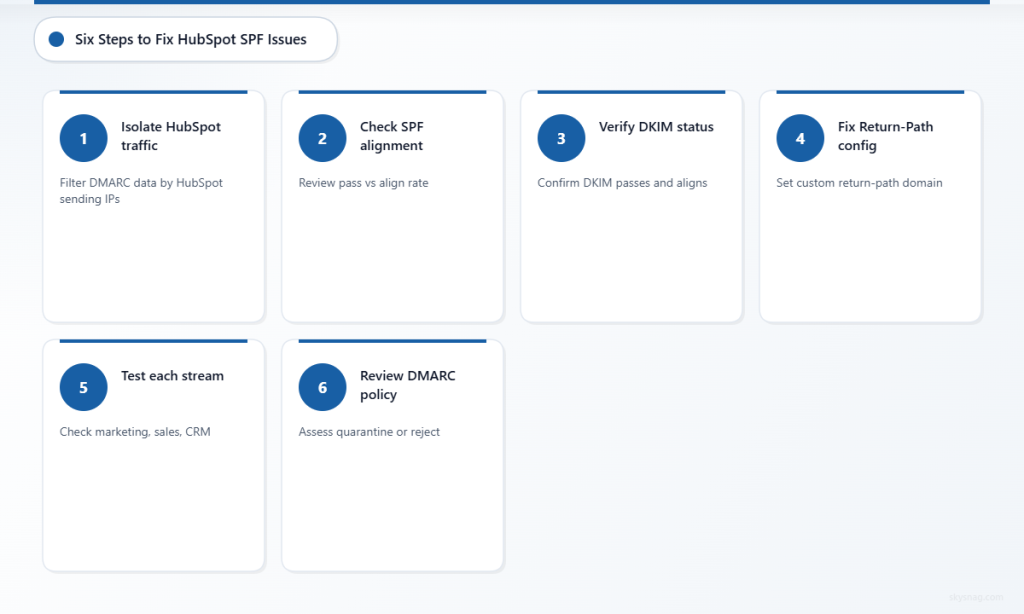
XVI. Step 1: Separate HubSpot Traffic from Other Senders
Do not evaluate the entire domain as one block.
Separate HubSpot traffic from other senders such as:
- Google Workspace
- Microsoft 365
- Amazon SES
- Salesforce
- Zendesk
- Mailchimp
- SendGrid
- Postmark
- Custom applications
- Legacy servers
This prevents HubSpot-specific behavior from being hidden inside the domain average.
XVII. Step 2: Check SPF Pass vs SPF Alignment
For HubSpot traffic, review:
- Did SPF pass?
- Which domain passed SPF?
- Did the SPF domain align with the visible From domain?
- Was alignment relaxed or strict?
- Did DMARC pass through SPF or DKIM?
SPF passing alone is not enough.
If SPF passes but does not align, SPF is not helping DMARC.
XVIII. Step 3: Confirm DKIM Is Passing and Aligned
Check whether HubSpot DKIM is doing the DMARC work.
Confirm:
- DKIM is present
- DKIM passes
- DKIM
d=aligns with the visible From domain - The selector matches the expected HubSpot configuration
- All relevant HubSpot streams are covered
If DKIM is the main DMARC pass path, it should be monitored continuously.
XIX. Step 4: Review Return-Path Configuration
Review whether HubSpot is using a return-path domain that aligns with the From domain.
If a custom return-path is available and appropriate for the account, configure it carefully and verify the DNS records.
A custom return-path can improve SPF alignment because DMARC evaluates SPF alignment against the return-path domain.
XX. Step 5: Look for Stream-Specific Failures
Once the main HubSpot stream is understood, investigate the small failure percentage.
Look for patterns by:
- Campaign
- Subdomain
- Workflow
- Sending IP
- DKIM selector
- Message type
- Date and time
- Forwarding route
- Recipient domain
This helps determine whether the issue is broad, isolated, or tied to a specific configuration.
Step 6: Review DMARC Policy Before Enforcement
If the domain is still at p=none, HubSpot failures may be visible but not actively enforced.
If the domain moves to p=quarantine or p=reject, misaligned or failing messages may be filtered or rejected depending on the receiving provider.
Before moving toward enforcement, verify that HubSpot and every other legitimate sender has at least one aligned authentication path.
Avoid relying on percentage-based rollout as the primary strategy. Current DMARC-aware programs should stage enforcement by domain, subdomain, sender group, and business function.
What to Tell Customers About HubSpot SPF Failures
The right explanation should be balanced.
Do not present low SPF alignment as a total HubSpot failure if overall failed volume is low.
But do not dismiss it either.
A clear customer-facing explanation is:
HubSpot traffic is mostly passing DMARC through DKIM. SPF alignment is weak across much of the HubSpot stream, which means SPF is not acting as a reliable fallback. As long as DKIM remains valid and aligned, DMARC passes. However, if DKIM fails on a subset of HubSpot messages, those messages may fail DMARC because SPF is not aligned. The current failed volume may be low, but the SPF alignment gap should be treated as a resilience and monitoring concern.
That wording explains the issue without creating unnecessary alarm.
How Skysnag Protect Helps Identify HubSpot SPF Failures

Skysnag Protect helps organizations understand how HubSpot and other SaaS senders are actually authenticating in receiver-side data.
Instead of only checking whether DNS records exist, Skysnag shows whether each sender is passing SPF, DKIM, and DMARC with alignment.
For HubSpot, Skysnag Protect can help identify:
- Whether HubSpot is passing DMARC through DKIM or SPF
- Whether SPF is technically passing but failing alignment
- Which HubSpot streams are failing DKIM
- Whether specific campaigns or subdomains are causing failures
- Whether return-path alignment is configured correctly
- Whether unauthorized sources are using the domain
- Whether shared infrastructure behavior is affecting visibility
- Whether the domain is ready for stronger DMARC enforcement
This matters because HubSpot may show the domain as authenticated while DMARC reports still reveal alignment gaps.
Use Skysnag Protect to monitor HubSpot SPF failures, DKIM alignment, return-path behavior, and DMARC enforcement readiness:
Key Takeaways
HubSpot SPF failures do not always mean HubSpot email is broadly failing.
In many cases, HubSpot traffic passes DMARC through aligned DKIM while SPF alignment remains weak.
Many customers miss this because HubSpot may show the domain as authenticated even though DMARC reports show SPF is not aligned.
This can have sending repercussions if DKIM fails, if messages are modified, or if the domain is moved toward p=quarantine or p=reject.
SPF pass is not the same as SPF alignment. For SPF to help DMARC pass, the return-path domain must align with the visible From domain.
A custom return-path can improve SPF alignment when configured correctly.
A dedicated IP can provide more sending control, but it does not automatically solve authentication or alignment issues.
The safest approach is to monitor HubSpot through DMARC aggregate reports, verify DKIM alignment, review return-path configuration, and identify the small percentage of messages that fail.
Skysnag Protect helps organizations detect HubSpot SPF failures, monitor DKIM dependency, and understand whether HubSpot traffic is ready for stronger DMARC enforcement.