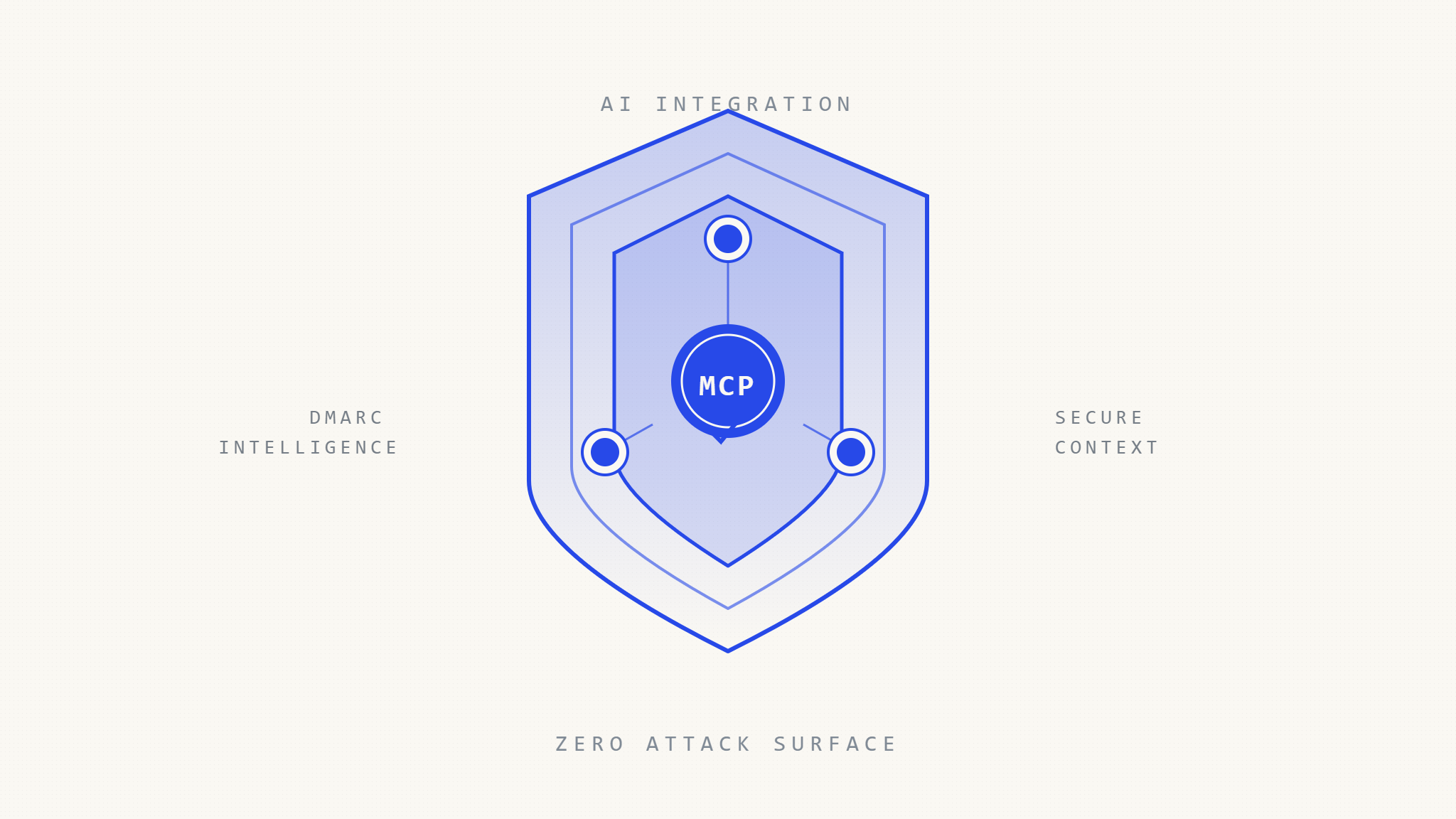
AI integration in DMARC platforms represents a significant opportunity and a critical architectural challenge. As organizations increasingly rely on AI driven email security intelligence, the fundamental question is not whether to integrate AI, but how to do so without compromising the security boundaries that make email authentication effective.
This analysis explores architectural patterns for secure AI DMARC integration, focusing on maintaining security boundaries while enabling advanced threat detection and automated response capabilities.
I. The Real Problem: Security Data Exposure
AI systems require access to security sensitive data to provide meaningful insights. DMARC reports contain authentication telemetry, threat intelligence, and organizational email patterns that, if improperly exposed, create new attack vectors for adversaries.
Traditional AI integration approaches often prioritize functionality over security boundaries, leading to:
- Overexposed telemetry data across organizational boundaries
- Uncontrolled tool access that bypasses established security workflows
- Expanded attack surface through new AI accessible endpoints
- Lack of auditability in automated security decisions
Uncontrolled AI access to DMARC data is not innovation—it is an expansion of the attack surface. It shifts risk from attackers to your own architecture.
The core architectural principle must be:
AI must operate within existing security boundaries—not redefine or bypass them.
II. Why Architecture Matters
In security architecture, convenience driven design is almost always a precursor to control failure.
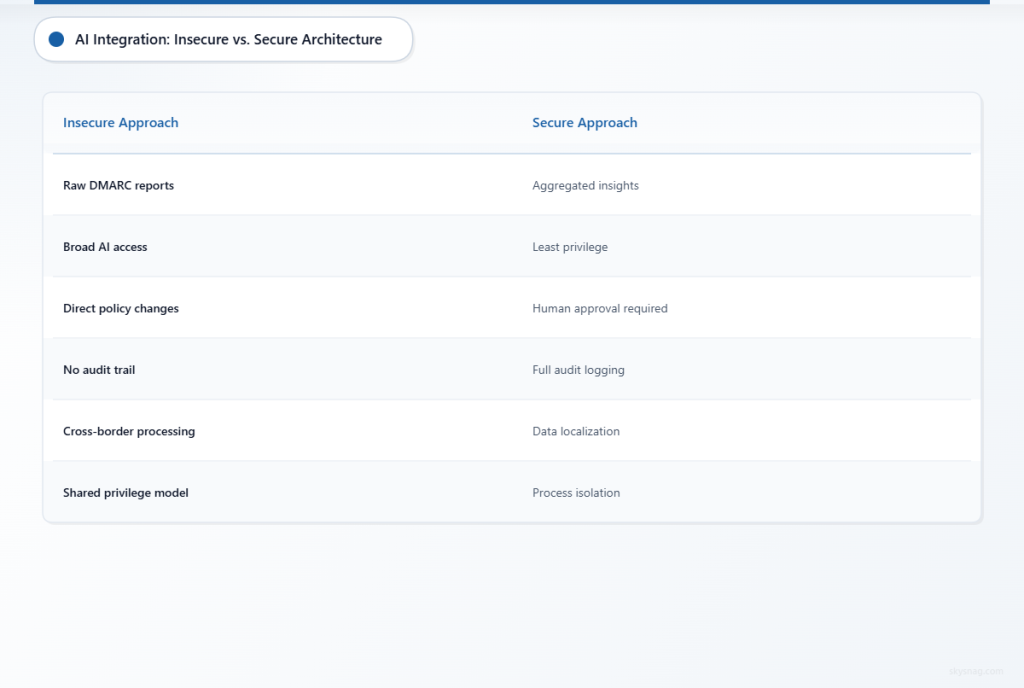
Security in AI DMARC integration is not about the AI models themselves. It is about architectural decisions governing how AI agents access, process, and act upon security data.
Poor architectural choices create cascading security failures:
Insufficient Data Minimization
AI agents receiving raw DMARC reports instead of processed insights expose sensitive authentication patterns and organizational email infrastructure details.
Privilege Creep
AI systems granted broad access for flexibility inevitably accumulate capabilities that exceed operational requirements.
Boundary Erosion
Integration patterns that blur lines between analysis and action enable AI agents to make security impacting changes without appropriate human oversight.
Audit Gaps
Architectures without comprehensive audit trails for AI actions create compliance risks and impede incident response.
III. Data Exposure Considerations
General Data Protection Regulation and similar privacy frameworks create specific obligations for organizations processing email authentication data through AI systems:
Cross Border Processing
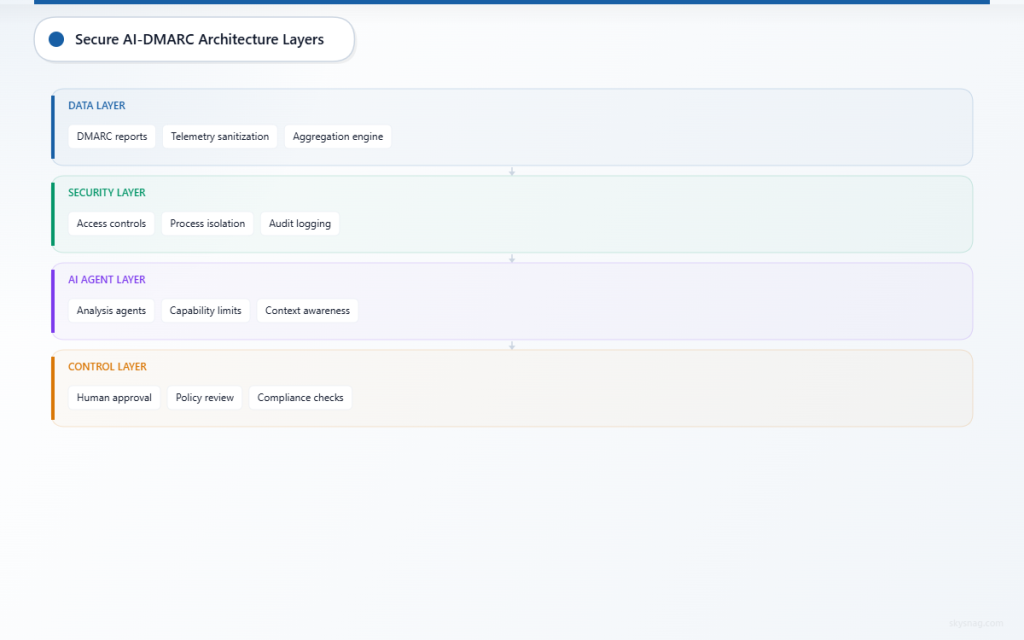
AI services often process data across geographic boundaries, potentially triggering data localization requirements. DMARC reports may contain metadata subject to residency restrictions in regulated industries.
Telemetry Sensitivity
Email authentication reports contain patterns revealing organizational communication structures, business relationships, and operational schedules. This metadata requires careful handling to prevent inadvertent disclosure.
Retention and Processing Purpose
AI training and analysis activities must align with stated data processing purposes and respect retention limitations.
Organizations must implement data minimization strategies. AI should receive aggregated insights—not raw DMARC reports.
IV. Integration Frameworks and Controls
Modern AI integration frameworks like MCP provide standardized approaches for managing AI human collaboration in security contexts. These frameworks establish:
Process Isolation
AI models operate in separate processes from core DMARC infrastructure, preventing direct memory access or privilege escalation.
Capability Constraints
Integration frameworks define specific capabilities that AI agents can exercise, enabling precise control over actions AI can perform.
Contextual Security
Dynamic security contexts adjust AI permissions based on operational state and threat levels.
However, integration frameworks are tools—not solutions. Their security value depends entirely on implementation decisions.
V. What Happens Without Controls
The absence of proper architectural controls creates predictable failure patterns:
Uncontrolled Data Access
Some implementations expose raw telemetry directly to AI systems, inadvertently revealing authentication patterns and creating new attack vectors for adversaries studying email security implementations.
Policy Manipulation
AI systems with modification capabilities can make security policy changes that impact email deliverability or reduce authentication effectiveness without sufficient human oversight.
Compliance Violations
Uncontrolled AI processing of email authentication data can lead to violations of data protection regulations and organizational data handling policies.
Incident Response Gaps
AI actions without comprehensive audit trails impede security incident response and create blind spots in security operations.
In these scenarios, AI becomes an amplification layer for existing weaknesses—not a security enhancement.
VI. Secure Integration Principles
Effective AI DMARC integration follows fundamental security principles:
Least Privilege Access
AI agents receive only minimum data access and capabilities necessary for their specific functions.
Data Minimization
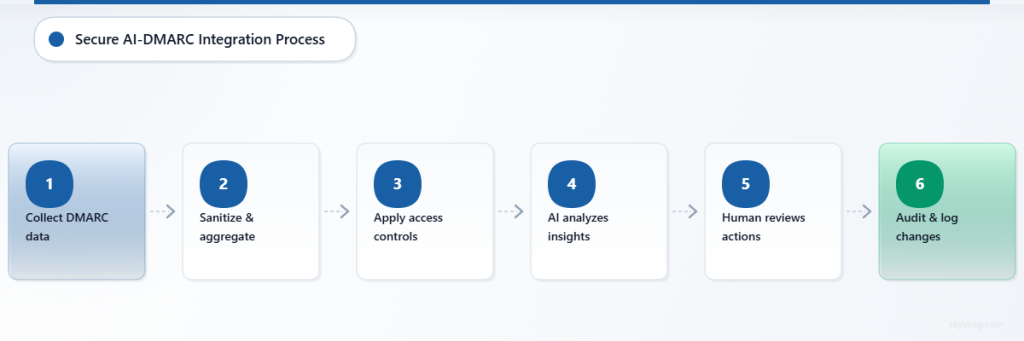
Security data flows to AI systems undergo sanitization and aggregation to remove sensitive details while preserving analytical value.
Separation of Concerns
Different AI functions operate through separate agents with distinct capability sets. Analysis functions remain isolated from policy modification functions.
Human in the Loop Controls
Critical security decisions maintain human approval requirements regardless of AI confidence levels.
Comprehensive Auditability
All AI actions, data access patterns, and decision rationales maintain detailed audit trails.
VII. Enterprise Requirements
Enterprise AI DMARC integration must address governance frameworks and compliance obligations:
Risk Management Integration
AI security decisions integrate with existing enterprise risk management frameworks.
Compliance Alignment
Integration patterns support industry specific compliance requirements including SOC 2, ISO 27001, and applicable regulatory frameworks.
Governance Frameworks
AI operations align with established IT governance processes, including change management and approval workflows.
Business Continuity
AI integration includes failover mechanisms and manual override capabilities.

Skysnag Protect is built on a privacy first AI architecture where intelligence is applied without exposing raw DMARC data or expanding the attack surface.
VIII. Architectural Implementation Patterns
Successful secure AI DMARC integration implements specific architectural patterns:
Capability Based Security
AI agents operate within capability based security models where permissions are granted for specific functions rather than broad system access.
Multi Agent Coordination
Complex environments deploy multiple AI agents with specialized functions, each with appropriate privilege boundaries.
Dynamic Context Adaptation
Security contexts adapt based on threat levels, enabling expanded AI capabilities during security incidents while maintaining minimal privileges during normal operations.
Validation and Approval Workflows
AI recommendations flow through validation and approval workflows appropriate to their potential impact.
IX. The Market Misconception
Many platforms are introducing AI chatbots and direct LLM integrations as a feature layer on top of DMARC data.
In practice, this often means exposing raw telemetry to external systems or expanding internal access without sufficient controls.
The result is not better security—it is a broader attack surface wrapped in a user friendly interface.
X. Conclusion: Trust Over Features
The future of email authentication depends on intelligent systems that enhance security effectiveness while maintaining the trust and reliability organizations require. This requires architectural discipline that prioritizes security boundaries over feature expansion.
Organizations implementing AI DMARC integration must resist maximizing AI capabilities at the expense of security controls. The most sophisticated AI analysis provides no value if it compromises the fundamental security principles that make DMARC effective.
Successful AI integration requires treating security as an architectural requirement, not an operational afterthought. By implementing proper data minimization, privilege controls, and governance frameworks, organizations can realize the benefits of AI enhanced email security intelligence while maintaining the security posture essential for effective DMARC deployment.
The goal is not to constrain AI—it is to ensure AI never operates outside the security model that protects your domain.