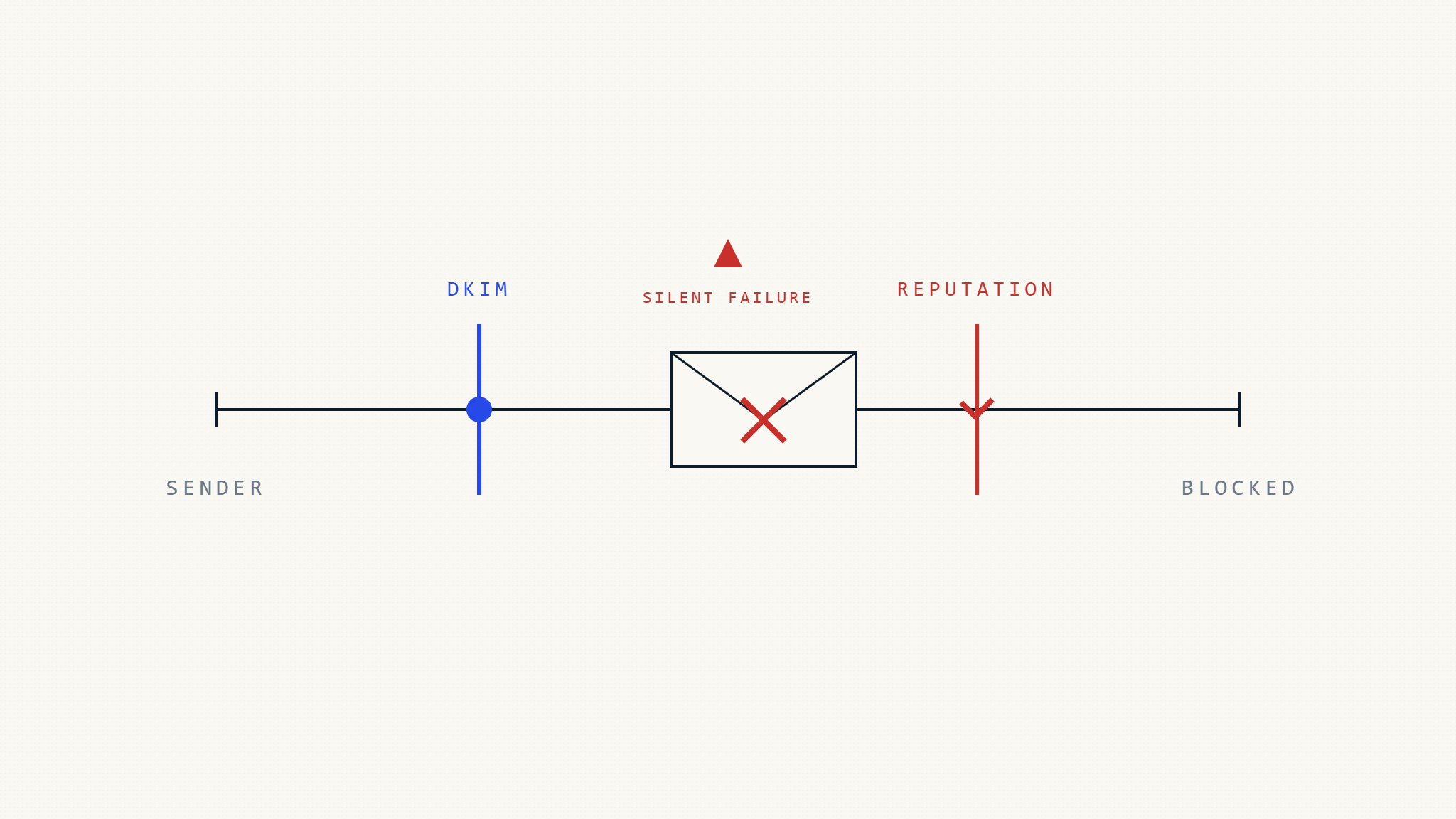
Your marketing emails are getting blocked, and the culprit might be hiding in plain sight. While most organizations focus on obvious spam triggers like subject lines or content filters, a more insidious problem often sabotages email deliverability: DKIM alignment failures that silently erode sender reputation over time.
Unlike hard bounces or obvious spam blocks, DKIM alignment issues create a gradual decline in email performance that’s difficult to trace. Your emails might still reach some recipients, but an increasing number get filtered to spam folders or blocked entirely—and you might not even know it’s happening.
I. What DKIM Alignment Really Means (And Why It’s Misunderstood)
DKIM (DomainKeys Identified Mail) alignment isn’t just about having a valid DKIM signature—it’s about ensuring that signature aligns with the domain in your email’s “From” header. This distinction trips up even experienced IT teams.
Here’s where it gets tricky: DKIM can pass authentication but still fail alignment. Your email might have a perfectly valid DKIM signature from your email service provider, but if that signature’s domain doesn’t align with your “From” domain, DMARC treats it as a failure. This misalignment tells receiving systems that while the email is technically authentic, it’s not properly authorized by your domain.
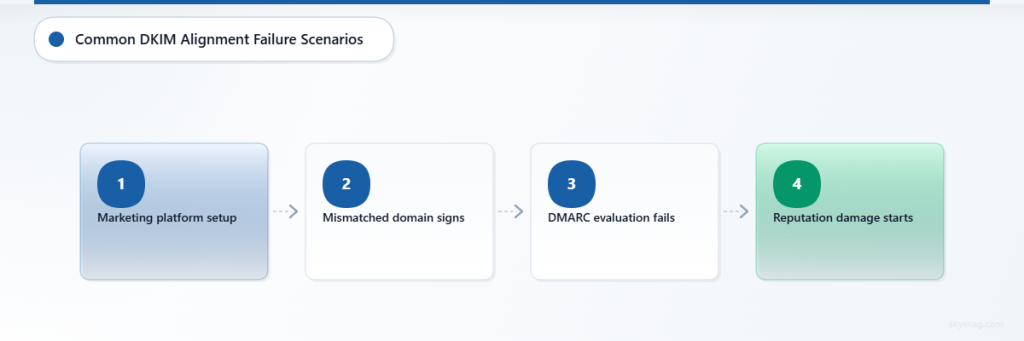
Common DKIM Alignment Failure Scenarios
Marketing Platform Misconfigurations: Your marketing emails show “From: yourcompany.com” but carry DKIM signatures from your email service provider’s domain (like mailchimp.com or constantcontact.com). The signature is valid, but it doesn’t align with your company domain.
Subdomain Strategy Errors: You’re sending from marketing.yourcompany.com with DKIM signatures for yourcompany.com. Without relaxed alignment configured, this creates a mismatch that fails DMARC evaluation.
Multiple Platform Complexity: Different email platforms (transactional, marketing, support) use different DKIM configurations, creating inconsistent alignment patterns that confuse receiving systems and damage overall domain reputation.
II. The Silent Reputation Damage You Can’t See
DKIM alignment failures don’t just affect individual emails—they create a pattern of authentication inconsistency that gradually destroys your sender reputation across major email providers. This damage accumulates over time and becomes increasingly difficult to reverse.
Gmail’s Reputation Algorithm: Google’s systems track authentication consistency over time. Frequent DKIM alignment failures signal to Gmail that your domain has poor email hygiene, leading to increasingly aggressive filtering of your messages.
Microsoft’s Sender Intelligence: Outlook.com and Exchange Online use authentication patterns as key reputation signals. Mixed alignment results can trigger their “suspicious sender” algorithms, routing your emails to spam folders without notification.
Cumulative Trust Erosion: Each alignment failure chips away at the trust relationship between your domain and receiving systems. Unlike content-based filtering that affects individual messages, reputation damage affects all future emails from your domain.
Why This Damage Is So Difficult to Detect
Traditional email analytics don’t reveal DMARC alignment failures clearly. Your marketing platform might report high delivery rates while alignment failures are silently degrading your reputation. The lag between alignment issues and visible deliverability problems means the root cause often goes unidentified for months.
Many organizations only discover alignment problems when they implement DMARC monitoring, revealing that emails they thought were properly authenticated have been failing alignment checks all along.
III. How DKIM Alignment Failures Sabotage Marketing Campaigns
Marketing emails are particularly vulnerable to DKIM alignment issues because they often involve complex sending infrastructure and multiple third-party platforms. Unlike transactional emails sent directly from your servers, marketing campaigns frequently use specialized platforms that introduce alignment challenges.
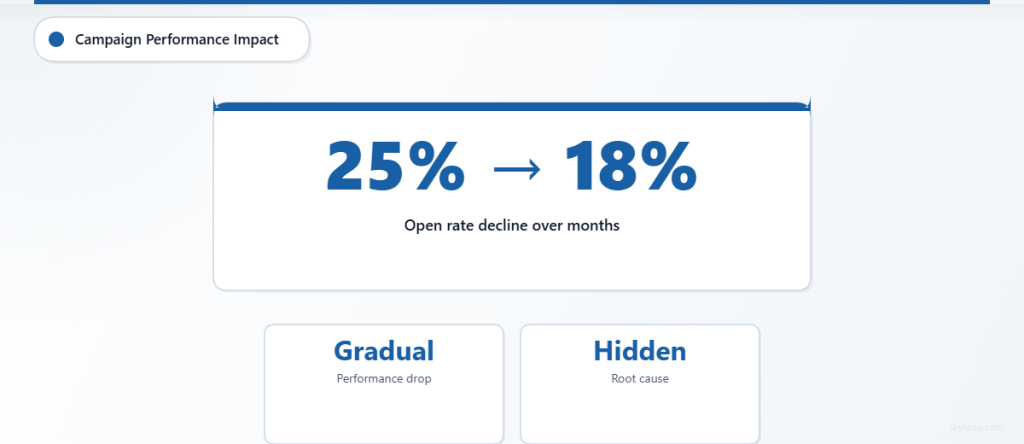
Campaign Performance Degradation: Even minor DKIM alignment issues can cause gradual performance decline. Your open rates might drop from 25% to 18% over several months as more messages get filtered to spam folders—a change that’s easy to attribute to other factors.
Inconsistent Delivery Patterns: Some recipients receive your emails normally while others never see them. This inconsistency frustrates customers and creates uneven engagement patterns that further damage sender reputation.
Compounding Reputation Effects: As alignment failures accumulate negative reputation signals, the threshold for content-based filtering becomes lower. Emails that would normally pass through start getting blocked, creating a downward spiral in deliverability.
The Multi-Platform Amplification Problem
Modern marketing operations often use multiple email platforms simultaneously: dedicated marketing tools for campaigns, CRM systems for sales outreach, and support platforms for customer communications. Each platform may have different DKIM configurations, creating a complex web of potential alignment failures.
When your domain sends emails with inconsistent authentication patterns across platforms, receiving systems interpret this as evidence of poor email governance or potential abuse. This perception spreads across all your email communications, not just the problematic platform.
IV. Technical Implementation: Fixing DKIM Alignment
Resolving DKIM alignment requires coordinated configuration across your DNS, email platforms, and DMARC policy. The solution involves ensuring that every email platform you use can create DKIM signatures that align with your sending domain.
Platform-Specific DKIM Configuration
Marketing Platform Setup: Configure your email marketing platform to sign emails with your domain’s DKIM key rather than their default domain. This requires adding specific CNAME records to your DNS that delegate signing authority to the platform while maintaining alignment.
Subdomain Strategy: Implement a consistent subdomain approach where marketing emails send from marketing.yourcompany.com with properly configured DKIM for that subdomain. Ensure your DMARC policy specifies relaxed alignment to allow subdomain matching.
Cross-Platform Coordination: Audit all platforms that send emails on your behalf. Each must either use aligned DKIM signatures or be explicitly included in your SPF record with proper configuration to ensure at least one authentication method aligns.
DNS Configuration Requirements
Your DNS configuration must support DKIM alignment across all sending platforms. This involves creating specific CNAME records that allow external platforms to generate aligned signatures while maintaining security.
# Example DKIM DNS configuration for marketing platform
dkim._domainkey.marketing.yourcompany.com. IN CNAME dkim.platform.provider.com.
The exact configuration depends on your email platforms, but the principle remains consistent: enable external platforms to create signatures that align with your domain structure.
Common Implementation Failures to Avoid
Incomplete Platform Coverage: Fixing DKIM alignment on your primary marketing platform while leaving other platforms misaligned doesn’t solve the reputation problem. All platforms must be properly configured for consistent authentication.
DNS Propagation Oversight: DKIM changes require proper DNS propagation time. Testing alignment immediately after DNS changes may show failures that resolve within 24-48 hours. Always verify configuration after full propagation.
DMARC Policy Misalignment: Your DMARC policy’s alignment setting (strict vs. relaxed) must match your DKIM implementation strategy. Subdomain approaches require relaxed alignment, while direct domain signing can use strict alignment.
V. Monitoring and Preventing Future Alignment Issues
DKIM alignment isn’t a one-time configuration—it requires ongoing monitoring to catch issues before they damage sender reputation. Email platforms change their configurations, new services get added, and DNS changes can break existing setups.

Skysnag Protect provides comprehensive DMARC monitoring that reveals DKIM alignment failures across all your email platforms. Rather than waiting for deliverability problems to surface, you can identify and fix alignment issues immediately.
Key Monitoring Indicators
Authentication Consistency Trends: Track the percentage of your emails that achieve DKIM alignment over time. Sudden drops indicate configuration problems that need immediate attention.
Platform-Specific Failure Patterns: Monitor which email platforms are generating alignment failures. This helps identify which systems need configuration updates or replacement.
Reputation Recovery Metrics: After fixing alignment issues, monitor how quickly your sender reputation improves across different email providers. Full recovery can take several weeks of consistent proper authentication.
Automated Alert Configuration
Set up automated alerts for DKIM alignment failure rates exceeding 5% of total email volume. Early detection allows you to address configuration problems before they significantly impact campaign performance.
Monitor new email platforms or services that might start sending emails from your domain without proper authentication configuration. Shadow IT email solutions are a common source of sudden alignment problems.
VI. Key Takeaways
DKIM alignment failures represent a hidden threat to email deliverability that gradually erodes sender reputation without obvious warning signs. Unlike content-based filtering or obvious spam triggers, alignment issues create cumulative damage that affects all future email communications from your domain.
The solution requires comprehensive DKIM configuration across all email platforms, proper DNS setup to enable aligned signatures, and ongoing monitoring to catch issues before they impact campaign performance. Organizations that proactively address DKIM alignment see measurable improvements in email deliverability and engagement rates.
Don’t let hidden authentication failures sabotage your marketing efforts. Implement proper DKIM alignment monitoring and configuration to protect your sender reputation and ensure your messages reach their intended recipients.
Ready to uncover hidden email authentication issues affecting your deliverability? Skysnag Protect provides the visibility and tools you need to identify and resolve DKIM alignment problems before they damage your sender reputation.