Email authentication failures create an open door for attackers to impersonate your organization. Most CISOs deploy DMARC but struggle with what comes next: translating authentication data into actionable security intelligence.
The difference between having DMARC and having effective DMARC lies in monitoring the right metrics. Security teams often focus on implementation checkboxes rather than the operational intelligence that reveals threats, misconfigurations, and program gaps.
I. Why DMARC Metrics Matter for Executive Leadership
DMARC monitoring gives CISOs something many security controls can’t: quantifiable evidence of protection. Every message claiming to come from your domain creates a measurable authentication event. This generates data that translates directly into business risk metrics.
Authentication failures reveal two critical issues security teams need to address: active spoofing campaigns targeting your customers and configuration problems that could disrupt legitimate business communications. The Verizon Data Breach Investigations Report consistently identifies email as a primary attack vector, making authentication monitoring essential for threat detection.
Executive teams want concrete metrics showing security investment returns. DMARC monitoring delivers trackable KPIs that demonstrate protection improvements and support compliance reporting requirements. This becomes particularly valuable during budget cycles and audit preparations.
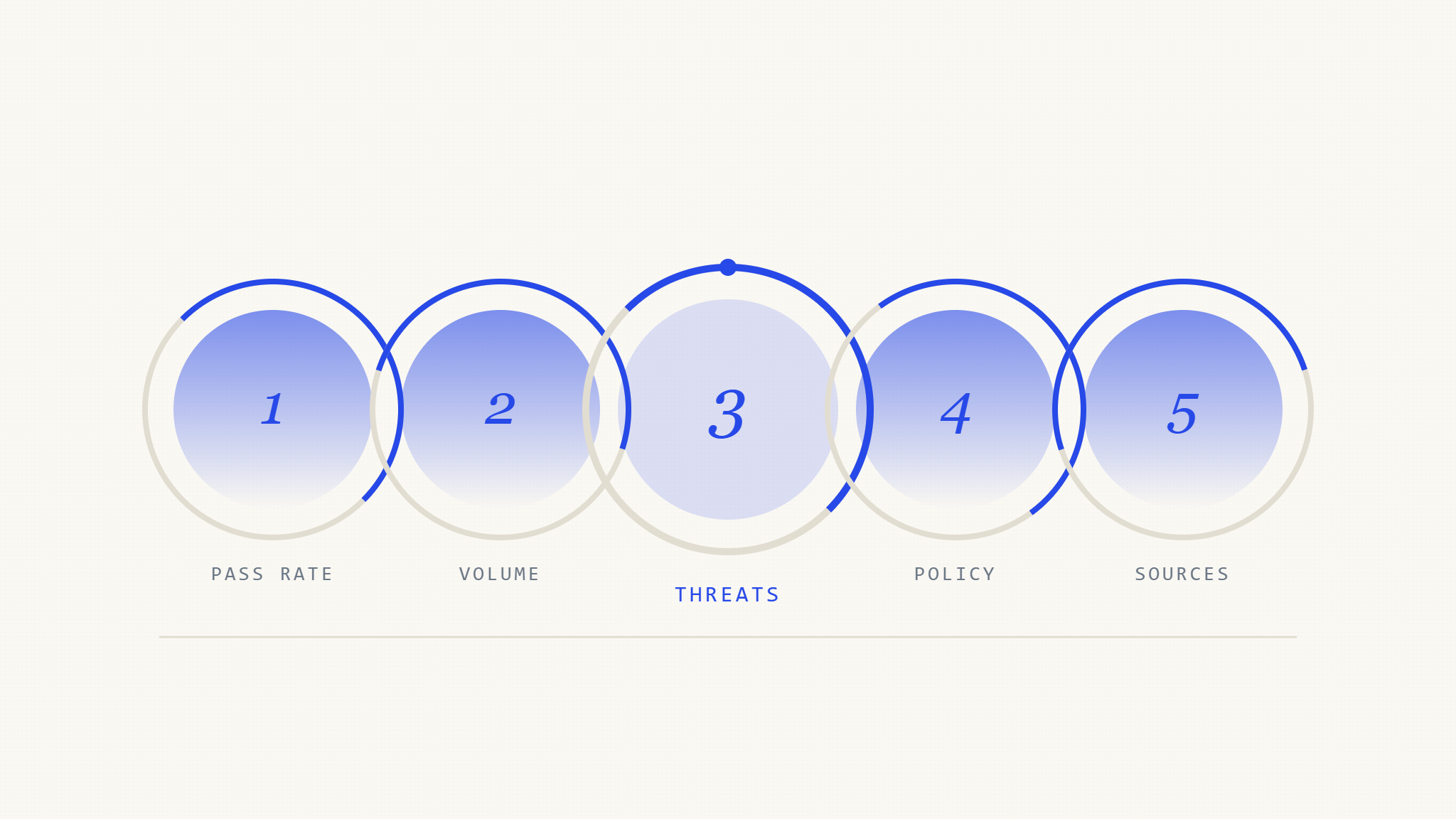
II. 5 Critical DMARC Monitoring Metrics for CISOs
1. Authentication Pass Rate
What it measures: Percentage of legitimate email successfully authenticating through SPF and DKIM checks before DMARC evaluation.
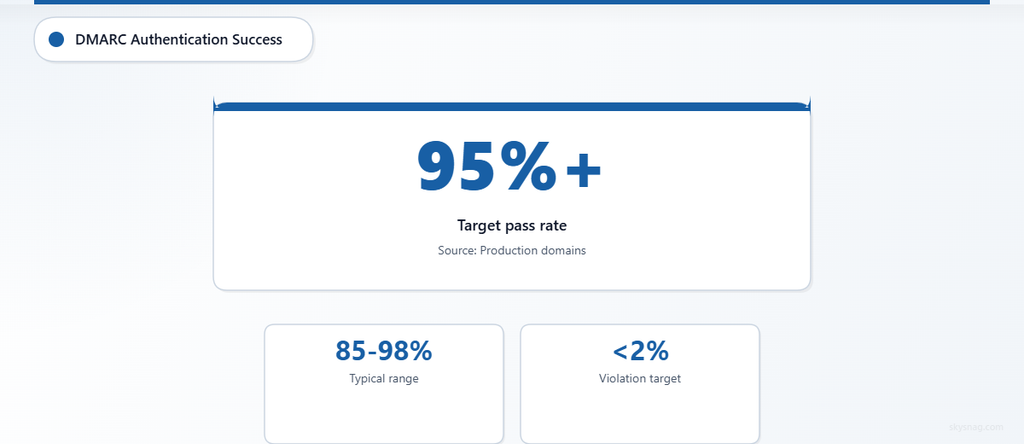
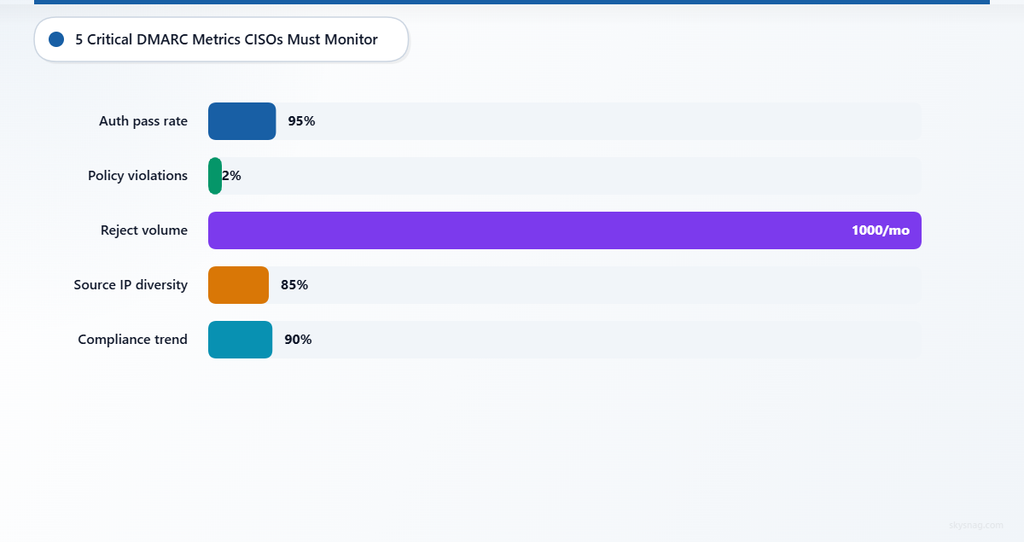
This metric reveals the health of your email infrastructure. Organizations typically see pass rates between 85-98% for legitimate mail. The variation depends on email complexity and how many third-party services send on your behalf.
Declining pass rates often signal configuration drift—someone changed email settings without updating authentication records. This creates security gaps and can disrupt business communications. Monitor weekly to catch problems before they escalate.
Security teams frequently overlook this metric, focusing instead on obvious failures. However, gradual authentication degradation indicates systemic issues requiring operational attention.
Target benchmark: 95% or higher for production domains with established email programs.
2. Policy Violation Rate
What it measures: Percentage of messages failing DMARC authentication checks, indicating potential spoofing attempts or misconfigurations.
Policy violations represent messages that failed both SPF and DKIM authentication while claiming to originate from your domain. These could be malicious spoofing attempts or legitimate email sources that need authentication setup.
Sudden spikes often correlate with active phishing campaigns using your domain for social engineering. Consistent violation rates above 5% typically indicate incomplete email source discovery during DMARC implementation.
Many security teams misinterpret this metric. Not all violations indicate attacks—new business services, marketing campaigns, or infrastructure changes can temporarily increase violation rates.
Target benchmark: Under 2% for mature DMARC implementations with comprehensive source identification.
3. Reject Rate and Volume
What it measures: Number and percentage of messages rejected by receiving mail systems due to DMARC policy enforcement.
This quantifies your DMARC policy’s protective impact. Organizations with “reject” policies typically see thousands of blocked spoofing attempts monthly. Track both absolute volume and percentage relative to total mail volume.
High rejection volumes with low legitimate authentication failures indicate effective protection without business disruption. This metric only applies to domains with DMARC policies set to “quarantine” or “reject” enforcement levels.
Implementation insight: Organizations often hesitate to move beyond “monitor” mode, but reject rates demonstrate the protection value of enforcement policies.
4. Source IP Diversity and Geolocation Patterns
What it measures: Number of unique IP addresses attempting to send email from your domain and their geographic distribution.
Legitimate email sources typically originate from predictable IP ranges—your email infrastructure and authorized service providers. Unusual geographic patterns or IP address proliferation may indicate spoofing campaigns or unauthorized email sources.
Monitor for IP addresses from countries where your organization has no business presence. Attackers often use compromised infrastructure in diverse geographic locations to evade detection and improve campaign success rates.
Security teams sometimes dismiss geographic anomalies as false positives. However, consistent patterns from unexpected regions warrant investigation and may reveal sophisticated attack campaigns.
Security application: This metric supports threat intelligence and helps identify emerging attack patterns targeting your domain.
5. Compliance Trend Analysis
What it measures: Changes in authentication success rates, policy adherence, and security posture over time.
Trend analysis reveals whether your DMARC program maintains effectiveness as your email environment evolves. Successful programs show improving authentication rates and decreasing violation incidents over 3-6 month periods.
Seasonal variations or periodic compliance degradation may indicate process gaps requiring operational attention. Organizations implementing new email services should expect temporary compliance fluctuations.
Track compliance trends monthly for strategic planning and quarterly for executive reporting. Consistent improvement demonstrates program maturity and justifies security investment.
III. Essential DMARC Monitoring Checklist
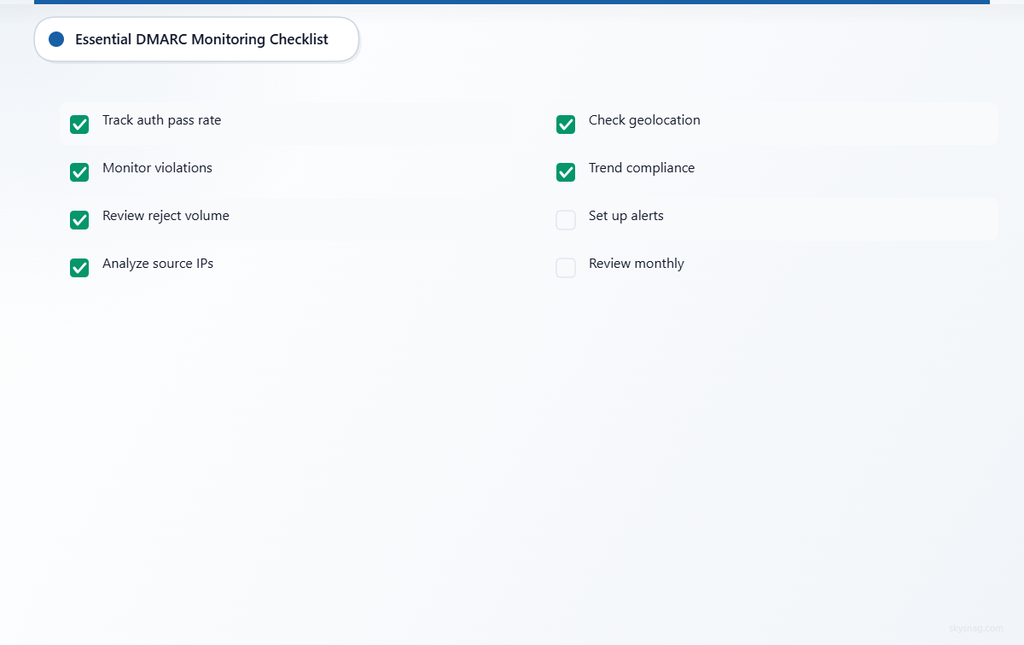
Establish monitoring capabilities that provide actionable intelligence for security decision-making. Implementation details depend on your email infrastructure, compliance requirements, and risk tolerance.
- Configure automated DMARC report collection and parsing from all receiving mail providers
- Establish baseline metrics for authentication pass rates across all monitored domains
- Set up alerting thresholds for sudden changes in policy violation rates or authentication failures
- Implement geographic and IP address monitoring to identify unusual email source patterns
- Create executive dashboards displaying key metrics with month-over-month trend comparisons
- Schedule weekly reviews of authentication failures to identify configuration issues or new email sources
- Establish quarterly compliance reporting processes for stakeholder communication and audit documentation
- Configure integration between DMARC monitoring data and existing security information management systems
- Document escalation procedures for authentication failures or suspected spoofing campaigns
- Plan regular validation of monitoring system accuracy and alert effectiveness
IV. Implementing Automated DMARC Monitoring
Manual analysis of DMARC reports becomes impractical as organizations scale their email authentication programs. Parsing XML reports from dozens of receiving providers quickly overwhelms security teams trying to extract actionable intelligence.
Modern DMARC monitoring requires automated data collection, analysis, and alerting capabilities that integrate with existing security operations. Effective platforms correlate DMARC data with broader security events, providing context for authentication failures and supporting incident response activities.

Skysnag Comply provides automated DMARC monitoring with executive-level dashboards and configurable alerting for these metrics. The platform aggregates data from multiple receiving providers, identifies trends, and generates compliance reports suitable for audit documentation and stakeholder communication.
Integration with security information and event management (SIEM) systems enables comprehensive threat visibility across email and other attack vectors. This correlation helps security teams distinguish between malicious activity and operational issues requiring different response approaches.
V. Key Takeaways
DMARC monitoring success depends on tracking authentication pass rates, policy violations, rejection volumes, source analysis, and compliance trends with appropriate context and trending analysis. These five metrics provide the foundation for maintaining program effectiveness.
Automated monitoring eliminates manual report analysis while providing timely alerts for security incidents or configuration issues. Executive dashboards enable data-driven security decisions and support compliance reporting requirements without overwhelming security teams with raw data.
Regular review of these metrics ensures your DMARC program continues protecting against domain spoofing while maintaining legitimate email deliverability. Organizations implementing comprehensive monitoring typically see measurable improvements in email security posture within 90 days of deployment.
Ready to implement automated DMARC monitoring with executive-level reporting? Start your Skysnag Comply assessment to establish comprehensive email authentication visibility for your organization.