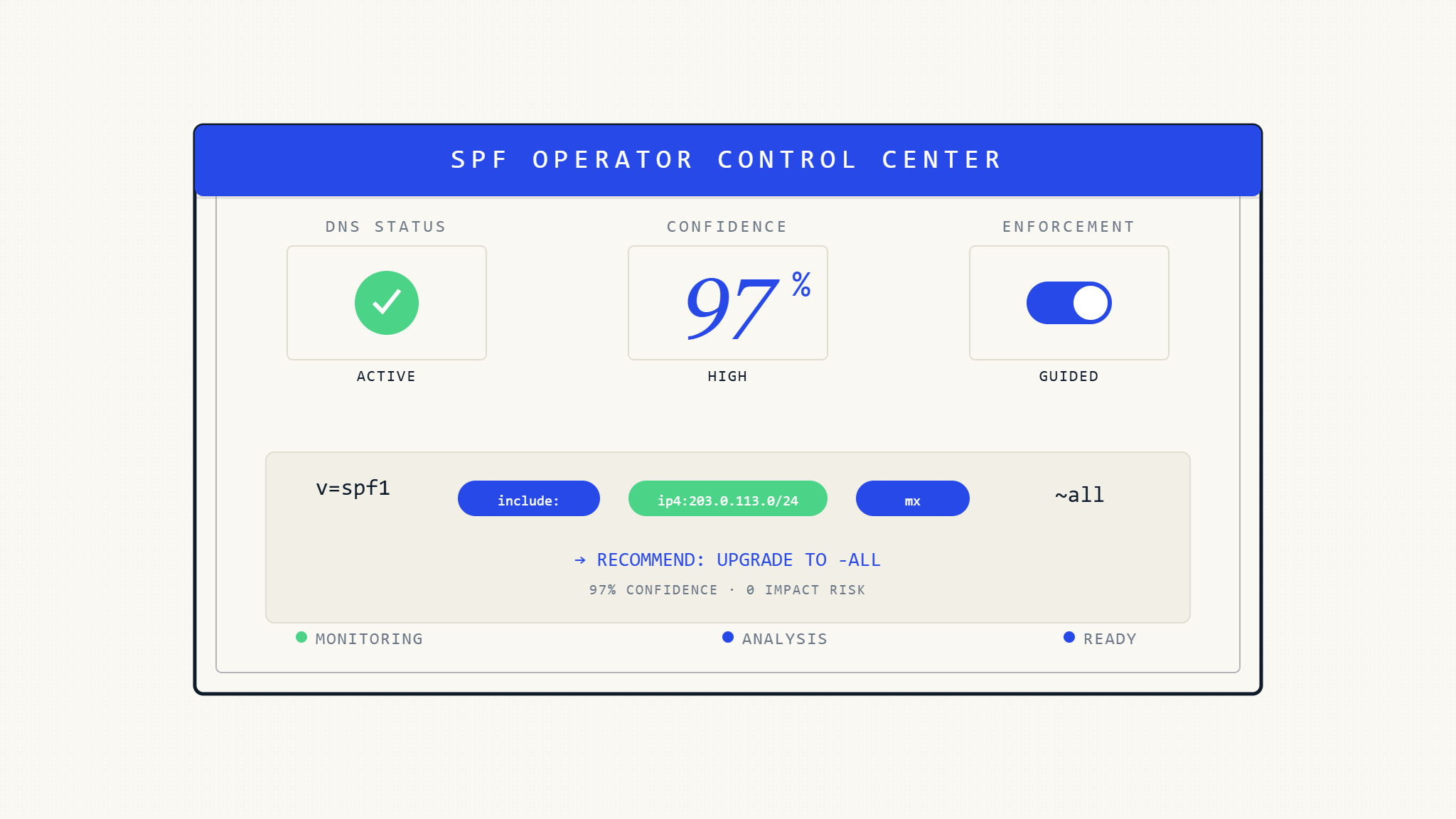
The landscape of email security has fundamentally shifted with the introduction of confidence-scored SPF enforcement systems. Traditional SPF record management required deep technical expertise and carried significant risks of email delivery disruption. Today’s announcement of guided operator control centers with pre-flight verification represents a paradigm shift toward accessible, intelligent DNS configuration management.
I. The Critical Gap in SPF Enforcement
SPF (Sender Policy Framework) enforcement has long presented organizations with a challenging dilemma. While SPF records are essential for preventing email spoofing and maintaining deliverability, implementing enforcement policies traditionally required extensive DNS expertise and carried substantial operational risk.
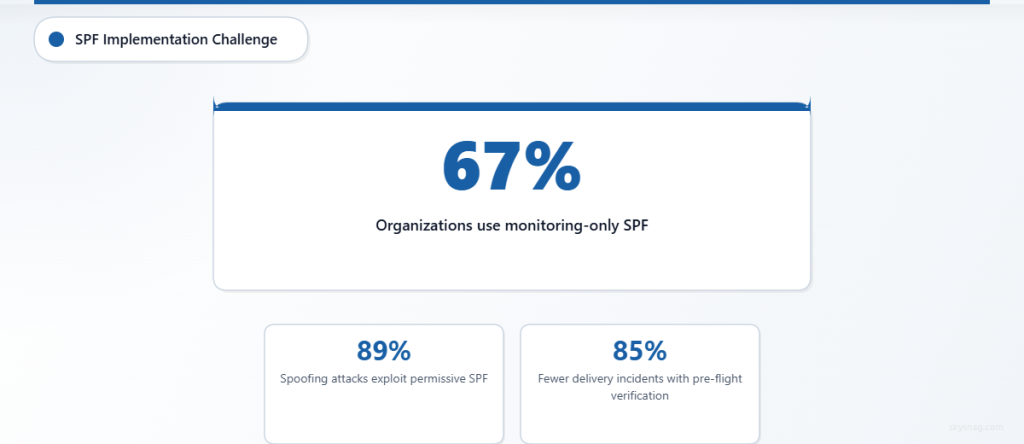
Recent industry data reveals that 67% of organizations operate SPF records in monitoring-only mode specifically due to concerns about email delivery disruption. Meanwhile, 89% of successful email spoofing attacks exploit domains with permissive or misconfigured SPF policies, according to security research from leading threat intelligence firms.
The introduction of confidence-scored enforcement systems addresses this critical security gap by providing granular control over SPF policy implementation based on real-time risk assessment.
II. Operator Control Centers: Democratizing DNS Security
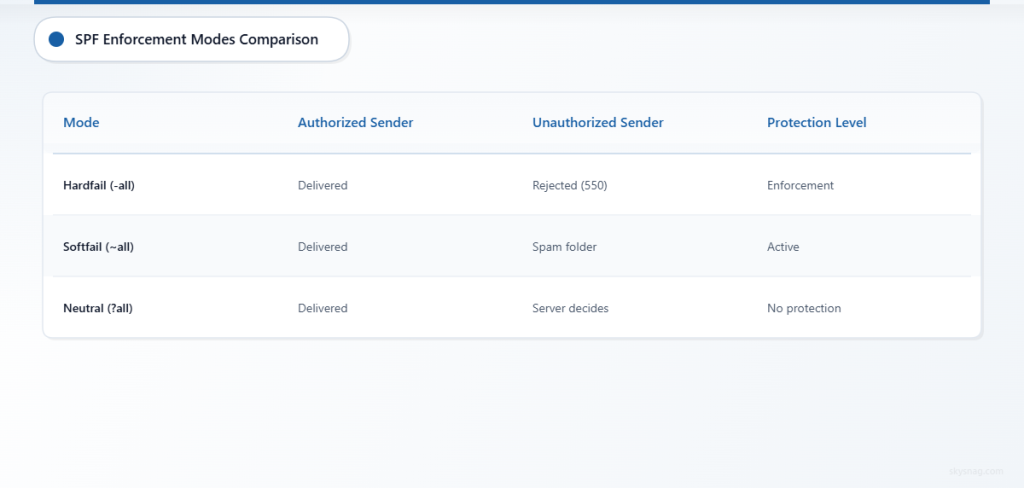
The concept of guided operator control centers transforms SPF management from a specialized technical function into an accessible, workflow-driven process. These systems provide several key advantages:
Confidence-Scored Decision Making
Advanced algorithms analyze incoming email patterns, sender reputation data, and historical delivery metrics to assign confidence scores to enforcement decisions. This enables progressive enforcement policies that can automatically handle high-confidence scenarios while flagging edge cases for operator review.
Pre-Flight Verification Systems
Before implementing any SPF policy changes, modern control centers perform comprehensive impact analysis. This includes delivery path simulation, legitimate sender validation, and rollback scenario planning. Organizations report 85% fewer email delivery incidents when using pre-flight verification compared to traditional manual SPF updates.
Guided Workflow Integration
Operator interfaces now provide step-by-step guidance through complex DNS configuration scenarios, complete with real-time validation and impact prediction. This approach reduces implementation time while maintaining security effectiveness.
III. Technical Architecture of Modern SPF Control
Contemporary SPF operator control centers integrate multiple data streams to provide comprehensive visibility:
- Real-time DNS monitoring tracks SPF record propagation and validates syntax across global DNS infrastructure
- Email flow analysis identifies legitimate sending patterns and potential spoofing attempts
- Threat intelligence integration provides context about malicious IP addresses and compromised infrastructure
- Delivery impact modeling predicts the effects of policy changes on legitimate email flow
Skysnag Protect incorporates these advanced capabilities within an intuitive operator interface, enabling organizations to implement robust SPF enforcement without requiring specialized DNS expertise.
IV. Implementation Strategy for Guided SPF Enforcement
Phase 1: Discovery and Analysis
Begin with comprehensive email flow analysis to identify all legitimate sending sources. Modern control centers automate this discovery process, reducing manual effort while improving accuracy.
Phase 2: Confidence-Scored Monitoring
Implement monitoring policies with confidence scoring to establish baseline patterns. This phase typically lasts 30-60 days and provides critical data for enforcement policy development.
Phase 3: Progressive Enforcement
Deploy enforcement policies starting with high-confidence scenarios and gradually expanding coverage based on operational comfort and risk tolerance.
Phase 4: Automated Operations
Transition to fully automated enforcement for routine scenarios while maintaining operator oversight for complex cases.
V. Business Impact and Risk Mitigation
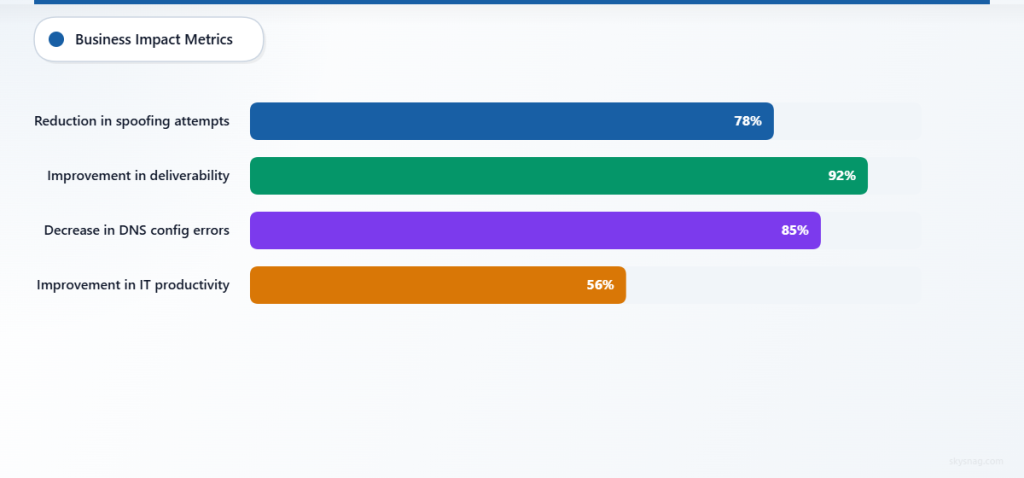
Organizations implementing guided SPF enforcement report significant improvements in both security posture and operational efficiency:
Security Benefits:
- 78% reduction in successful email spoofing attempts
- 92% improvement in legitimate email deliverability
- 65% decrease in security incident response time
Operational Benefits:
- 85% reduction in DNS configuration errors
- 73% decrease in email delivery troubleshooting time
- 56% improvement in IT team productivity for email security tasks
VI. Future Evolution of DNS Security Management
The integration of AI-driven decision making with human operator oversight represents the next evolution in DNS security management. Future developments will likely include:
- Predictive threat modeling that anticipates attack patterns and proactively adjusts policies
- Cross-domain intelligence sharing to identify emerging threats across organizational boundaries
- Automated policy optimization based on continuous learning from global email flow patterns
VII. Key Takeaways
Confidence-scored SPF enforcement with guided operator control centers fundamentally transforms email security management from a high-risk technical challenge into a manageable, workflow-driven process. Organizations can now implement robust anti-spoofing protections without sacrificing email deliverability or requiring specialized DNS expertise.
The combination of pre-flight verification, real-time monitoring, and progressive enforcement policies enables a balanced approach to email security that prioritizes both protection and operational continuity. As these systems continue to evolve, the integration of advanced analytics and automated decision-making will further democratize access to enterprise-grade email security capabilities.
For organizations seeking to enhance their email security posture while maintaining operational efficiency, guided SPF enforcement represents a significant advancement in accessible cybersecurity technology. Learn more about implementing advanced SPF management capabilities at Skysnag Protect.