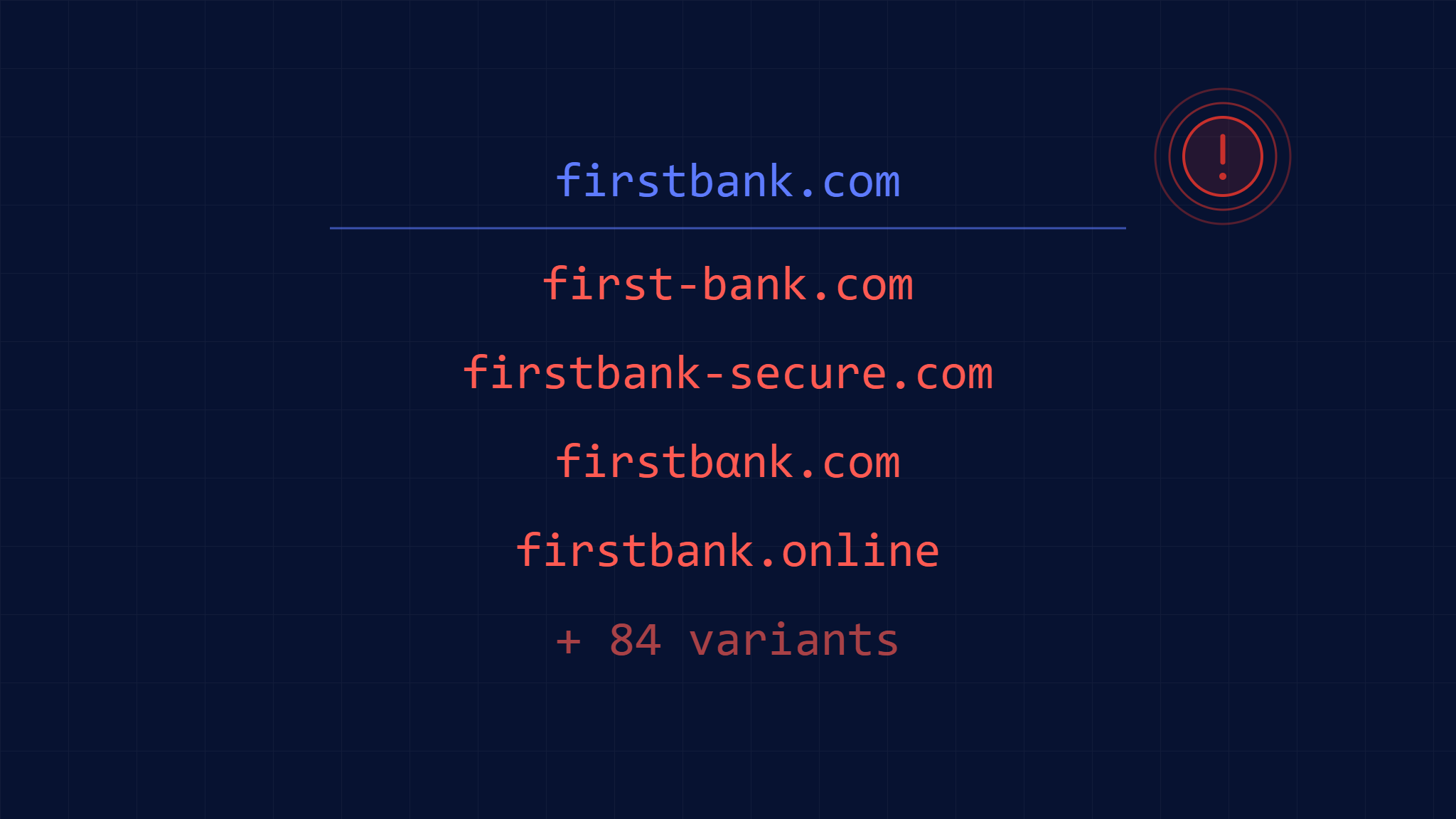
Financial institutions are frequent targets of domain impersonation and phishing because attackers can exploit the trust customers place in banks, credit unions, payment providers, and fintech brands.
A fraudulent domain that closely resembles a legitimate financial institution can be used to harvest credentials, redirect payments, collect payment-card information, distribute malware, or support broader social engineering campaigns.
For banks, the threat goes beyond a fake website. An attacker may combine a lookalike domain with phishing email, SMS messages, fraudulent advertisements, compromised accounts, fake customer-support calls, or malicious login pages. The objective is often simple: make the victim believe they are interacting with a financial institution they already trust.
U.S. banking regulators have addressed this risk for years. OCC guidance describes website spoofing as the creation of fraudulent sites that resemble legitimate banking websites and warns that these attacks can expose both banks and customers to privacy, fraud, operational, strategic, and reputational risks.
This guide explains how domain spoofing and lookalike-domain attacks work in financial services, why banks are particularly attractive targets, where DMARC and email authentication help, where they do not, and how institutions can build a layered defense against brand impersonation.
I. What Is Domain Spoofing in Financial Services?
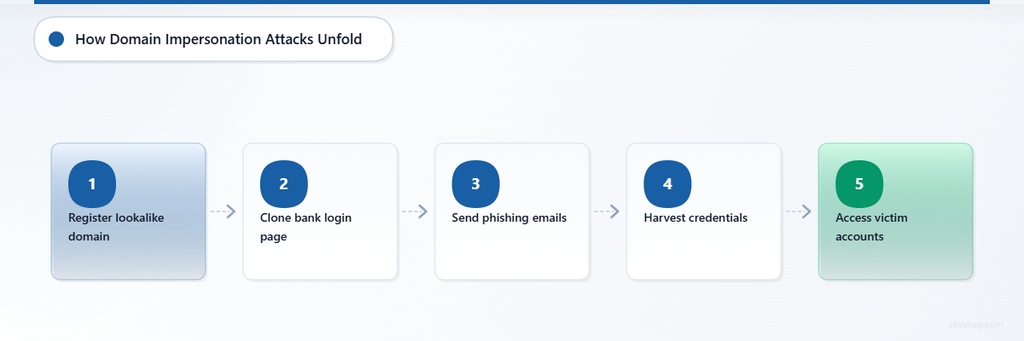
“Domain spoofing” is often used as a broad term for attacks that make a malicious digital identity appear connected to a trusted organization.
In practice, security teams should distinguish between several different techniques.
Direct Domain Spoofing
Direct domain spoofing occurs when an attacker attempts to send email that appears to originate from a legitimate institution’s actual domain without authorization.
For example:
From: [email protected]even though the message was not sent through infrastructure authorized by examplebank.com.
SPF, DKIM, and DMARC are directly relevant to this attack type.
Lookalike Domain Impersonation
A lookalike-domain attack is different.
Instead of spoofing the real domain, the attacker registers another domain that resembles it.
For example:
example-bank-security.comor:
examplebnk.comThe attacker controls that domain and can configure valid DNS, SPF, DKIM, DMARC, and TLS certificates for it.
Email authentication alone therefore cannot determine that the domain is deceptive.
CISA documents domain acquisition as an adversary technique and specifically notes the use of Internationalized Domain Names to create visually similar domains for malicious activity.
Typosquatting
Typosquatting involves registering domains based on predictable typing mistakes, missing characters, transposed letters, or other variations of a trusted domain.
For example:
examplebnk.com
examplebannk.com
examplbank.com
For financial institutions, the risk is particularly significant because the malicious site can replicate a login experience and request credentials, authentication codes, payment information, or other sensitive data.
IDN and Homograph Attacks
Internationalized Domain Names allow characters outside the basic ASCII character set.
Attackers may attempt to use visually similar characters from different alphabets so that a malicious hostname resembles a trusted brand when displayed to a user.
These attacks are commonly called IDN homograph attacks.
Modern browsers, registries, and security platforms implement defenses against many forms of IDN abuse, but visually deceptive domains remain relevant to phishing and malware campaigns.
Misleading Domain Structures
Attackers can also create hostnames containing words that users associate with trusted financial services.
For example:
secure.examplebank-login.comA distracted user may focus on:
secureor:
examplebankwithout recognizing that the actual registrable domain is controlled by the attacker.
Words such as:
secure
login
verify
account
support
banking
authentication
do not make a domain legitimate.
Users and security systems must evaluate the actual registered domain, not merely trusted-looking words embedded within it.
II. Why Banks Are Prime Targets
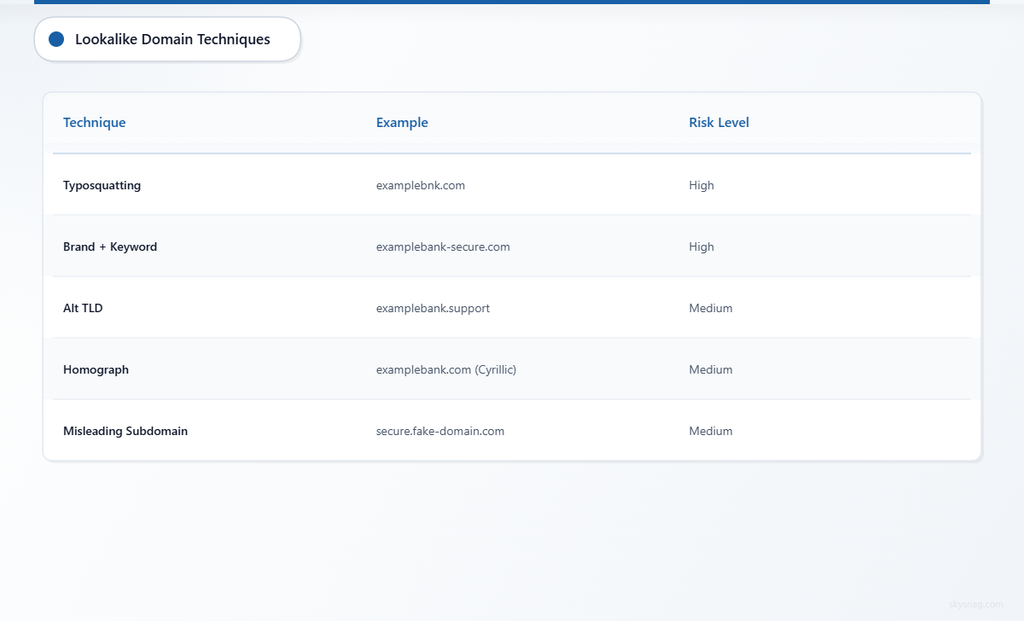
Financial institutions combine several characteristics that make brand impersonation particularly valuable to attackers.
1. Direct Access to Financial Assets
Banking credentials can potentially provide access to:
- Account balances
- Payment functionality
- Stored beneficiaries
- Credit facilities
- Payment-card information
- Personal financial records
- Business banking systems
Unlike data that must later be monetized, compromised financial credentials may offer attackers a relatively direct path toward fraud.
2. Customers Expect Security Messages
Banks legitimately send customers communications about:
- Suspicious transactions
- New-device logins
- Fraud alerts
- Password resets
- Account verification
- Payment confirmation
- Card activity
- Security updates
Attackers exploit those same workflows.
A phishing message claiming:
“Unusual activity was detected on your account”
can create enough urgency that a customer interacts with a fraudulent domain before carefully inspecting it.
Consumer-protection agencies regularly advise customers not to use links or contact details contained in suspicious messages and instead to contact their financial institution through independently verified channels.
3. Banking Has a Large Digital Attack Surface
Modern financial institutions no longer operate through a single website.
Customers may interact with:
- Web banking
- Mobile applications
- Payment portals
- Card-management systems
- Wealth-management platforms
- Loan portals
- Customer-support systems
- Investment platforms
- Third-party financial services
- Authentication providers
Financial-sector guidance has repeatedly highlighted how digital banking, APIs, mobile access, remote services, and third-party connectivity increase the number of potential attack surfaces.
As the legitimate digital ecosystem becomes more complex, it can become harder for customers to distinguish legitimate infrastructure from convincing imitations.
4. Financial Brands Carry Built-In Trust
Attackers do not need to establish a new relationship with the victim when impersonating a known bank.
The relationship already exists.
A customer recognizes:
- The institution’s name
- Its logo
- Its colors
- Its terminology
- Common account workflows
A cloned page can exploit those familiar visual cues.
The objective is not necessarily to convince the victim that an unknown company is trustworthy. It is to borrow trust the legitimate financial institution has already earned.
III. How Financial Domain-Impersonation Attacks Work
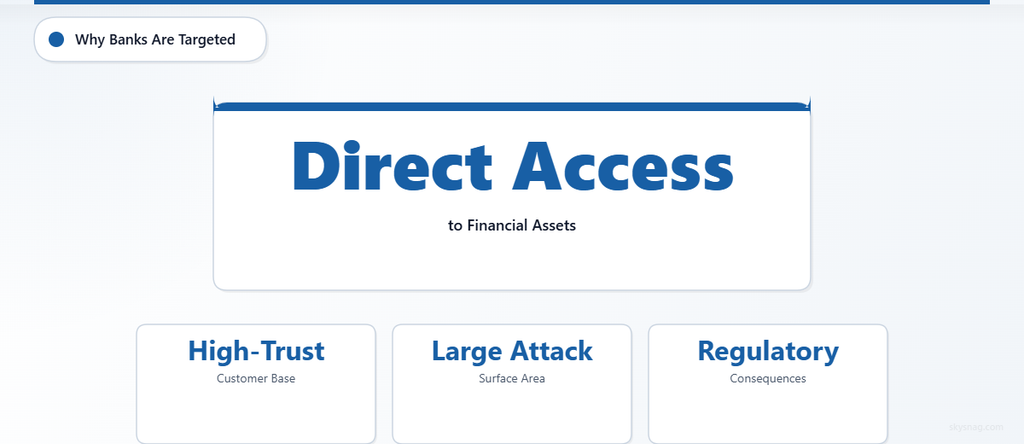
A sophisticated attack can involve several stages.
Stage 1: Domain Registration
The attacker registers a domain resembling the institution.
For example:
examplebank-security.comThe domain may incorporate:
- Typographical errors
- Added words
- Removed characters
- Alternative top-level domains
- Hyphenation
- Phonetic similarity
- Unicode characters
- Brand names combined with security terminology
The domain itself may initially contain no malicious content.
That means early detection during or shortly after registration can be valuable.
Stage 2: Infrastructure Setup
The attacker can configure the domain with:
- DNS records
- Web hosting
- MX records
- TLS certificates
- SPF
- DKIM
- DMARC
This creates an important security distinction:
A malicious lookalike domain can be technically well configured.
A valid TLS certificate does not prove that a website belongs to the institution being impersonated.
Likewise:
SPF: pass
DKIM: pass
DMARC: pass
does not prove that examplebank-security.com is a legitimate banking domain.
Those controls establish authentication for the domain being used. They do not determine whether the domain itself is deceptive.
Stage 3: Brand Cloning
The attacker reproduces elements of the legitimate institution’s online identity.
These might include:
- Logo
- Navigation
- Login screen
- Fonts
- Colors
- Security language
- Account-verification screens
- MFA prompts
- Fraud-warning pages
The resulting website may appear highly convincing, particularly on a mobile screen.
Stage 4: Traffic Generation
Attackers then need victims to reach the malicious infrastructure.
Distribution can occur through:
- Phishing email
- SMS
- QR codes
- Search advertisements
- Social media
- Malicious redirects
- Compromised websites
- Messaging platforms
- Fake customer-support interactions
The safest user behavior is to avoid accessing banking services through unsolicited links and instead use the official banking app, a verified bookmark, or a known legitimate website.
Stage 5: Credential or Data Collection
Once the user reaches the fraudulent page, the attacker may request:
Username
Password
Card number
PIN
One-time password
Security answer
Personal information
More sophisticated attacks may attempt to proxy the legitimate login process in real time so that information supplied by the victim is immediately used against the genuine service.
Stage 6: Follow-On Fraud
Stolen data can then support:
- Account takeover
- Unauthorized transfers
- Card fraud
- Identity theft
- Business fraud
- Social engineering
- Credential reuse
- Further phishing
The initial lookalike domain may therefore be only the first stage in a broader fraud campaign.
Common Domain Impersonation Techniques Targeting Banks
IV. Typosquatting
Attackers register predictable misspellings.
For example:
securebank.commight be imitated as:
securbank.com
securebnk.com
secure-bank.com
The attacker is relying on either a typing mistake or the recipient failing to notice the variation inside an email, SMS message, advertisement, or browser.
V. Brand + Keyword Domains
Another common pattern combines a recognizable brand with security-related language.
For example:
examplebank-verification.com
examplebank-login.com
examplebank-support.com
These domains may be particularly convincing because the additional words appear contextually appropriate.
VI. Alternative Top-Level Domains
Attackers can also register a recognizable string under another top-level domain.
For example:
examplebank.exampleinstead of the institution’s legitimate domain.
Users unfamiliar with the institution’s exact domain portfolio may assume the alternative is legitimate.
VII. Homograph and Unicode Variations
Characters that look visually similar can create deceptive hostnames.
This is particularly relevant when users inspect URLs quickly or on smaller mobile screens.
VIII. Misleading Subdomains
An attacker controlling:
bank-security.examplecan create:
login.bank-security.example
secure.bank-security.example
accounts.bank-security.example
The presence of login or secure does not indicate legitimacy.
The registrable domain remains:
bank-security.exampleThe Business Impact of Domain Impersonation
The damage from a successful impersonation campaign can extend beyond the account initially compromised.
IX. Financial Fraud
Stolen credentials may enable unauthorized transactions or other forms of account abuse.
Financial losses can also include:
- Investigation
- Fraud reimbursement
- Incident response
- Customer support
- Legal review
- Takedown operations
- Threat intelligence
- Additional authentication measures
The exact financial responsibility depends on the account type, jurisdiction, circumstances, and applicable consumer-protection rules.
X. Customer Trust Erosion
Customers do not always distinguish between infrastructure controlled by the bank and infrastructure impersonating the bank.
A convincing fake site may therefore damage confidence in the legitimate institution even though its actual systems were never breached.
Brand abuse creates an unusual security problem:
The attacker can create reputational harm without compromising the organization’s network.
XI. Operational Disruption
Active phishing campaigns can require coordination between:
- Security teams
- Fraud teams
- Legal counsel
- Customer support
- Registrars
- Hosting providers
- Certificate authorities
- Law enforcement
- Threat intelligence providers
These response activities can consume significant operational resources even when the institution’s internal infrastructure remains uncompromised.
XII. Regulatory and Evidence Requirements
Not every phishing campaign automatically creates a reportable regulatory incident.
However, if an impersonation attack results in unauthorized access, exposure of protected information, fraud, or another reportable event, the institution may face notification, investigation, documentation, or evidence-preservation obligations depending on the applicable regulatory framework.
Financial institutions should therefore be able to demonstrate how they:
- Detect threats
- Protect authentication systems
- Monitor suspicious activity
- Educate users
- Respond to incidents
- Maintain appropriate records
What DMARC Can and Cannot Prevent
DMARC is an important control for financial institutions, but its scope must be understood correctly.
XIII. DMARC Helps Protect the Bank’s Actual Domain
Suppose the legitimate institution uses:
examplebank.comAn attacker attempts to send:
From: [email protected]through unauthorized infrastructure.
With correctly configured SPF and/or DKIM alignment and DMARC enforcement at:
p=quarantineor:
p=rejectparticipating receiving systems can apply the institution’s DMARC policy to unauthenticated messages claiming to originate from the protected domain.
DMARC therefore significantly reduces direct spoofing of domains the institution actually controls.
XIV. DMARC Does Not Stop Attacker-Owned Lookalike Domains
Now suppose the attacker registers:
examplebank-security.comThe attacker owns that domain.
They can publish:
SPF: pass
DKIM: pass
DMARC: pass
for it.
Your DMARC policy for:
examplebank.comdoes not control:
examplebank-security.combecause it is a completely different domain.
This distinction is critical.
DMARC protects your authenticated domain identity. It does not prevent criminals from registering deceptive domains they control.
That is why financial institutions need both email authentication and external lookalike-domain monitoring.
The Financial Institution’s Layered Defense
Effective protection requires controls across several layers.
XV. 1. Enforce DMARC on Legitimate Domains
Financial institutions should maintain a complete inventory of legitimate email sources and move eligible domains toward DMARC enforcement at:
p=quarantineor:
p=rejectafter validating legitimate senders.
DMARC should be supported by correctly configured:
- SPF
- DKIM
- Alignment
- Aggregate reporting
- Sender discovery
- Continuous monitoring
DMARC enforcement should be introduced only after legitimate sending infrastructure has been identified and validated.
XVI. 2. Monitor for Lookalike Domains
Authentication protects domains the organization owns.
External-domain monitoring addresses domains it does not own.
Financial institutions should monitor for registrations involving:
- Misspellings
- Brand variations
- Phonetic similarity
- Hyphenated variants
- Additional security words
- Alternative TLDs
- Unicode variations
- Suspicious MX records
- Active cloned pages
Skysnag BrandGuard helps organizations monitor for lookalike domains and suspicious registrations associated with phishing, fraud, and brand impersonation.
XVII. 3. Monitor Certificate Transparency Data
Certificate Transparency data can provide another signal when investigating suspicious infrastructure.
Security teams can monitor for certificates associated with:
- Their legitimate domains
- Suspicious brand variations
- Newly discovered lookalike domains
However, a valid TLS certificate must never be interpreted as proof that a site belongs to the institution.
If an attacker legitimately controls:
examplebank-login.comthey may also legitimately obtain a TLS certificate for that domain.
TLS protects the connection between the user and that site.
It does not certify that the site is the bank the user thinks it is.
XVIII. 4. Use DNS and Web Filtering
Financial institutions can also limit exposure internally by blocking access to known malicious infrastructure.
Controls can include:
- Secure DNS
- URL filtering
- Domain reputation
- Browser protection
- Endpoint detection
- Web isolation
- Threat intelligence feeds
DNS and reputation-based filtering can reduce employee exposure to known malicious and suspicious domains.
XIX. 5. Strengthen Identity and Authentication Controls
Domain monitoring cannot assume every user will recognize every attack.
Institutions should reduce the value of stolen credentials through controls such as:
- Multi-factor authentication
- Risk-based authentication
- Device intelligence
- Transaction monitoring
- Behavioral analysis
- Session controls
- Step-up verification
Layered authentication is particularly important because no domain-monitoring system can guarantee that every deceptive registration will be detected before a user encounters it.
XX. 6. Prepare Customers for Bank-Impersonation Attacks
Generic advice such as “look for bad grammar” is increasingly insufficient.
Customers should understand that a convincing phishing page can contain:
- Correct branding
- HTTPS
- A valid TLS certificate
- Professional language
- Familiar security terminology
Financial institutions should encourage customers to access services through:
- The official banking application
- A saved, previously verified bookmark
- A known official website
- Contact details obtained independently of a suspicious message
Customers should be cautious about account-access links received through:
- Unsolicited email
- SMS
- Social media
- Search advertisements
- Messaging applications
7. Establish a Domain Takedown Process
Detection is useful only if suspicious infrastructure can be investigated and acted upon.
A mature response process should establish:
- Domain discovery
- Risk classification
- Evidence collection
- Hosting-provider identification
- Registrar escalation
- Trademark or abuse evidence
- Takedown request
- Customer notification where appropriate
- Continued monitoring for re-registration
Attackers can rotate infrastructure rapidly, so removing one domain should not automatically close the incident.
Related registrations and infrastructure should also be investigated.
Why Email Authentication and Lookalike Protection Must Work Together
Banks sometimes treat direct spoofing and lookalike-domain impersonation as the same technical problem.
They are not.
Consider these two attacks.
Attack A
From: [email protected]

Unauthorized sending infrastructure
This is a direct email-authentication problem.
SPF, DKIM, and DMARC are the relevant controls.
Attack B
From: [email protected]

Attacker owns examplebank-security.com
The attacker may configure SPF, DKIM, and DMARC correctly.
This is primarily a domain-impersonation problem.
The controls are different:
- Lookalike-domain detection
- Threat intelligence
- Web analysis
- Domain reputation
- Certificate monitoring
- Takedown processes
- User awareness
A mature financial-services security program needs both.
Financial-Sector Regulatory Considerations
There is no single universal regulation that says:
“Every bank must deploy lookalike-domain monitoring.”
Requirements vary by jurisdiction and institution type.
However, financial-sector security guidance consistently supports a layered, risk-based approach to phishing, authentication, monitoring, fraud prevention, and digital-channel security.
Relevant controls may include:
- Layered security
- Multi-factor authentication
- Monitoring
- Anti-phishing controls
- DMARC
- User education
- Social-engineering testing
- DNS filtering
Separate guidance for financial institutions has also addressed the need to monitor and respond to fraudulent use of institutional brands through phishing and spoofing.
The implication is not that DMARC or lookalike monitoring alone creates compliance.
Rather, these controls can form part of a broader, risk-based security program designed to protect customers, financial systems, and institutional identity.
How Skysnag Protect and BrandGuard Address Different Parts of the Problem
Protecting a financial brand requires securing both the institution’s legitimate email identity and the external domain ecosystem attackers may abuse.
Skysnag Protect: Protect the Domains You Own

Skysnag Protect focuses on email authentication and domain enforcement.
It helps organizations manage and monitor:
- DMARC
- SPF
- DKIM
- Sender discovery
- Authentication alignment
- Unauthorized sending sources
- DMARC enforcement
This reduces attackers’ ability to directly spoof email from domains controlled by the institution.
Learn more: Skysnag Protect
Skysnag BrandGuard: Detect Domains You Do Not Own
BrandGuard addresses the external impersonation problem.
BrandGuard helps identify suspicious and lookalike domains associated with:
- Phishing
- Fraud
- Brand impersonation
- Typosquatting
- Malicious domain registrations
It complements email authentication by addressing infrastructure that exists outside the institution’s own DNS environment.
Learn more: Skysnag BrandGaurd
Financial Institution Domain Protection Checklist
Evaluate whether your organization has controls for each layer:
- DMARC deployed across all legitimate corporate domains
- Legitimate sending infrastructure identified before moving to enforcement
- DMARC enforced at
p=quarantineorp=rejectwhere operationally appropriate - SPF and DKIM continuously monitored
- Dormant and defensive domains inventoried
- Lookalike-domain monitoring enabled
- Typosquatting variations monitored
- Unicode and homograph variants considered
- Suspicious MX and DNS activity analyzed
- Certificate Transparency data incorporated where useful
- DNS and web filtering deployed for known malicious domains
- Customer phishing education addresses lookalike websites
- MFA or equivalent layered authentication controls implemented
- Registrar and hosting-provider escalation procedures documented
- Takedown evidence and ownership documentation prepared in advance
- Domain impersonation incidents included in response playbooks
- Newly registered and previously dormant lookalike domains continuously reassessed
Key Takeaways
Financial institutions are attractive targets for domain impersonation because attackers can exploit established customer trust and potentially convert stolen credentials into financial fraud.
But not every form of “domain spoofing” is the same.
Direct domain spoofing abuses an institution’s actual domain without authorization.
Lookalike-domain impersonation uses a different attacker-controlled domain designed to resemble the institution.
Typosquatting exploits predictable domain variations and typing mistakes.
IDN and homograph attacks use visually similar characters to make malicious domains appear familiar.
This distinction determines which controls are effective.
DMARC, SPF, and DKIM can significantly reduce unauthorized use of domains the financial institution actually controls.
They cannot prevent an attacker from registering a separate deceptive domain.
A malicious lookalike domain can have valid SPF, DKIM, DMARC, HTTPS, and a legitimate TLS certificate and still be malicious.
That is why effective financial-sector brand protection requires multiple layers:
- Strong email authentication
- DMARC enforcement
- Lookalike-domain monitoring
- DNS and URL filtering
- Threat intelligence
- Identity protection
- Customer education
- Rapid investigation and takedown
Skysnag Protect helps financial institutions secure the domains they control through DMARC, SPF, DKIM, sender discovery, and enforcement:
Skysnag BrandGuard extends protection beyond those domains by detecting lookalike infrastructure used for phishing, fraud, and brand impersonation:
Together, the two address different sides of the same problem: protecting the institution’s authenticated identity while identifying attackers attempting to imitate it elsewhere on the internet.