Digital platforms are under more pressure than ever to prove that their services are safe, accountable, and resistant to abuse.
The European Union’s Digital Services Act has accelerated that shift by raising expectations around platform governance, user protection, transparency, risk management, and accountability across the digital ecosystem. The European Commission describes the DSA as a framework designed to make the online environment safer and more trustworthy. (Digital Strategy)
Most of the discussion around the DSA focuses on content moderation, illegal content, trader traceability, advertising transparency, systemic risk, and platform accountability.
But there is another layer that often receives less attention:
How platforms communicate with users, customers, traders, partners, and internal teams.
Email is still one of the most important trust channels in the digital economy. Platforms use it to verify accounts, reset passwords, notify users, support sellers, communicate policy decisions, send security alerts, and manage operational workflows.
If those emails can be spoofed, impersonated, or abused, platform trust weakens.
That is where email authentication becomes strategically important.
DMARC, SPF, DKIM, MTA-STS, and TLS-RPT do not make an organization “DSA compliant” by themselves. The DSA does not mandate these protocols by name.
But for platforms operating in Europe, email authentication supports the broader trust, safety, anti-abuse, and governance objectives that modern digital regulation expects organizations to manage.
The issue is no longer just deliverability.
It is whether the organization can show that its communication layer is controlled, monitored, and protected from domain abuse.
I. The DSA Raises the Standard for Digital Trust
The DSA is part of a wider regulatory movement in Europe: digital services are expected to operate with stronger accountability.
That accountability does not stop at the platform interface.
It extends to the systems platforms use to communicate with users and stakeholders.
A platform may have strong moderation policies, clear terms of service, and documented escalation procedures. But if attackers can send fake account alerts, fake enforcement notices, fake seller communications, or fake support emails using the platform’s domain, the trust model is incomplete.
For users, the email often feels like the platform.
A password reset email, a seller verification request, a policy violation notice, or a security alert can trigger immediate action. If that message is fraudulent, the user may not distinguish between platform abuse and platform failure.
That is why email authentication belongs in the DSA-era trust conversation.
Not as a narrow legal checkbox.
As a practical control for protecting the credibility of platform communication.
II. What Email Authentication Actually Protects
Email authentication helps receiving mail servers determine whether a message claiming to come from a domain is authorized.
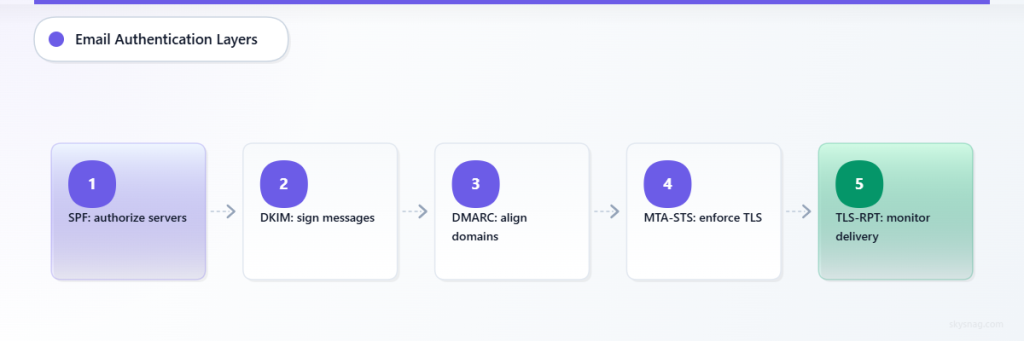
The core protocols work together:
- SPF identifies which servers are authorized to send email for a domain.
- DKIM adds a cryptographic signature to verify that a message was authorized by the signing domain and was not altered in transit.
- DMARC connects authentication back to the visible From domain that users see.
- MTA-STS helps enforce encrypted mail transport between supporting mail servers.
- TLS-RPT provides reporting on TLS delivery issues.
For platform operators, the most important control is DMARC alignment.
A message passes DMARC only when at least one of the following is true:
- SPF passes and the SPF-authenticated domain aligns with the visible From domain.
- DKIM passes and the DKIM signing domain aligns with the visible From domain.
This matters because users do not see authentication headers. They see the visible From domain.
DMARC helps protect that visible identity.
When DMARC is enforced at quarantine or reject, the domain owner tells receiving systems how to handle messages that fail authentication and alignment. That helps reduce exact-domain spoofing, where attackers try to send email that appears to come directly from the platform’s real domain.
III. What Email Authentication Does Not Solve
Email authentication is powerful, but it is not a complete anti-abuse program.
DMARC does not stop every phishing attack. It does not prevent lookalike domains from being registered. It does not stop display-name impersonation. It does not guarantee inbox placement. It does not replace fraud detection, user education, content moderation, access controls, or incident response.
This distinction is important.
Email authentication protects the platform’s own domain identity.
It does not eliminate every form of impersonation.
A mature trust program needs both:
- DMARC, SPF, and DKIM to protect the real domain.
- Brand monitoring, abuse detection, and takedown workflows to address lookalike domains and impersonation infrastructure.
For DSA-relevant platforms, this distinction makes the program more credible. It shows that email authentication is understood as one part of a broader trust and safety architecture.
IV. Why Platforms Should Care
Platforms send emails that users rely on.
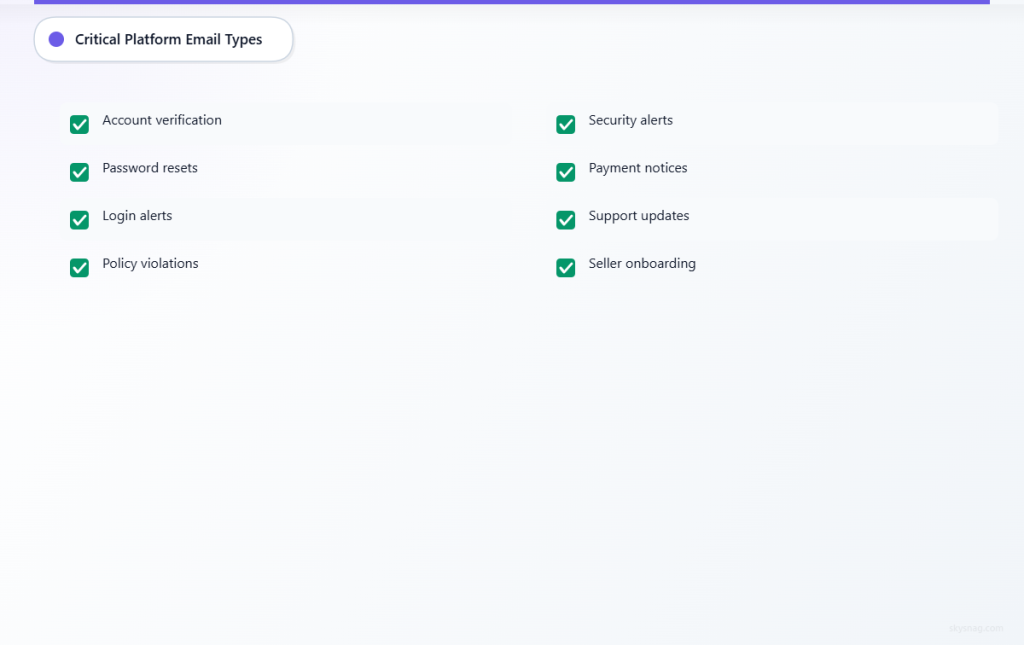
Examples include:
- Account verification emails
- Password reset emails
- Login alerts
- Seller or trader onboarding messages
- Policy violation notices
- Security alerts
- Support case updates
- Payment and billing notifications
- Marketplace operation emails
- Regulatory or legal notices
If attackers can impersonate these communications, the impact can be serious.
A fake policy notice can trick a seller into submitting credentials. A fake security alert can push a user into a phishing portal. A fake support message can redirect a customer into fraud. A fake payment notification can damage confidence in the platform.
From a trust perspective, the platform has a responsibility to reduce the chance that its own domain can be abused in this way.
DMARC supports that responsibility by helping platforms answer important questions:
- Which systems are authorized to send email for our domains?
- Which third-party platforms send on our behalf?
- Are user-facing emails properly authenticated?
- Are security and support messages aligned?
- Are any unknown sources attempting to use our domain?
- Are regional, campaign, or legacy domains exposed?
- Are we monitoring authentication failures over time?
These are operational questions, but they have governance value.
They show whether the organization is actively managing the integrity of its communication layer.
V. The Hidden Risk: Partial Protection
Many organizations protect their primary domain first.
That is a good start, but it is not enough.
Platforms often operate many domains and subdomains:
- Main corporate domains
- Product domains
- Support domains
- Marketplace domains
- Seller onboarding domains
- Regional domains
- Campaign domains
- Developer or API domains
- Legacy domains
Attackers do not need to spoof the best-protected domain. They look for the weakest credible domain.
A platform may enforce DMARC on its main domain but leave a regional or campaign domain at monitoring mode. That domain can still be abused in phishing campaigns that look believable to users.
This creates a governance problem.
If the organization has identified domain impersonation as a risk, partial implementation becomes harder to defend over time.
A mature program should cover the full domain portfolio, not only the most visible domain.
VI. Third-Party Senders Create the Most Complexity
Modern platforms rarely send all email from one place.
They rely on multiple services:
- CRM platforms
- Marketing automation systems
- Customer support tools
- Identity providers
- Billing platforms
- Marketplace notification systems
- Transactional email providers
- HR and internal communication tools
Each sender must be authorized, authenticated, and aligned.
This is where many email authentication programs break.
A vendor may be included in SPF but fail DMARC alignment. Another platform may sign with DKIM, but under its own domain instead of the platform’s domain. A business team may launch a campaign from an unapproved sender. A legacy system may continue sending mail without proper authentication.
These gaps create both security and governance issues.
For platforms operating under stronger regulatory expectations, third-party sender management should not be informal. It should be part of vendor onboarding, change management, and security review.
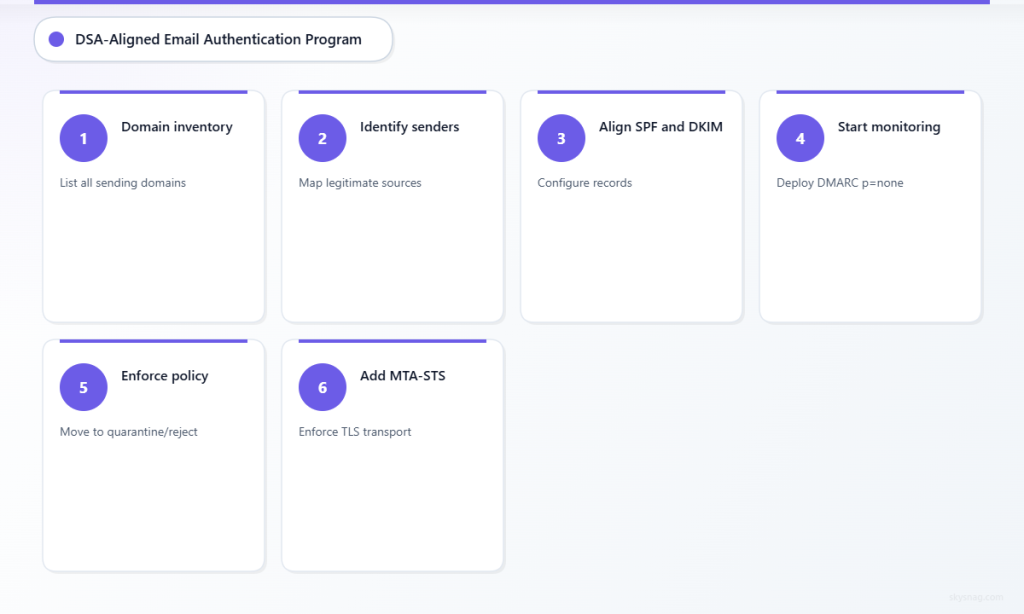
VII. A Practical DSA-Aligned Email Authentication Program
The right approach is not to treat DMARC as a quick DNS project.
The right approach is to treat email authentication as a controlled trust program.
VIII. 1. Build a Complete Domain Inventory
Start by identifying every domain and subdomain used for platform communication.
Include:
- User-facing domains
- Support domains
- Marketplace or trader domains
- Regional domains
- Campaign domains
- Transactional email domains
- Legacy domains
- Internal communication domains
For each domain, document whether it sends email, who owns it, what systems use it, and what authentication policy is currently in place.
IX. 2. Identify Every Legitimate Sender
Create a sender inventory.
For each sending source, document:
- Platform or vendor name
- Business owner
- Message type
- Sending domain
- SPF authorization
- DKIM signing status
- DMARC alignment status
- Volume
- Criticality
- Approval status
- Review date
This inventory becomes the foundation for security operations, vendor management, and compliance evidence.
X. 3. Align SPF and DKIM
DMARC depends on SPF and DKIM.
Before enforcement, legitimate senders must pass aligned SPF or aligned DKIM.
SPF records should include only authorized senders and must stay within DNS lookup limits. DKIM should be enabled for all major user-facing and security-sensitive communications.
Where possible, third-party senders should sign with DKIM aligned to the platform’s domain. This is often more reliable than SPF in complex routing and forwarding scenarios.
XI. 4. Start DMARC Monitoring
Before moving toward enforcement, platforms need visibility.
That visibility starts with DMARC monitoring.

The recommended path is to generate a free DMARC monitoring record through Skysnag. This gives the organization a managed reporting destination and allows security teams to start collecting authentication data without manually building a static record that may never be reviewed.
Start here:
“`text id=”skysnag-signup”
https://app.skysnag.com/en/register/
Once the domain is added, Skysnag provides the DMARC record to publish in DNS.

A traditional static DMARC monitoring record may look like this:
dns id=”dmarc-static-example”
v=DMARC1; p=none; rua=mailto:[email protected]
That approach can work, but only if someone is actively receiving, parsing, analyzing, and acting on the reports.

A static record without monitoring creates a false sense of progress.

At this stage, the goal is not enforcement. The goal is visibility.

Monitor:

- Legitimate senders passing DMARC

- Legitimate senders failing DMARC

- Unknown sources

- High-volume mail streams

- Subdomain behavior

- Regional differences

- Spoofing attempts

- Third-party alignment issues

Avoid enabling forensic failure reports by default. They can contain sensitive information and should only be used after privacy, legal, and security review.

## 5. Move Toward Enforcement

Once legitimate senders are aligned, move toward enforcement.

A practical path is:

1. Use monitoring mode for discovery.

2. Move selected domains or subdomains to quarantine.

3. Remediate legitimate sender failures.

4. Move mature domains to reject.

5. Continue monitoring after enforcement.

Before moving to reject, confirm:

- Critical senders pass DMARC.

- Third-party platforms are aligned.

- Business owners have reviewed impact.

- Support teams are prepared.

- Rollback procedures exist.

- Exceptions are documented.

DMARC enforcement should be based on evidence, not assumption.

## 6. Add MTA-STS and TLS-RPT Where Appropriate

DMARC protects sender authentication. It does not enforce encrypted transport between mail servers.

MTA-STS and TLS-RPT support the transport layer.

MTA-STS allows a domain to publish a policy requiring supporting mail servers to use TLS when delivering mail to that domain. TLS-RPT provides reports about TLS delivery issues.

For platforms sending account, support, marketplace, or security communications, these controls can strengthen the overall email trust chain.

Example MTA-STS policy:
text id=”mta-sts-example”
version: STSv1
mode: enforce
mx: mail.example.com
max_age: 86400
Example TLS-RPT record:dns id=”tls-rpt-example”
_smtp._tls.example.com. IN TXT “v=TLSRPTv1; rua=mailto:[email protected]”
“`
XII. Governance Matters More Than the DNS Record
A strong email authentication program needs ownership.
Without governance, authentication posture drifts.
New vendors are added. Campaigns launch. Regional teams create domains. DNS records change. DKIM keys rotate. Legacy systems remain active.
Recommended governance elements include:
- Executive sponsor
- Security owner
- DNS owner
- Compliance stakeholder
- Business owner for each sender
- Vendor onboarding process
- Change management workflow
- Exception process
- Regular review cadence
- Incident response procedure
This is where the program becomes defensible.
Not because a DMARC record exists, but because the organization can show that email authentication is owned, monitored, and maintained.
XIII. Evidence Platforms Should Maintain
For DSA-relevant organizations, evidence matters.
Maintain documentation for:
- Domain inventory
- Sender inventory
- SPF, DKIM, DMARC, MTA-STS, and TLS-RPT records
- DMARC policy history
- Authentication report analysis
- Sender remediation
- Third-party approvals
- Exception decisions
- Rollback procedures
- Monitoring cadence
- Incident response actions
- Transport security controls
This evidence helps demonstrate that platform communication is actively managed as part of the organization’s broader trust and anti-abuse program.
XIV. Implementation Checklist
Use this checklist as a practical starting point.
- [ ] Inventory all domains and subdomains used for platform communication.
- [ ] Identify all internal and third-party sending sources.
- [ ] Map each sender to a business owner.
- [ ] Confirm SPF records include only authorized senders.
- [ ] Review SPF lookup limits.
- [ ] Enable DKIM for critical sending platforms.
- [ ] Confirm SPF or DKIM alignment with the visible From domain.
- [ ] Start DMARC monitoring through Skysnag and publish the generated monitoring record.
- [ ] If using a traditional static DMARC record, confirm reports are actively collected and reviewed.
- [ ] Analyze DMARC reports before enforcement.
- [ ] Remediate legitimate senders that fail authentication.
- [ ] Move mature domains toward quarantine or reject.
- [ ] Avoid default forensic reporting unless approved by privacy and legal teams.
- [ ] Review support, marketplace, seller, security, and user-notification domains.
- [ ] Establish third-party sender onboarding requirements.
- [ ] Implement MTA-STS and TLS-RPT where appropriate.
- [ ] Define ownership and escalation paths.
- [ ] Maintain documentation for governance and audit readiness.
- [ ] Review authentication posture regularly.
XV. How Skysnag Comply Helps
Skysnag Comply helps organizations manage the evidence and monitoring layer behind email authentication.
For EU-facing platforms, Skysnag Comply supports:
- Domain inventory visibility
- DMARC monitoring
- SPF and DKIM alignment visibility
- Unauthorized sender detection
- Third-party sender review
- Enforcement readiness tracking
- Compliance-facing reporting
- Evidence collection for governance reviews
- Continuous visibility into authentication failures
Skysnag Comply does not turn the DSA into a DMARC mandate.
It helps organizations show that email authentication is monitored, governed, and maintained as part of a broader trust and anti-abuse program.
XVI. Key Takeaways
The Digital Services Act does not mandate DMARC, SPF, DKIM, MTA-STS, or TLS-RPT by name.
But platforms operating in Europe should not ignore the role of trusted email communication in user safety, platform integrity, marketplace operations, support workflows, and incident response.
DMARC helps reduce exact-domain spoofing. SPF and DKIM provide authentication signals. MTA-STS and TLS-RPT support transport security visibility.
Together, these controls help organizations maintain a more defensible email trust posture.
For DSA-relevant platforms, the question is not only:
“Does the DSA explicitly require DMARC?”
The stronger question is:
“Can we demonstrate that platform communications are authenticated, monitored, governed, and protected from domain abuse?”
That is where email authentication becomes strategically important.
Start DMARC monitoring with Skysnag and get your free DMARC record: