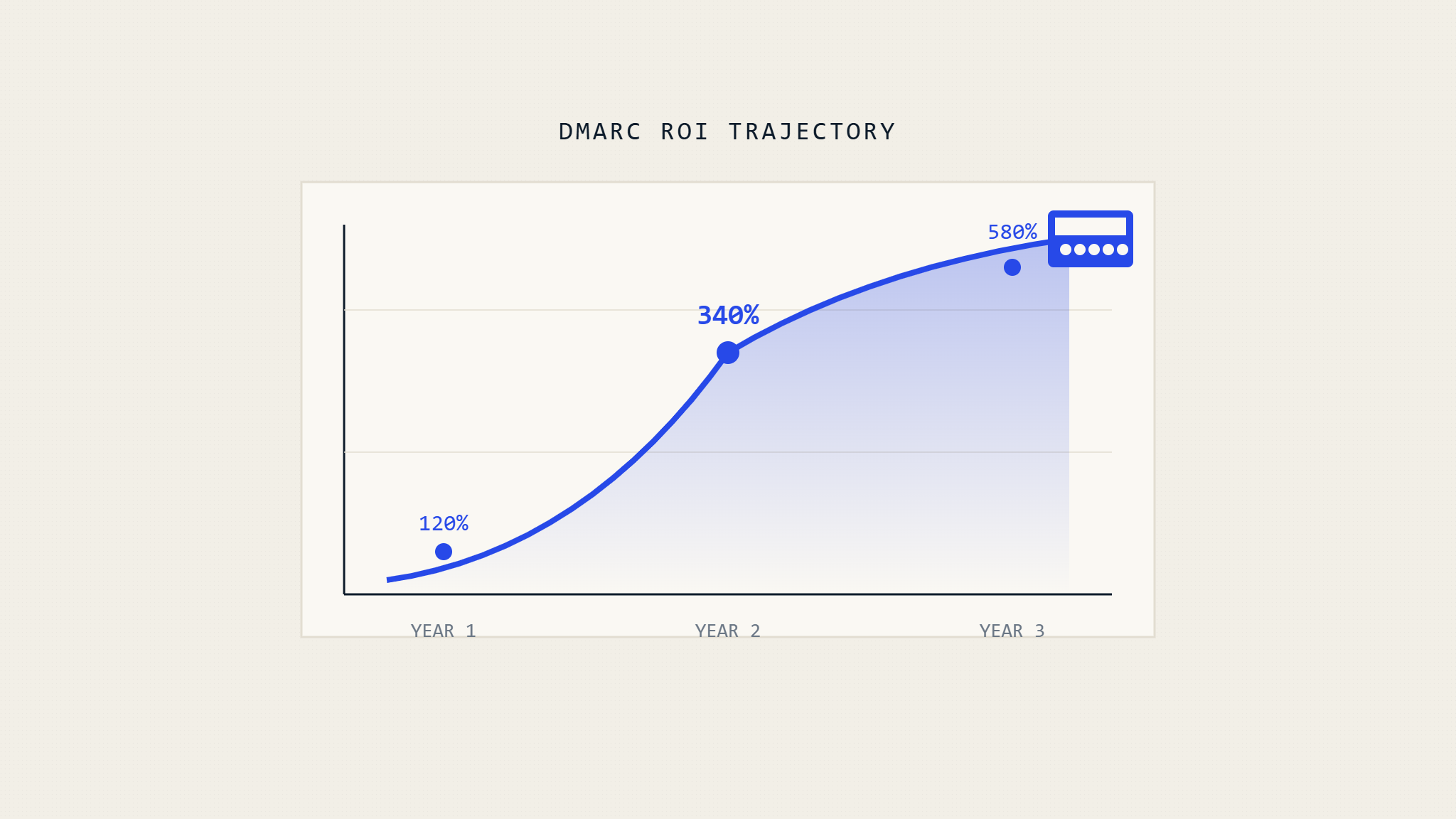
Managed Service Providers face a common challenge when proposing email security investments: translating technical benefits into clear financial value. While you understand that DMARC protects against phishing and brand impersonation, your clients want to see concrete numbers that justify the investment.
The solution lies in building a comprehensive DMARC ROI framework that demonstrates measurable returns through cost avoidance, productivity gains, and competitive advantages. This guide provides MSPs with practical tools and metrics to quantify email security value for any client scenario.
I. Understanding DMARC Investment Components
Before calculating ROI, MSPs need to identify all investment components and corresponding value drivers. DMARC implementations involve both direct costs and opportunity costs that affect the overall financial picture.
Direct Implementation Costs
DMARC deployment requires several cost categories that vary based on client size and complexity:
Technology and Platform Costs:
- DMARC monitoring and management platform subscriptions
- DNS hosting and management fees
- Email security gateway upgrades or additions
- Integration costs with existing security tools
Professional Services Investment:
- Initial assessment and policy development
- Implementation and configuration services
- Training for client IT teams
- Ongoing monitoring and optimization
Operational Overhead:
- Incident response and policy adjustments
- Regular reporting and compliance documentation
- Vendor management and relationship oversight
- Quarterly business reviews and optimization sessions
II. Quantifying Email Security Value Drivers
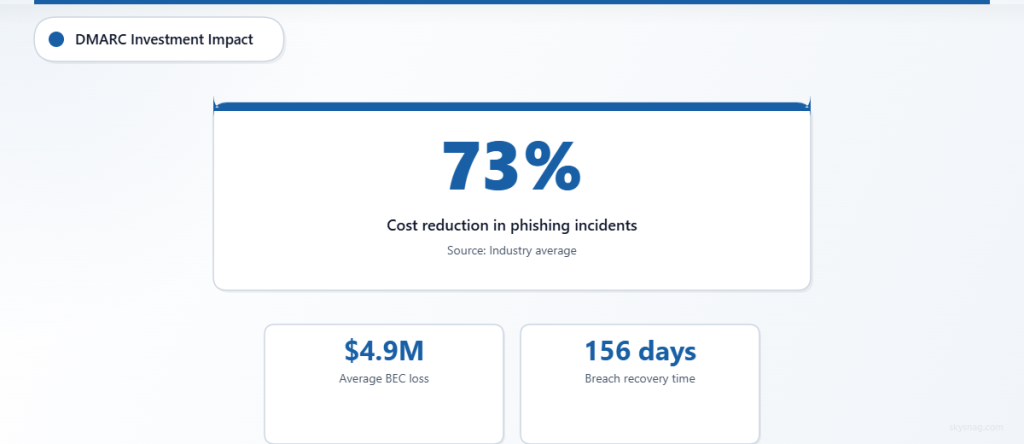
The most compelling DMARC ROI calculations focus on measurable value drivers that resonate with client decision-makers. These metrics transform technical controls into business outcomes.
Cost Avoidance Calculations
Phishing Incident Prevention:
Calculate potential savings by estimating the cost of a successful phishing attack. According to FBI IC3 reports, business email compromise incidents average significant financial losses per event. Factor in direct financial theft, recovery costs, legal expenses, and regulatory fines.
Brand Protection Value:
Quantify the cost of brand damage from email impersonation attacks. Consider customer trust erosion, lost sales opportunities, marketing investment to rebuild reputation, and competitive disadvantage during recovery periods.
Productivity Loss Mitigation:
Measure time savings from reduced spam and phishing emails reaching employee inboxes. Calculate employee hourly rates multiplied by time spent identifying and reporting suspicious emails across the organization.
Revenue Protection Metrics
Customer Retention Impact:
Estimate the value of maintaining customer relationships that might be damaged by successful impersonation attacks. Calculate customer lifetime value at risk and retention rate improvements from enhanced email security.
Compliance Cost Avoidance:
For regulated industries, calculate potential regulatory fines and audit costs avoided through improved email security controls. Include both direct penalties and indirect costs of compliance remediation efforts.
Insurance Premium Optimization:
Some cyber insurance providers offer premium reductions for organizations with mature email security programs. Factor these savings into the overall ROI calculation.
III. Building Client-Specific ROI Models
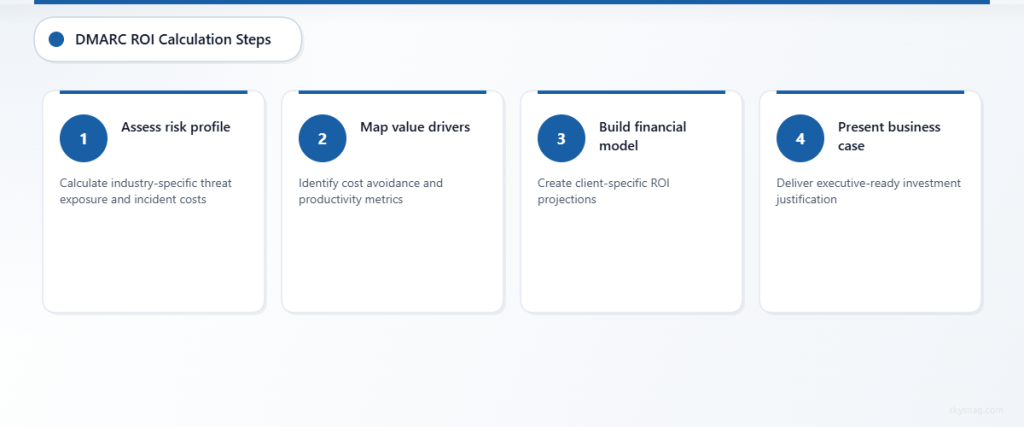
Effective DMARC ROI calculations must reflect each client’s unique risk profile, industry requirements, and business priorities. Generic calculations fail to resonate with decision-makers who need relevant, specific justifications.
Industry-Specific Risk Assessment
Financial Services Clients:
Focus on regulatory compliance costs, customer trust metrics, and the high value of financial transactions at risk. Emphasize wire fraud prevention and regulatory examination findings related to email security.
Healthcare Organizations:
Highlight HIPAA compliance support, patient data protection, and the reputation impact of healthcare data breaches. Calculate the cost of breach notification requirements and potential regulatory actions.
Professional Services Firms:
Emphasize client confidentiality protection, intellectual property security, and the reputational damage from client data exposure through email compromise.
Organization Size Considerations
Enterprise Clients (1000+ employees):
Focus on scalability benefits, centralized security management, and the compound effect of security improvements across large user bases. Calculate savings from reduced security incident response overhead.
Mid-Market Companies (100-1000 employees):
Emphasize cost-effective security posture improvement and competitive advantage from enhanced security credibility with customers and partners.
Small Business Clients (under 100 employees):
Focus on business continuity protection and the disproportionate impact that a single security incident could have on smaller organizations.
IV. Creating Compelling ROI Presentations
MSPs need presentation frameworks that translate technical DMARC benefits into executive-friendly business cases. The most effective presentations combine quantitative analysis with qualitative risk scenarios.
Financial Dashboard Development
Create visual dashboards that display:
- Monthly cost avoidance from blocked impersonation attempts
- Productivity time savings from reduced phishing emails
- Comparative risk exposure versus industry benchmarks
- Implementation timeline with milestone-based value realization
Risk Scenario Modeling
Develop “what-if” scenarios that illustrate potential costs without DMARC protection:
- Executive impersonation attack resulting in wire fraud
- Customer data breach from compromised email credentials
- Regulatory investigation triggered by inadequate email security
- Competitive disadvantage from damaged brand reputation
Value Realization Timeline
Present a clear timeline showing when clients will realize different types of value:
- Immediate: Visibility into email authentication failures
- 30-60 days: Reduced phishing emails reaching employee inboxes
- 90-180 days: Full policy enforcement and maximum protection
- Annual: Measurable improvements in security posture metrics
V. Implementation Best Practices for MSP DMARC Programs
Successful DMARC ROI realization requires structured implementation approaches that maximize value while minimizing disruption to client operations.

Skysnag MSP/MSSP Comply provides comprehensive tools for managing DMARC implementations across multiple client environments. The platform offers centralized monitoring, automated reporting, and policy management capabilities that streamline MSP service delivery.
Phased Deployment Strategy
Phase 1: Discovery and Baseline (30 days)
Establish current email authentication status, identify legitimate email sources, and document baseline security metrics for ROI measurement.
Phase 2: Monitoring Implementation (60 days)
Deploy DMARC monitoring with policy set to “none” to gather intelligence on email flows without affecting delivery.
Phase 3: Policy Enforcement (90 days)
Gradually increase policy enforcement based on monitoring data, moving from “quarantine” to “reject” as appropriate for each domain.
Phase 4: Optimization and Reporting (Ongoing)
Continuous monitoring, policy refinement, and regular ROI reporting to demonstrate ongoing value realization.
VI. Measuring and Reporting Ongoing Value
DMARC ROI extends beyond initial implementation through ongoing value delivery that MSPs must track and communicate to maintain client satisfaction and justify continued investment.
Key Performance Indicators
Security Metrics:
- Percentage reduction in successful phishing attempts
- Number of blocked email impersonation attacks
- Improvement in email authentication pass rates
- Decrease in security incident response frequency
Business Impact Metrics:
- Estimated cost avoidance from prevented incidents
- Time savings from reduced spam and phishing emails
- Improvement in email delivery rates for legitimate communications
- Customer satisfaction scores related to email security
Operational Efficiency Metrics:
- Reduced time spent on email security incident investigations
- Decreased help desk tickets related to suspicious emails
- Improved compliance audit results
- Enhanced security team productivity
Quarterly Business Reviews
Structure regular client meetings around ROI demonstration:
- Present security metrics and blocked attack statistics
- Calculate cumulative cost avoidance since implementation
- Identify new threats and recommend security enhancements
- Plan future email security investments based on demonstrated ROI
VII. Competitive Positioning and Market Differentiation
MSPs using DMARC ROI calculations effectively can differentiate their services and command premium pricing for comprehensive email security programs.
Value-Based Pricing Models
Move beyond hourly billing to outcome-based pricing that reflects the value delivered:
- Percentage of estimated cost avoidance
- Tiered pricing based on organization size and risk profile
- Performance bonuses for achieving specific security milestones
- Annual contracts with guaranteed ROI thresholds
Client Retention Strategies
Use DMARC ROI success stories to strengthen client relationships:
- Document and share success metrics with client executives
- Develop case studies highlighting specific ROI achievements
- Leverage positive results for referrals and testimonials
- Expand services based on demonstrated security value
VIII. Common ROI Calculation Pitfalls
Avoid these mistakes that can undermine DMARC ROI credibility:
Overestimating Attack Frequency:
Use conservative estimates based on credible threat intelligence rather than inflated statistics from marketing materials.
Ignoring Implementation Complexity:
Account for the time and resources required for proper DMARC implementation, including DNS changes and email flow analysis.
Underestimating Operational Overhead:
Include ongoing monitoring, policy maintenance, and incident response costs in the total cost of ownership calculation.
Generic Risk Assumptions:
Tailor risk calculations to each client’s specific industry, size, and threat landscape rather than using one-size-fits-all models.
IX. Key Takeaways
DMARC ROI calculations provide MSPs with powerful tools for justifying email security investments and differentiating their services in competitive markets. Success requires combining quantitative cost avoidance metrics with qualitative risk scenarios tailored to each client’s unique circumstances.
The most effective ROI models focus on measurable business outcomes rather than technical features, presenting email security as a business enabler rather than just an IT requirement. By implementing structured measurement and reporting processes, MSPs can demonstrate ongoing value that justifies premium pricing and strengthens client relationships.
Regular ROI reporting and business reviews ensure that clients understand the continuing value of their email security investment while providing opportunities for MSPs to expand their security services based on demonstrated success.
Ready to implement comprehensive DMARC programs that deliver measurable ROI for your clients? Skysnag MSP/MSSP Comply provides the tools and expertise needed to build profitable email security practices with clear value demonstration capabilities.